
What it is
Pure zeaxanthin (3R,3'R-zeaxanthin) is a macular xanthophyll carotenoid that concentrates selectively in the central macula, filtering blue light and quenching reactive oxygen species in the foveal region.
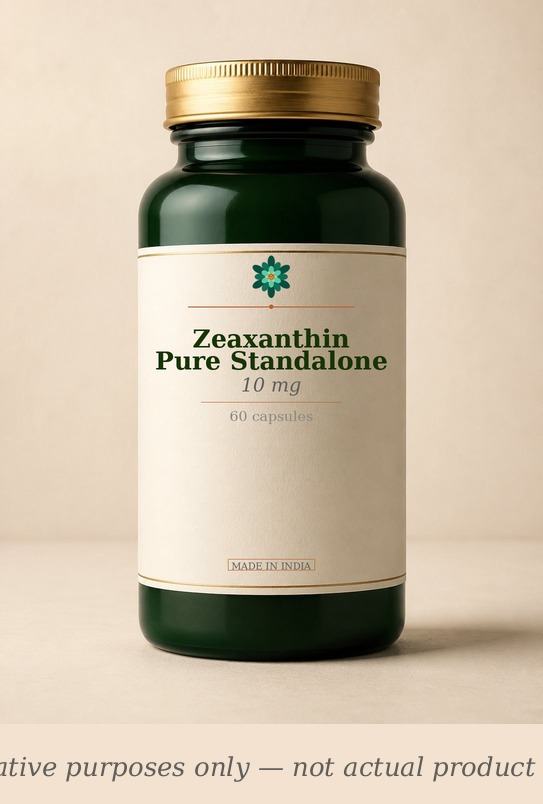
10 mg · gluten-free · 60 caps
Affiliate link · we earn from qualifying purchases. No paid placements.
Pure zeaxanthin (3R,3'R-zeaxanthin) is a macular xanthophyll carotenoid that concentrates selectively in the central macula, filtering blue light and quenching reactive oxygen species in the foveal region.
Zeaxanthin isomers deposit in the Henle fibre layer and inner segment of foveal cones, where they act as a pre-receptoral blue-light filter and as lipid-soluble antioxidants that inhibit peroxidation of retinal membranes.
Individuals with early AMD, those who cannot tolerate lutein-containing formulas, and people seeking to increase macular pigment optical density (MPOD) centrally where zeaxanthin dominates.
Avoid if you have carotenoid metabolism disorders or a history of crystal deposits in the macula. Side effects: Very safe; rare yellowing of skin (carotenoderma) at doses >20 mg/day.
A plain-English read of the literature behind this supplement. Not a clinical recommendation.
Key citations: PMID 22858124 (Le Ma 2012 — lutein and zeaxanthin improve MPOD and visual function in early AMD), PMID 27420092 (Le Ma 2016 — meta-analysis of 20 RCTs showing xanthophyll supplementation increases MPOD in AMD and healthy subjects with dose-response relationship)
SacredBod's longer take on Zeaxanthin Pure Standalone — context the structured blocks above don't capture.
Zeaxanthin Pure Standalone provides zeaxanthin without the lutein found in most eye formulas. Zeaxanthin is one of the two major macular pigment carotenoids, but unlike lutein which distributes more peripherally in the macula, zeaxanthin concentrates in the foveal centre — the region responsible for sharp central vision. This makes standalone zeaxanthin particularly relevant for individuals with early AMD who want targeted central macular support, or those who experience skin yellowing (carotenoderma) from lutein-containing products.
| Goal | Dose | Timing |
|---|---|---|
| Maintenance / prevention | 10 mg/day | Morning with fat-containing meal |
| Low baseline MPOD | 20 mg/day | Morning with fat-containing meal |
Zeaxanthin is lipophilic; absorption improves 2–3 fold when taken with oil, ghee or nuts. Do not take simultaneously with orlistat or high-fibre supplements that may reduce absorption.
Zeaxanthin has an exceptional safety profile. The only notable effect at high doses is cosmetic yellowing of the skin (carotenoderma), which reverses upon dose reduction. It does not convert to vitamin A, so hypervitaminosis A is not a concern.
While zeaxanthin as an isolated molecule is modern, the concept of Chakshushya (eye-promoting) yellow pigments appears in Ayurveda. Haridra (turmeric) and Kesar (saffron) are both Varnya and Chakshushya. Marigold flowers (Genda phool) are used in traditional eye washes for conjunctivitis, though this is not equivalent to oral zeaxanthin supplementation. Modern Indian ophthalmology increasingly recognises MPOD measurement as part of AMD risk assessment in urban eye clinics.
Peptides are physician-only. Tell us a bit and we'll route you to the right specialist.