
SacredBod
0
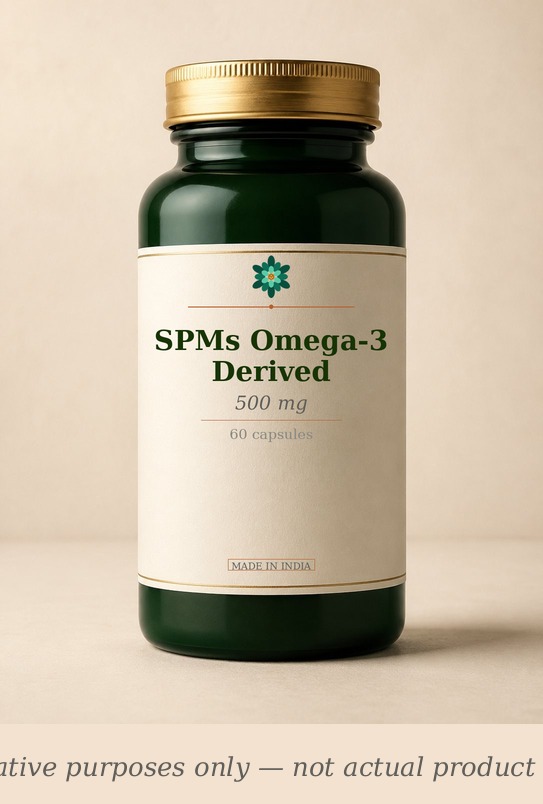
SPMs Omega-3 Derived — SacredBod supplement bottle (illustrative)
Supplement · Advanced Anti-Inflammatory

SPMs Omega-3 Derived

500 mg · gluten-free · 60 caps

Chronic low-grade inflammationJoint pain and stiffnessSlow wound healingPost-surgical inflammationAutoimmune flares JointsBrainGutImmune system
BUY on Amazon →

Affiliate link · we earn from qualifying purchases. No paid placements.

What it is

Specialised Pro-Resolving Mediators (SPMs) are bioactive lipid molecules enzymatically derived from omega-3 fatty acids (EPA and DHA). Unlike standard fish oil that primarily prevents inflammation, SPMs actively resolve existing inflammation by stimulating macrophage efferocytosis, neutrophil apoptosis and tissue regeneration.

How it works

Resolvins (E-series from EPA; D-series from DHA), protectins (neuroprotectin D1) and maresins (MaR1) bind specific G-protein-coupled receptors (GPR32, ALX/FPR2, ChemR23) on immune cells. This triggers: (1) cessation of neutrophil recruitment, (2) enhancement of macrophage phagocytosis of cellular debris, (3) promotion of tissue repair and (4) reduction of pro-inflammatory cytokine production.

Who should take it

Individuals with chronic low-grade inflammation, osteoarthritis, post-surgical recovery needs, autoimmune conditions and those who take omega-3 but still experience inflammatory symptoms — suggesting poor endogenous SPM conversion.

Avoid / careful

Avoid if you have a fish or shellfish allergy. Use caution if you are on anticoagulants at high doses. Side effects: Very well tolerated; rare mild fishy aftertaste, GI upset or loose stools. No bleeding risk at standard doses.

When to take it

Morning
Noon
Evening
Night

How to take it

With food
Empty stomach
Before food

FAQs

Frequently asked

How long before I see results?
Unlike standard omega-3 which may take 8–12 weeks, SPMs act on active resolution pathways and may produce noticeable improvements in joint comfort and inflammatory markers within 2–4 weeks.
Is it safe to take daily?
Yes. SPMs are endogenous molecules naturally produced by the body from omega-3s. Supplemental SPMs have shown excellent safety profiles in clinical studies. They do not suppress the immune system — they modulate it toward resolution.
Can I take it with regular fish oil?
Yes, but you may not need both. SPM-enriched oils contain both the precursor omega-3s and the active SPMs. If you already take high-dose fish oil, consider switching to an SPM product rather than adding it.

In plain English

A plain-English read of the literature behind this supplement. Not a clinical recommendation.

Key citations: PMID 41057538 (SPMs in PRP reduce IL-6 and CTX-II in osteochondral explants; higher SPM content correlates with stronger anti-inflammatory activity), PMID 35227568 (Serhan 2022 — comprehensive review of SPM biosynthesis, stereochemistry and clinical readiness), PMID 35227568 (SPMs outperformed indomethacin, morphine and gabapentin in preclinical pain models), PMC11306062 (2024 — SPM role in PRP therapeutic mechanisms)

Editorial notes

SacredBod's longer take on SPMs Omega-3 Derived — context the structured blocks above don't capture.

What It Is

SPMs Omega-3 Derived delivers the active resolution-phase lipid mediators that your body produces from EPA and DHA — but often in insufficient quantities during chronic inflammation. Standard fish oil provides the substrate (omega-3 fatty acids) for inflammation prevention. SPMs provide the signal (resolvins, protectins, maresins) for inflammation resolution. This is a critical distinction: prevention stops inflammation from starting; resolution actively ends it once underway. In India, SPM supplements are not yet widely available and must typically be imported.

How It Works

  1. Neutrophil cessation — Resolvin E1 (RvE1) and Resolvin D1 (RvD1) bind ChemR23 and ALX/FPR2 receptors, stopping further neutrophil recruitment to inflamed tissues. This halts the “inflammatory cascade.”
  2. Macrophage efferocytosis — Maresin 1 (MaR1) and Protectin D1 (PD1) stimulate macrophages to engulf and clear apoptotic neutrophils and cellular debris — a process called efferocytosis that is defective in chronic inflammation.
  3. Tissue regeneration — SPMs activate stem cells and promote the synthesis of novel cysteinyl-SPMs (MCTRs, PCTRs, RCTRs) that stimulate tissue repair and organ protection.
  4. Cytokine modulation — SPMs reduce TNF-α, IL-6 and IL-1β while increasing IL-10 — shifting the immune balance from attack to repair.

Who Benefits Most

  • Osteoarthritis patients with ongoing joint inflammation despite standard care.
  • Post-surgical patients wanting to accelerate healing and reduce scar tissue inflammation.
  • Autoimmune condition sufferers who experience persistent low-grade flares.
  • Individuals with poor omega-3 to SPM conversion — genetic variants in 15-lipoxygenase or low aspirin exposure reduce endogenous SPM production.

Dosage Guide

GoalDoseTiming
General inflammation resolution500 mg SPM-enriched oil/dayMorning with fat-containing meal
Osteoarthritis / joint support500–1,000 mg/dayDivided doses
Post-surgical recovery1,000 mg/dayDivided doses for 4–6 weeks

SPMs are lipophilic and require dietary fat for absorption. Take with meals containing ghee, nuts, avocado or fatty fish. Store in the refrigerator to prevent oxidation.

Safety and Interactions

SPMs are endogenous molecules with an exceptional safety profile. Unlike NSAIDs that block both protective and pathological prostaglandins, SPMs selectively promote resolution without disrupting homeostatic functions. No bleeding risk has been documented at standard doses. Chronic NSAID use may actually impair SPM biosynthesis — another reason to consider SPMs as an alternative or adjunct.

India-Specific Context

  • Hindi/Sanskrit name: No classical equivalent; SPMs are modern lipidomic discoveries.
  • Local availability: Not available on Amazon.in as of 2026-05-16. Brands like Designs for Health (SPM Supreme), Metagenics and Double Wood Supplements sell SPM products in the US/UK. Indian buyers must import via iHerb, Vitacost or Desertcart.in at premium prices (₹3,000–8,000 for 60–120 softgels).
  • Regulatory status: Not a Schedule H drug; sold as a dietary supplement. Import duty and GST apply.
  • Ayurvedic parallel: The concept of Shamana (pacification) and Ropana (healing) in Ayurveda aligns with SPM-mediated resolution. Classical herbs like Guduchi and Shatavari are used for similar immune-modulating and tissue-repair purposes, though through entirely different mechanisms.
  • “Alternative for India”: If SPMs are unavailable, high-quality omega-3 (EPA/DHA 2–3 g/day) plus low-dose aspirin (81 mg, physician-guided) can enhance endogenous SPM production.

Traditional Use in Indian Medicine

SPMs do not appear in classical Ayurvedic texts — they were discovered by Charles Serhan at Harvard Medical School in the early 2000s. However, the Ayurvedic concept of Ama (undigested toxic metabolites) and its clearance (Ama Pachana) conceptually parallels SPM-mediated cellular debris clearance. Modern Indian integrative medicine is beginning to recognise the “resolution deficiency” hypothesis — the idea that chronic disease persists not because inflammation starts, but because it fails to resolve. SPM supplementation represents the cutting edge of this paradigm shift.

Added to your stack.