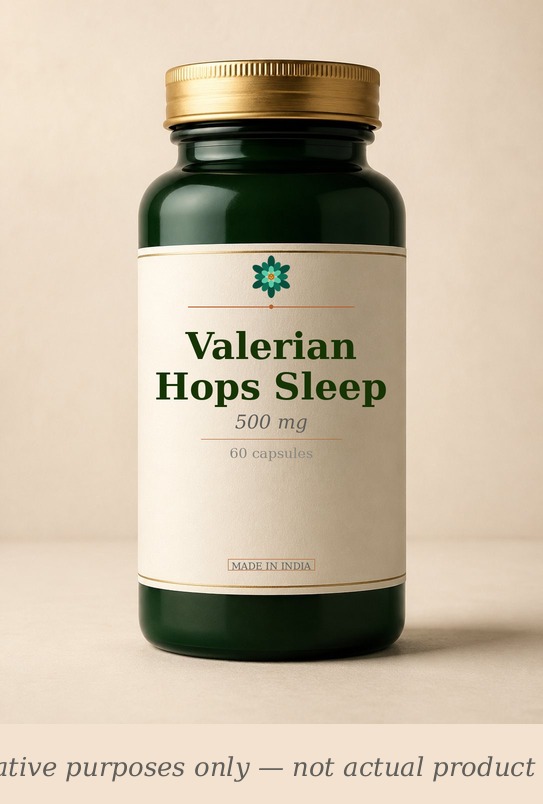
SacredBod's longer take on Valerian Hops Sleep — context the structured blocks above don't capture.
What It Is
Valerian Hops Sleep delivers the clinically validated fixed extract combination (Ze 91019) that pairs Valeriana officinalis (valerian) root with Humulus lupulus (hops) strobiles. While valerian alone has mixed evidence for insomnia, the combination is demonstrably superior — the Koetter 2007 RCT showed that the fixed extract reduced sleep latency significantly, while valerian alone failed to beat placebo. This synergy arises from complementary pharmacology: valerian’s valerenic acid and hop’s xanthohumol together modulate GABA-A receptors and serotonin pathways more effectively than either herb in isolation. In India, Tagar (Valeriana wallichii) is the indigenous valerian species used in Ayurveda.
How It Works
- GABA-A receptor modulation — Valerenic acid and xanthohumol bind to GABA-A receptor allosteric sites, enhancing the inhibitory effect of endogenous GABA without the dependence or tolerance of benzodiazepines. The combination upregulates GABA-A receptor subunit expression (α1, β2, γ2) in animal models.
- Serotonergic enhancement — Hops compounds increase 5-HT1A receptor expression, promoting the serotonergic calm that precedes sleep onset. Valerian volatile oil increases serotonin and GABA in the hippocampus via serotonergic synapse activation.
- Amygdala CRF suppression — The combination reduces corticotropin-releasing factor (CRF) expression in the amygdala, dampening the hyperarousal and anxiety that prevent sleep initiation in stress-related insomnia.
- Adenosine A1 receptor involvement — Hop compounds may activate adenosine A1 receptors — the same target as caffeine’s opposite — promoting sleepiness and reducing neuronal excitability.
Who Benefits Most
- Non-organic insomnia sufferers with sleep latency >30 minutes.
- Individuals who tried valerian alone without benefit — the combination is clinically superior.
- Those transitioning off benzodiazepines — a non-dependent GABA-A modulator under medical supervision.
- Stress-related sleep disruption — the amygdala CRF suppression addresses the anxiety component.
Dosage Guide
| Goal | Valerian Dose | Hops Dose | Timing |
|---|
| Sleep latency reduction | 500 mg extract | 120 mg extract | 30–60 min before bed |
| Maintenance | 250–500 mg | 60–120 mg | As above |
Look for products that specify the Ze 91019 ratio or standardised valerenic acid content (0.8 %). Raw valerian root powder is unpredictable in potency. The combination is superior to either herb alone — do not substitute with single-herb products if sleep latency is the primary goal.
Safety and Interactions
Valerian-hops is remarkably safe. No dependence, tolerance, withdrawal or significant organ toxicity has been documented in clinical trials. The main caution is additive sedation with CNS depressants (benzodiazepines, alcohol, zolpidem). Some individuals experience vivid dreams or morning grogginess — reduce the dose if this occurs. Avoid in pregnancy and liver disease.
India-Specific Context
- Sanskrit/Hindi name: Tagar (टगर) for Indian valerian (Valeriana wallichii); there is no classical Ayurvedic equivalent for hops.
- Ayurvedic classical texts: Tagar is mentioned in Charaka Samhita and Sushruta Samhita as a Medhya Rasayana, Nidrajanana (sleep-inducing) and Shirovirechaniya (headache-relieving) herb. It is used for Unmada (insanity/anxiety), Apasmara (epilepsy) and Vatavyadhi (neuromuscular disorders).
- Indian brands: Himalaya markets Tagara (Valerian) tablets — an Ayurvedic proprietary formulation. Trexgenics and 1 Tree sell valerian root extract capsules on Amazon.in. True valerian-hops combination products are less common than single-herb valerian; buyers may need to combine separate products.
- Regulatory status: Not a Schedule H drug; sold as a dietary supplement and Ayurvedic proprietary medicine.
- Cultivation: Valeriana wallichii (Indian valerian) grows in the Himalayan regions of Kashmir, Himachal Pradesh and Uttarakhand. It is considered pharmacologically similar to European V. officinalis.
Traditional Use in Indian Medicine
Tagar (Indian valerian) holds an important place in Ayurvedic Medhya Rasayana therapy. Charaka Samhita describes it as Tikta (bitter) and Katu (pungent), with a heating potency. It is used for Vata disorders of the mind and nervous system — insomnia, anxiety, tremors and convulsions. Traditional practitioners prescribe Tagar powder (1–3 g) with warm milk or ghee before bed for sleep induction. The modern combination with hops applies the same empirical principle with added serotonergic and GABA-A synergistic mechanisms. Some Ayurvedic pharmaceutical companies (Himalaya, Baidyanath) now formulate Tagar in combination with other sleep herbs like Jatamansi and Brahmi for enhanced polypharmacological effect.