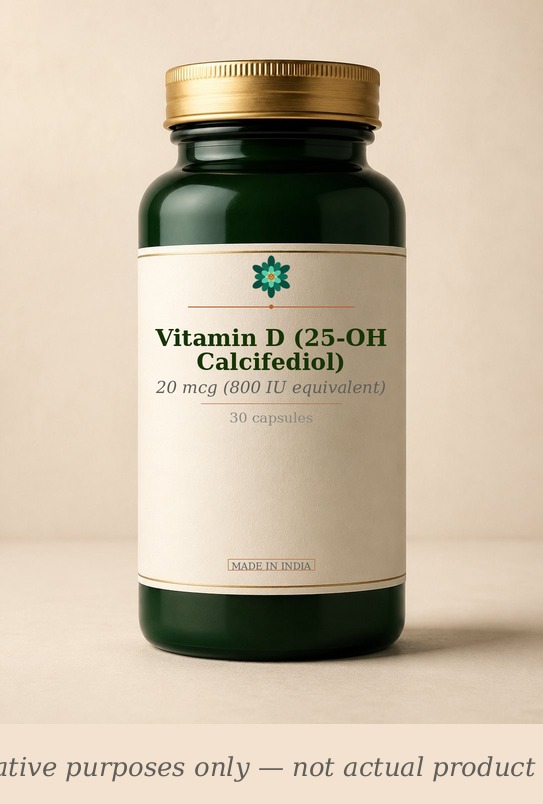
SacredBod's longer take on Vitamin D (25-OH Calcifediol) — context the structured blocks above don't capture.
What the Evidence Actually Says
Calcifediol (25-hydroxyvitamin D3) is the immediate precursor to the active form of vitamin D (calcitriol). Unlike cholecalciferol (D3), which requires hepatic 25-hydroxylation, calcifediol bypasses this step and is directly converted to calcitriol in the kidneys. The human research base is calcifediol has genuine pharmacokinetic advantages over d3: faster onset, linear dose-response, less adipose sequestration, and efficacy in liver disease/malabsorption.
Mechanism in Plain Terms
Calcifediol is approximately 3-5x more potent than D3 on a microgram basis because it bypasses the rate-limiting hepatic hydroxylation step. It has a more predictable, linear dose-response curve and is less affected by body weight (D3 is sequestered in adipose tissue). In patients with liver disease, malabsorption, or obesity, calcifediol achieves target 25(OH)D levels more rapidly and reliably than D3.
Who Should Consider It
Individuals with severe vitamin D deficiency who need rapid correction. Patients with liver disease, malabsorption syndromes, or obesity who respond poorly to D3. NOT available as a general consumer supplement in most countries—typically prescription or specialty product.
Who Should Avoid or Use Caution
Individuals with hypercalcemia, hyperphosphatemia, or granulomatous diseases should avoid. Those with a history of kidney stones should use caution. Pregnant women should only use under physician guidance. Calcifediol is more potent than D3—overdose risk is higher.
Dosing Guidance
Typical dose: 10-20 mcg (400-800 IU equivalent) daily, or 255 mcg monthly for severe deficiency
Best timing: Morning with breakfast. Morning dosing aligns with natural circadian vitamin D metabolism.
With food: Take with breakfast for absorption and to allow daytime calcium metabolism monitoring.
Practical notes: Calcifediol is NOT widely available as an OTC supplement in India. It is available by prescription in some countries. The 2022 review confirms calcifediol achieves target 25(OH)D more rapidly than D3. The 2021 COVID RCT showed calcifediol corrected deficiency faster than placebo.
Stacking & Interactions
Pairs well with: Vitamin K2 for calcium trafficking to bone. Magnesium for D3 activation support. Calcium for the mineral being absorbed.
Avoid combining with: Avoid combining with thiazide diuretics (increase hypercalcemia risk). Do not combine with high-dose D3 simultaneously.
Common stacks: vitamin-k2, magnesium, calcium
Indian Market Context
In India, this supplement is not readily available on major e-commerce platforms; TBD000000 indicates no verified amazon.in listing. Prices typically range from premium import prices or are unavailable. Import costs and limited availability make this inaccessible for most Indian consumers. The Indian vitamin market is highly competitive with both domestic and imported options. Always verify third-party testing for purity, especially for fat-soluble vitamins where overdose risk exists. Store in cool, dry conditions away from direct sunlight.
Comparison with Standard Care
Vitamin D (25-OH Calcifediol) should be viewed as adjunctive nutritional support, not a replacement for established medical therapy or standard vitamin forms. For the conditions mentioned, standard alternatives often outperform: standard vitamin D3 for most healthy adults, which is sufficient and far more accessible. The specialized vitamin form adds incremental benefit with a favorable safety profile in most cases but should not delay appropriate medical evaluation.
Safety & Side Effects
Generally well-tolerated at recommended doses. The most common adverse effects vary by compound: Hypercalcemia risk with excessive dosing . Severe adverse events are rare at moderate doses in healthy individuals. Discontinue and seek medical care if you experience persistent vomiting, jaundice, signs of bleeding, or severe allergic reactions.
Evidence Grade Summary
Grade: B
Calcifediol has genuine pharmacokinetic advantages over D3: faster onset, linear dose-response, less adipose sequestration, and efficacy in liver disease/malabsorption. However, it is not widely available as a consumer supplement and requires medical oversight. For most healthy adults, standard D3 is sufficient and far more accessible.
Research Highlights
- 2021 — Endocr Pract: Calcifediol treatment reduces NLR in hospitalized COVID-19 patients. Oral 25(OH)D3 corrected vitamin D deficiency in COVID-19 patients. 76.4% achieved sufficiency at 30 days vs ≤12.5% placebo.
- 2022 — Expert Rev Clin Pharmacol: Calcifediol: review of pharmacological characteristics and clinical use. Calcifediol achieves target 25(OH)D more rapidly than D3, has predictable linear dose-response, and is less prone to adipose sequestration.
- 2023 — J Bone Miner Res: Efficacy and dose-response of calcifediol supplementation in healthy adults. 50 mcg calcifediol over 8 weeks significantly increased 25(OH)D and decreased PTH. Dose-dependent effects observed.
vitamin-k2, magnesium, calcium, vitamin-d-k2-mk7-combo
Bottom Line
Calcifediol has genuine pharmacokinetic advantages over D3: faster onset, linear dose-response, less adipose sequestration, and efficacy in liver disease/malabsorption. However, it is NOT widely available as an OTC supplement in India and requires medical oversight. For most healthy adults, standard D3 (2,000-5,000 IU) is sufficient, far more accessible, and significantly cheaper. Calcifediol is best reserved for those with severe deficiency, obesity, liver disease, or malabsorption who respond poorly to D3.