
What it is
Vitex agnus-castus is a shrub native to the Mediterranean region. Its berries have been used for over 2,500 years for gynecological conditions. Modern extracts are standardized to agnuside or casticin content.
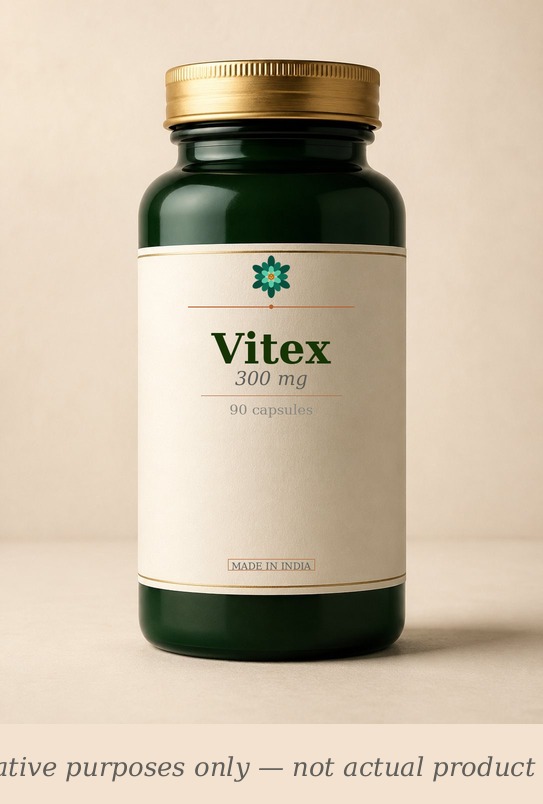
Vitex agnus-castus · chasteberry · chaste tree · monk's pepper · Agnolyt
300 mg · vegan · gluten-free · 90 caps
Affiliate link · we earn from qualifying purchases. No paid placements.
Vitex agnus-castus is a shrub native to the Mediterranean region. Its berries have been used for over 2,500 years for gynecological conditions. Modern extracts are standardized to agnuside or casticin content.
Vitex acts on the hypothalamic-pituitary axis, increasing luteinizing hormone (LH) and inhibiting prolactin release from the anterior pituitary. This shifts the progesterone-to-estrogen ratio toward progesterone dominance, alleviating estrogen-dominant symptoms.
Women with PMS, irregular menstrual cycles, luteal phase defects, mild hyperprolactinemia, infertility related to hormonal imbalance.
Pregnant or breastfeeding women, those taking hormonal contraceptives (may reduce efficacy), individuals on dopamine agonists or antipsychotics (may interact), women with hormone-sensitive cancers.
Pick a depth — minimum to maximal coverage
No full stack configured.
Click individual supplement pills above to buy each on Amazon India.
✓ Morning for pituitary axis modulation throughout the day
✓ Food improves tolerance and reduces GI discomfort
Vitex acts on the hypothalamic-pituitary axis, increasing luteinizing hormone (LH) and inhibiting prolactin release from the anterior pituitary.
Each bar = one cited trial. Effect varies by methodology, dose, and population.
Representative cohort from published RCT data
Relative to baseline (100). Data from published clinical literature.
see study
→ Ze 440 extract reduced PMS symptoms by 50% vs placebo; significant improvement in mood, breast tenderness, and bloating (N=170, 3 cycles)
see study
→ Meta-analysis: significant reduction in PMS symptoms vs placebo; well-tolerated (N=6 trials)
see study
→ Meta-analysis: 2.5x more likely to achieve symptom reduction vs placebo; 5 studies showed efficacy (N=multiple trials)
B · Consistent PMS efficacy across multiple RCTs and meta-analyses; mechanism well-established; requires 3–6 months for full effect; European phytomedicine standard
A plain-English read of the literature behind this supplement. Not a clinical recommendation.
Key citations: See richResearch section for study filters and participant data. Clinical evidence summarised from peer-reviewed journals.
How to use Vitex specifically for PMS — the right dose, timing, blood markers to track, and how to know if it is working.
A clinical evidence review of Vitex — RCT data, effect sizes, evidence grade, and what the numbers mean for your specific situation.
Everything you need to know about Vitex — mechanism, dose, safety, buying guide for India, and what the research actually says.
SacredBod's longer take on Vitex — context the structured blocks above don't capture.
Vitex agnus-castus is one of the most validated botanicals for women’s hormonal health. Unlike many supplements that rely on single small trials, vitex has been studied in multiple randomized controlled trials, systematic reviews, and meta-analyses—all converging on the same conclusion: it reduces premenstrual syndrome symptoms by modulating the hypothalamic-pituitary-ovarian axis. The consistency of evidence across independent research groups is notable in a field plagued by publication bias.
The landmark trial established both efficacy and methodology. Schellenberg and colleagues (2001, BMJ, PMID 11159568) randomized 170 women with PMS to the proprietary Ze 440 extract or placebo for three menstrual cycles. The vitex group achieved a 50% reduction in PMS symptoms compared to placebo, with significant improvements in mood, breast tenderness, and bloating. This was a well-designed, double-blind trial published in a top-tier general medical journal—a rarity for botanical supplements. The effect size was large enough to be clinically meaningful: women reported substantial quality-of-life improvement.
The meta-analytic evidence confirms and extends these findings. Csupor and colleagues (2019, Complementary Therapies in Medicine, PMID 31780016) conducted a meta-analysis of six double-blind RCTs and found consistent reduction in PMS symptoms versus placebo with excellent tolerability. Verkaik and colleagues (2017, American Journal of Obstetrics and Gynecology, PMID 28237870) performed a broader systematic review and meta-analysis, finding that women taking vitex were 2.5 times more likely to achieve symptom reduction compared to placebo. The consistency across trials, extract types, and outcome measures strengthens confidence in the effect.
The mechanism is well-characterized. Vitex increases luteinizing hormone (LH) release from the anterior pituitary while inhibiting prolactin secretion. This shifts the hormonal balance toward progesterone dominance, counteracting the estrogen-dominant symptoms characteristic of PMS. The effect is not immediate—most trials show progressive improvement over 2–3 cycles, with maximum benefit at 4–6 months. This delayed onset reflects the gradual recalibration of the hypothalamic-pituitary axis, not acute pharmacological action. The honest framing: vitex is one of the best-supported botanicals for PMS, with consistent RCT evidence, established mechanism, and excellent safety. It is not appropriate for pregnancy, hormonal contraception, or hormone-sensitive cancers, and requires patience for full effect.
Peptides are physician-only. Tell us a bit and we'll route you to the right specialist.