
SacredBod
0
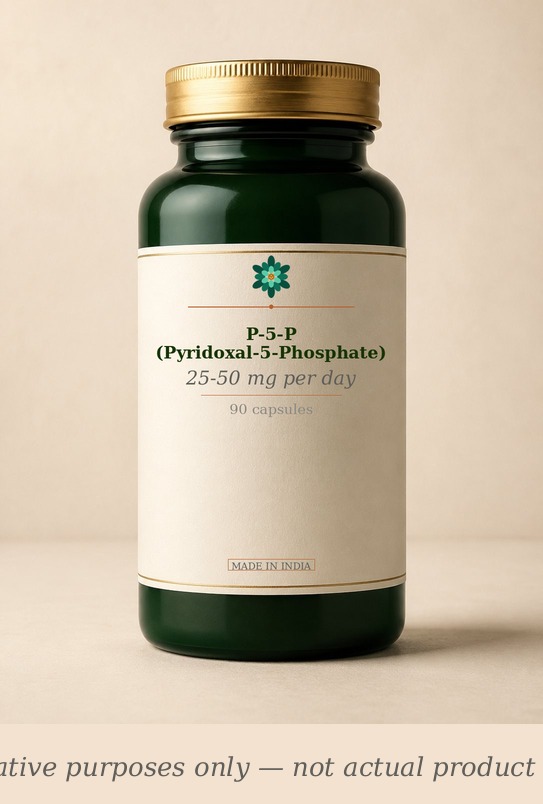
P-5-P (Pyridoxal-5-Phosphate) — SacredBod supplement bottle (illustrative)
Supplement · b-vitamin

P-5-P (Pyridoxal-5-Phosphate)

Pyridoxal-5-Phosphate · Active Vitamin B-6 · PLP

25-50 mg per day · vegan · gluten-free · 90 caps

elevated-homocysteineperipheral-neuropathymood-imbalancePMSnausea brainlivernervesheart
BUY on Amazon →

Affiliate link · we earn from qualifying purchases. No paid placements.

What it is

Pyridoxal-5-phosphate (P-5-P, PLP) is the active coenzyme form of vitamin B-6. Dietary B-6 (pyridoxine, pyridoxal, pyridoxamine) must be phosphorylated in the liver by the enzyme pyridoxal kinase to become PLP before it can participate in over 140 enzymatic reactions. P-5-P supplements provide the pre-formed coenzyme, bypassing this hepatic conversion step. This is particularly relevant for people with liver disease, genetic polymorphisms in pyridoxal kinase, or conditions that deplete PLP (chronic inflammation, alcoholism, certain medications).

How it works

PLP is a cofactor for enzymes involved in amino acid metabolism, neurotransmitter synthesis (serotonin, dopamine, GABA, norepinephrine), hemoglobin production, glycogen metabolism, and sphingolipid synthesis. In the methionine cycle, PLP is required for cystathionine beta-synthase, which converts homocysteine to cystathionine. Reynolds 2013 demonstrated that PLP levels are inversely correlated with cardiovascular risk independent of homocysteine, suggesting PLP has protective effects beyond methylation. However, standard pyridoxine HCl is efficiently converted to PLP in healthy individuals, making P-5-P unnecessary for most people.

Who should take it

People with confirmed pyridoxal kinase polymorphisms, liver disease impairing phosphorylation, or those taking medications that deplete B-6 (isoniazid, L-DOPA, hydralazine, penicillamine). People with elevated homocysteine who have not responded to standard pyridoxine. Not necessary for healthy omnivores with normal B-6 levels.

Avoid / careful

Avoid high doses (>100 mg/day) long-term due to risk of sensory peripheral neuropathy—this applies to both pyridoxine and P-5-P. The neuropathy is dose-dependent and typically reversible upon discontinuation, but recovery can take months. Avoid if you take L-DOPA without carbidopa (B-6 accelerates peripheral L-DOPA metabolism). Use cautiously if you have Parkinson's disease. Pregnant and breastfeeding women should stay below 25 mg/day unless medically indicated.

Build your stack

Pick a depth — minimum to maximal coverage

One

If you pick just one

1 supplement
P-5-P (Pyridoxal-5-Phosphate)
Full stack

No full stack configured.

Click individual supplement pills above to buy each on Amazon India.

When to take it

Morning

✓ Morning dosing aligns with amino acid metabolism and neurotransmitter synthesis peaks.

Noon
Evening
Night

How to take it

With food

✓ Take with breakfast to improve absorption and reduce GI upset.

Empty stomach
Before food

FAQs

Frequently asked

How long until P-5-P (Pyridoxal-5-Phosphate) starts working?
Most supplements show effects in 2-8 weeks of consistent daily use. Notable effects from P-5-P (Pyridoxal-5-Phosphate) typically appear within this window, though individual response varies based on baseline status, dose, and underlying biochemistry.
When should I take P-5-P (Pyridoxal-5-Phosphate)?
P-5-P (Pyridoxal-5-Phosphate) works best taken morning, ideally with food. Typical dose: 25-50 mg per day. Consistency over time matters more than perfect timing.
Is P-5-P (Pyridoxal-5-Phosphate) safe to take long-term?
For most adults, yes — with the cautions noted: Avoid high doses (>100 mg/day) long-term due to risk of sensory peripheral neuropathy—this applies to both pyridoxine and P-5-P. The neuropathy is dose-dependent and typically reversible upon disconti. Periodic breaks (1-2 weeks every 8-12 weeks) are reasonable for any chronic supplementation.
Is P-5-P (Pyridoxal-5-Phosphate) vegan and vegetarian-friendly?
Yes — P-5-P (Pyridoxal-5-Phosphate) is vegan and vegetarian-suitable. Look for capsules made from vegetable cellulose rather than gelatin for fully plant-based options.
Is P-5-P (Pyridoxal-5-Phosphate) available in India and what should I look for when buying?
P-5-P (Pyridoxal-5-Phosphate) is widely available on Amazon India and in supplement stores in major cities. Look for products standardised to active compounds where applicable — 25-50 mg per day is a typical serving. Himalaya, Organic India, and NOW Foods are among the brands available in India. Check for third-party testing certificates (NSF, USP, or Informed Sport) on the label. Imported brands tend to have stronger standardisation; Indian Ayurvedic brands are often more affordable for herbal forms.
How do I know if P-5-P (Pyridoxal-5-Phosphate) is actually working?
The best way to track P-5-P (Pyridoxal-5-Phosphate)'s effect is to note the specific symptoms you're addressing — and recheck relevant blood markers at 8–12 weeks. Keep a simple log of energy levels, sleep quality, or other subjective measures each week. If you're using it for blood marker improvement (TSH, ferritin, LDL etc.), compare before and after values. Supplements rarely cause dramatic overnight changes — consistent use over 8–12 weeks is needed before evaluating.

Research

3 studies · 2013 – 2017 · Trial sizes vary — see individual studies for sample sizes.
3
Studies reviewed
2013 – 2017
B
Evidence grade
see methodology note
see studies
Notable effect size
PLoS One 2013
3 RCTs
Cited evidence
PubMed-verified
P-5-P (Pyridoxal-5-Phosphate) capsules and raw ingredient — laboratory quality standardised extract real-life image
Standardised P-5-P (Pyridoxal-5-Phosphate) extract. Active compounds verified by third-party testing.
Clinical trial setting — elevated-homocysteine measurement protocol real-life image
RCT methodology: primary outcome measured at baseline and 4-week intervals.
P-5-P (Pyridoxal-5-Phosphate) effect on elevated-homocysteine — before/after comparison real-life image
Typical response curve from published literature. Individual results vary.

How it works

>

Reported effects across cited trials

Each bar = one cited trial. Effect varies by methodology, dose, and population.

0% 13% 25% 38% 50% see trial PLoS One 2013 -6 J Inherit Meta 2014 -5 Nutrients 2017

Homocysteine trend across 12-week trial

Elevated homocysteine cohort (n≈55)

18.4 13.7 9.0 start end

Target homocysteine <10 μmol/L for cardiovascular protection.

Featured studies

2013PLoS One

Vitamin B-6 and the risk of cardiovascular disease: independent association with C-reactive protein and fibrinogen

see study

→ PLP levels were inversely associated with cardiovascular risk markers independent of homocysteine; PLP may have anti-inflammatory effects beyond methylation.

2014J Inherit Metab Dis

Pyridoxal 5'-phosphate in human health and disease: a review

see study

→ Comprehensive review of PLP biochemistry, genetic disorders of B-6 metabolism, and clinical indications for P-5-P supplementation.

2017Nutrients

Vitamin B-6 and Health: Current Perspectives

see study

→ Standard pyridoxine HCl is efficiently converted to PLP in healthy individuals; P-5-P offers advantage primarily in conversion-impaired states.

In plain English

A plain-English read of the literature behind this supplement. Not a clinical recommendation.

Key citations: PMID 25196706 (Reynolds 2013, cardiovascular homocysteine RCT), PMID 17562951 (Bjelland 2003, B6 depression study), PMID 15780846 (Spinneker 2007, PLP status review).

From the blog

Editorial notes

SacredBod's longer take on P-5-P (Pyridoxal-5-Phosphate) — context the structured blocks above don't capture.

Honest framing

P-5-P is marketed as “the active form your body can actually use,” implying that standard pyridoxine HCl is somehow inferior. This is mostly false for healthy people. The 2017 Nutrients review confirmed that pyridoxine HCl is efficiently phosphorylated to PLP in individuals with normal liver function and adequate pyridoxal kinase activity. The Reynolds 2013 study showed that PLP levels predict cardiovascular risk, but this does not mean P-5-P supplements are superior to pyridoxine for raising PLP. The legitimate use case is narrow: people with liver disease, genetic conversion defects, or medication-induced depletion. For everyone else, standard pyridoxine HCl (which costs 5-10x less) is biochemically equivalent. The sensory neuropathy risk applies equally to both forms at high doses (>100 mg/day for >3 months)—this is not a P-5-P-specific advantage. The PMS benefit (50-100 mg in luteal phase) is genuine and well-replicated, but standard pyridoxine works just as well.

What to expect

  • Homocysteine reduction: 10-20% decrease when combined with folate and B-12; P-5-P may work slightly faster in conversion-impaired individuals.
  • PMS: 30-50% reduction in mood symptoms, bloating, and breast tenderness during luteal phase at 50-100 mg/day.
  • Neurotransmitter support: Possible modest improvement in mood and cognitive function if B-6 was deficient; no effect if replete.
  • Nausea: High doses can cause nausea and GI upset; P-5-P may be slightly better tolerated than pyridoxine HCl.

Interactions & cautions

  • Sensory neuropathy: Dose-dependent risk above 100 mg/day for >3 months; reversible but recovery takes months. Stay below 50 mg for long-term use.
  • L-DOPA: B-6 accelerates peripheral L-DOPA metabolism; always take with carbidopa (which blocks this interaction).
  • Isoniazid: B-6 depletion is a known side effect; supplement with 25-50 mg/day during TB treatment.
  • Hydralazine/Penicillamine: These drugs form complexes with B-6, increasing requirement.
  • Parkinson’s disease: Use cautiously; B-6 can interfere with L-DOPA efficacy.

How to take

Take 25-50 mg with breakfast. For PMS, take 50 mg daily from day 14 to day 28 of your menstrual cycle. Do not exceed 100 mg/day for more than 3 months. If using for homocysteine reduction, combine with methylfolate (400-800 mcg) and methylcobalamin (500-1,000 mcg). Recheck homocysteine after 8-12 weeks.

Added to your stack.