
“Adaptogen” is one of the most overworked words in supplement marketing, and that’s part of why the category gets brushed off. The technical definition — a substance that helps the body modulate stress response without forcing it in either direction — is real but ambiguous, and in practice, two herbs marketed as adaptogens often do nearly opposite things.
Korean ginseng and ashwagandha are the cleanest example of this. Both are called adaptogens. Both have decent human-trial evidence behind them. The active compounds, the targets, and the felt effects are all materially different. If you’ve tried one and it didn’t do anything, the answer is rarely “adaptogens don’t work for me” — it’s usually “I needed the other one.”
The two patterns that get conflated
Most stress doesn’t feel like one thing. People come to a supplement bottle for one of two patterns, and they need different tools:
Pattern A: Wired but tired. You’re stressed, sleep is poor, you can’t switch off in the evening, and even when you do sleep you wake up feeling unrecovered. Cortisol is running too high, often at the wrong time of day. You don’t need more energy — you need to come down.
Pattern B: Fogged and flat. You’re not anxious; you’re depleted. Mornings are slow, afternoons are slower, focus comes and goes. The stress in your life is real but the response feels muted rather than over-cranked. You don’t need to come down — you need to come up.
Ashwagandha is for Pattern A. Korean ginseng is for Pattern B. Take them the wrong way around and you’ll get an underwhelming or actively unpleasant result.
What ashwagandha actually does
Ashwagandha (Withania somnifera) is dominated by a family of compounds called withanolides. Trial work, mostly with the standardised KSM-66 and Sensoril extracts, consistently shows reductions in serum cortisol — the central stress hormone — over four to eight weeks. The felt effect is calmer mornings, less reactivity during the workday, and better sleep continuity.
It’s mildly sedating in higher doses. People who take 600 mg of a strong extract in the morning sometimes describe feeling “soft” or unmotivated through the day. The fix is to lower the dose, take it at night, or both.
Ashwagandha has thyroid-stimulating effects and may not suit anyone with an overactive thyroid (Graves’, hyperthyroid Hashimoto flares). It’s also nightshade-family, which a small number of people react to.
What Korean ginseng actually does
Korean ginseng (Panax ginseng) runs on a family of saponins called ginsenosides. These act on the dopamine and acetylcholine systems, on the HPA axis, and on nitric oxide pathways. The clinical signature is mildly stimulating: better mental stamina under load, faster reaction time, improved exercise tolerance, and — in middle-aged men — meaningful effects on mild erectile dysfunction.
It’s not a stimulant in the way coffee is. There’s no jitter, no crash, no tachycardia at sane doses. People describe it as “the day got longer without getting harder”, which is closer to the truth than the marketing language of “energy boost”.
Ginseng can mildly raise blood pressure and is best avoided after early afternoon — it’ll cost you sleep. It also has a small but real interaction with warfarin and other anticoagulants. Diabetics should know it modestly improves insulin sensitivity, which can compound with medication.
How to choose
The honest answer: pay attention to what you’re actually feeling, not what you read in a forum.
If you’re “always on”, lying awake at midnight with your jaw clenched, irritable with your kids, and waking with a heart rate in the high seventies — you want ashwagandha.
If you’re getting through your day adequately but feel hollow, can’t muster a workout, find afternoons increasingly fuzzy, and notice your mood is flatter than your circumstances justify — you want Korean ginseng.
If you’re somewhere ambiguous — and many people are — start with the milder option (ashwagandha at a low evening dose) for a week. If it pushes you further into flatness, that’s your answer. Try Korean ginseng next week instead.
How to combine them, if you’re going to
For people whose stress pattern shifts through the day — calm but flat in the morning, wired and unable to wind down at night — the cleanest combination is low-dose Korean ginseng (200 mg standardised extract) at breakfast, and low-dose ashwagandha (300 mg KSM-66) after dinner. They don’t compete; they cover different windows.
Don’t double-dose either when stacking. The whole point of using them together is gentleness across the full daily curve.
A note on cycling
Both herbs can plateau if you take them year-round. Six to eight weeks on, one to two weeks off, is the rhythm that keeps the response fresh. Many seasoned users only run them seasonally — ginseng through dark winter months, ashwagandha through high-stress quarters — which is also a sensible pattern.
Whichever you pick, give it at least three weeks before judging. Adaptogens don’t work like caffeine. The first dose tells you almost nothing.
Supplements mentioned
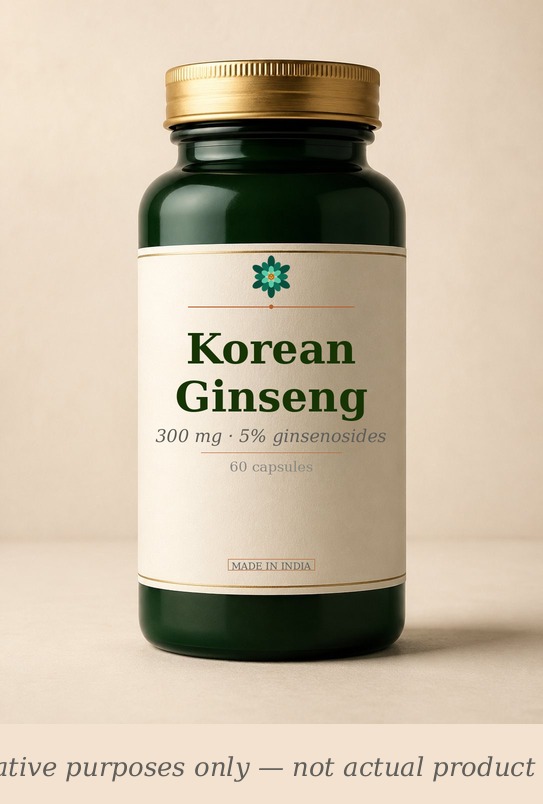
Korean Ginseng
Adaptogen · 300 mg · 5% ginsenosides · 60 caps