
SacredBod
0
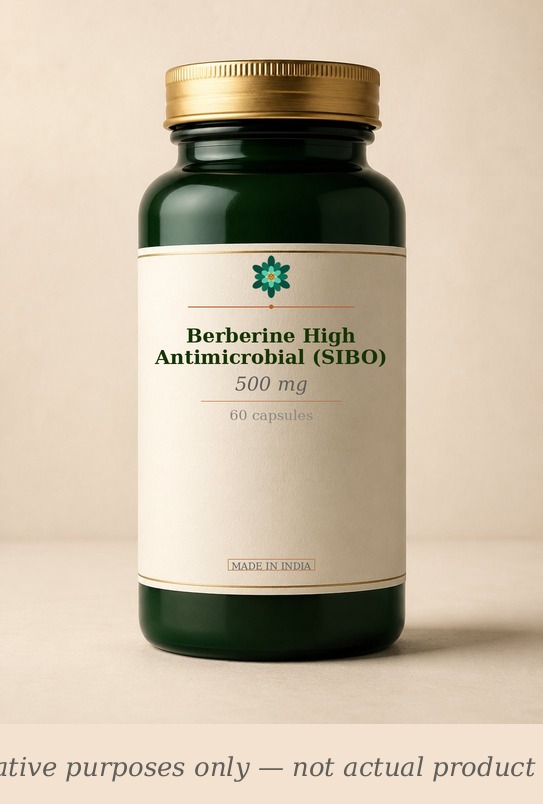
Berberine High Antimicrobial (SIBO) — SacredBod supplement bottle (illustrative)
Supplement · Antimicrobial & Anti-Candida

Berberine High Antimicrobial (SIBO)

500 mg · vegan · gluten-free · 60 caps

SIBOBloatingGasDiarrhoeaAbdominal painIBS-DH. pylori colonisationGut dysbiosis GutSmall intestineLiverPancreas
BUY on Amazon →

Affiliate link · we earn from qualifying purchases. No paid placements.

What it is

Berberine is an isoquinoline alkaloid found in Berberis vulgaris (barberry), Coptis chinensis (goldthread), Hydrastis canadensis (goldenseal), and Tinospora cordifolia (Giloy). At high antimicrobial doses (1,500–2,000 mg/day), berberine exerts bacteriostatic and bactericidal effects against a wide range of gut pathogens including E. coli, Enterococcus faecalis, Streptococcus species, and H. pylori. It also improves intestinal barrier function, enhances gut motility, and modulates the gut microbiome — making it uniquely suited for SIBO and dysbiosis. The BRIEF-SIBO trial (2023) is evaluating berberine + rifaximin head-to-head.

How it works

Berberine exerts antimicrobial effects through multiple mechanisms: (1) intercalation into bacterial DNA, inhibiting replication; (2) disruption of bacterial cell membranes via interaction with cell wall lipids; (3) inhibition of bacterial efflux pumps, restoring antibiotic sensitivity; (4) modulation of gut microbiota — increasing beneficial Bacteroidetes and reducing pathogenic Firmicutes; (5) enhancement of intestinal tight junctions, reducing leaky gut; and (6) prokinetic effect on the migrating motor complex (MMC), preventing bacterial stasis in the small intestine. The 2025 review confirmed berberine's ability to reverse disease-induced dysbiosis and restore healthy microbial community structure.

Who should take it

Individuals with SIBO (small intestinal bacterial overgrowth), IBS-D, H. pylori colonisation, or chronic gut dysbiosis; those with metabolic syndrome who also have gut issues (berberine addresses both simultaneously); and individuals seeking a natural alternative or adjunct to rifaximin for SIBO.

Avoid / careful

Pregnant or breastfeeding women; children under 12; individuals with severe liver or kidney disease; those with hypotension (berberine lowers blood pressure); people on multiple medications (berberine inhibits CYP3A4 and affects many drug levels). Side effects: Mild stomach upset, nausea, cramping, or diarrhoea in ~15% of users (usually transient). Constipation in some individuals. Rare headache or dizziness. Very well tolerated overall.

When to take it

Morning
Noon
Evening
Night

How to take it

With food
Empty stomach
Before food

FAQs

Frequently asked

How long before I see results?
For SIBO-related bloating and gas, improvement typically begins within 1–2 weeks. The BRIEF-SIBO trial is evaluating berberine head-to-head against rifaximin, with preliminary data suggesting comparable efficacy. For H. pylori, berberine is typically used as part of a 4-drug combination protocol for 2 weeks. For general dysbiosis, 3–4 weeks of 1,500 mg/day shows significant microbiome shifts.
Is this the same berberine used for diabetes?
Yes — berberine is the same compound. However, the antimicrobial protocol uses the upper end of the dosage range (1,500–2,000 mg/day) and is focused on gut bacteria rather than blood sugar. Interestingly, many SIBO patients also have insulin resistance, so berberine addresses both conditions simultaneously. For pure metabolic syndrome, 500 mg 2–3× daily is sufficient.
Can I take it with antibiotics?
Berberine can be combined with rifaximin or other antibiotics for enhanced SIBO eradication, but consult your gastroenterologist. Berberine also inhibits CYP3A4 and P-glycoprotein, which may increase levels of concurrently administered drugs. Separate berberine from other medications by 2 hours.

In plain English

A plain-English read of the literature behind this supplement. Not a clinical recommendation.

Key citations: PMC9974661 (Berberine and rifaximin effects on SIBO — BRIEF-SIBO trial protocol 2023), PMID 33091857 (complementary propolis antimicrobial evidence), PMC3768785 (complementary neem antifungal evidence)

Editorial notes

SacredBod's longer take on Berberine High Antimicrobial (SIBO) — context the structured blocks above don't capture.

What Berberine High Antimicrobial Is

Berberine is a bright yellow isoquinoline alkaloid found in several medicinal plants: Berberis vulgaris (barberry), Coptis chinensis (goldthread), Hydrastis canadensis (goldenseal), and Tinospora cordifolia (Giloy). In Ayurveda, Daru haridra (Berberis aristata) has been used for millennia as a Krimighna (antiparasitic), Kusthaghna (antifungal), and Yakrit-uttejaka (liver stimulant).

While berberine has gained fame as a metabolic supplement (lowering blood sugar, cholesterol, and triglycerides), its antimicrobial protocol uses higher doses (1,500–2,000 mg/day) to target SIBO, H. pylori, and gut dysbiosis. The BRIEF-SIBO trial (2023) is the first major RCT comparing berberine head-to-head with rifaximin — the gold-standard antibiotic for SIBO.

How It Works

  1. DNA intercalation — Berberine inserts between bacterial DNA base pairs, inhibiting replication and transcription.
  2. Membrane disruption — Interacts with bacterial cell wall lipids, increasing permeability and causing leakage.
  3. Efflux pump inhibition — Blocks bacterial ABC transporters that confer multidrug resistance, restoring sensitivity to antibiotics.
  4. Microbiome modulation — Increases beneficial Bacteroidetes and reduces pathogenic Firmicutes, reversing dysbiosis.
  5. Barrier repair — Enhances tight junction proteins (occludin, claudin, ZO-1), reducing intestinal permeability (leaky gut).
  6. Prokinetic effect — Stimulates the migrating motor complex (MMC), the “housekeeper” wave that sweeps bacteria out of the small intestine.

Who Benefits Most

  • SIBO patients — The BRIEF-SIBO trial is evaluating berberine as a rifaximin alternative.
  • IBS-D sufferers — Addresses both bacterial overgrowth and intestinal hyperpermeability.
  • H. pylori patients — Used in integrative eradication protocols alongside antibiotics.
  • Metabolic + gut issues — Berberine uniquely addresses insulin resistance, dyslipidaemia, and dysbiosis simultaneously.
  • Antibiotic-intolerant individuals — Natural alternative with fewer side effects than rifaximin.

Dosage Guide

GoalDoseDuration
SIBO500 mg 3× daily with meals4–6 weeks
H. pylori (adjunct)500 mg 2–3× daily2 weeks
General dysbiosis500 mg 2–3× daily3–4 weeks
Metabolic + gut500 mg 2× dailyOngoing

Take with meals to reduce GI upset. The yellow colour may temporarily tint urine and stool — this is harmless.

Safety & Interactions

  • CYP3A4: Berberine strongly inhibits CYP3A4 and P-gp; may increase levels of many medications. Separate from other drugs by 2 hours.
  • Blood sugar: May cause hypoglycaemia if combined with diabetes medications; monitor closely.
  • Blood pressure: Lowers BP; monitor if on antihypertensives.
  • Pregnancy: Contraindicated — may stimulate uterine contractions.
  • Children: Not for use under 12.

India-Specific Context

  • Availability: Berberine is well-represented on Amazon.in. Sushrut Ayurved Industries (B07NS74YDL — 500mg, 95% purity, GMP-certified), INLIFE (B07BGDFMML), and generic turmeric+berberine combos (B0B65R45BF) are all available. Prices range from ₹400–₹1,000 for 60 capsules.
  • Regulatory status: Berberine is sold as a dietary supplement and Ayurvedic extract in India. It is not a Schedule H drug.
  • Ayurvedic heritage: Daru haridra (Berberis aristata) is a classical Ayurvedic herb used in formulations like Darvyadi kwath, Rasanjana, and Nimbadi churna. It is indicated for Krimi (parasites), Kustha (skin diseases), Prameha (diabetes), and Yakrit roga (liver disorders).
  • Indian research: The BRIEF-SIBO trial and much of the berberine gut microbiome research comes from Indian and Chinese institutions, reflecting strong local scientific interest.
  • Cost: At ₹400–₹800 for a 1-month supply at antimicrobial doses, berberine is one of the most cost-effective SIBO interventions available in India.
  • Quality note: Look for 95%+ purity berberine HCl. Some combination products dilute the berberine with fillers or pair it with turmeric — these are fine for general health but may not deliver the full antimicrobial dose needed for SIBO.
Added to your stack.