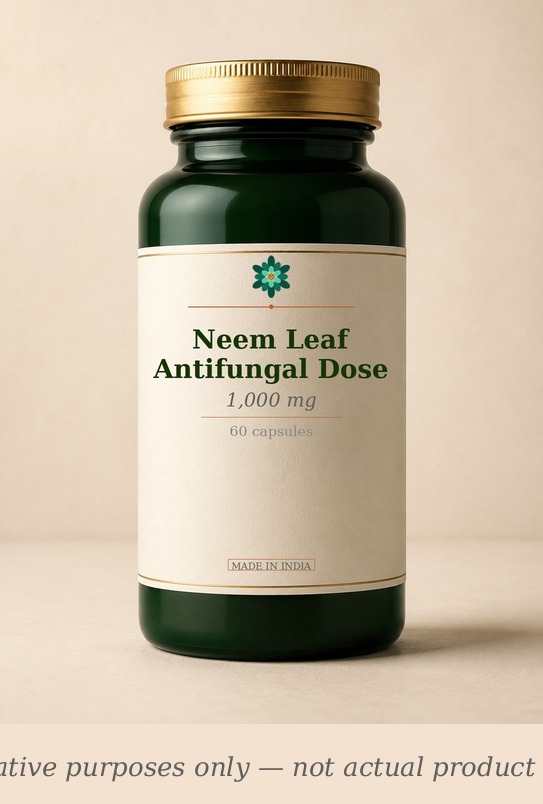
SacredBod's longer take on Neem Leaf Antifungal Dose — context the structured blocks above don't capture.
What Neem Leaf Antifungal Dose Is
Azadirachta indica, known in Sanskrit as Nimba (निंब — “the curer of all ailments”) and in Hindi as Neem (नीम), is arguably the most important medicinal tree in India. Every part of the neem tree — leaves, bark, seeds, flowers, and roots — has been used in Ayurveda, Unani, and Siddha medicine for over 4,000 years.
While standard neem capsules (500 mg) are widely used for general health, blood sugar management, and skin conditions, the high-dose antimicrobial protocol (1,000 mg/day of concentrated leaf extract) targets candida, parasites, and bacterial dysbiosis with pharmacological intensity. This dose provides concentrated azadirachtin, nimbin, nimbidin, quercetin, and beta-sitosterol — the compounds responsible for neem’s broad-spectrum antimicrobial effects.
How It Works
- Cell wall disruption — Azadirachtin and nimbin integrate into fungal cell walls, causing structural damage and leakage.
- Biofilm inhibition — Quercetin and beta-sitosterol prevent Candida adhesion to surfaces and inhibit biofilm matrix formation.
- Protease inhibition — Neem suppresses secreted aspartyl proteases (SAPs) — key virulence enzymes that Candida uses to invade tissues.
- Immune modulation — Enhances macrophage phagocytosis and increases neutrophil activity against fungal cells.
- Antibacterial — Active against E. faecalis, S. mutans, S. aureus, and multidrug-resistant pathogens.
Who Benefits Most
- Candida sufferers — The 2025 study confirmed activity against azole-resistant strains at MIC 50 µg/mL.
- Oral thrush patients — Neem is comparable to 3% sodium hypochlorite and superior to 2% chlorhexidine against oral Candida.
- Skin fungal infection patients — Topical neem oil + internal high-dose neem is a powerful combination.
- Diabetics with candida — Neem’s blood sugar-lowering effect addresses the glycaemic driver of candida overgrowth.
- Ayurveda adherents — One of the most validated classical Krimighna (antiparasitic) herbs.
Dosage Guide
| Goal | Dose | Duration |
|---|
| Candida overgrowth | 1,000 mg 2× daily | 4–6 weeks |
| Oral thrush | 1,000 mg/day + neem oil rinse | 2–3 weeks |
| Skin fungus (internal) | 1,000 mg/day | 4–6 weeks |
| General antimicrobial | 500 mg 2× daily | 2–4 weeks |
| Parasite support | 1,000 mg 2× daily | 4–6 weeks |
Take with meals. For topical use, dilute neem oil 1:1 with coconut oil.
Safety & Interactions
- Blood sugar: May lower glucose; monitor if on diabetes medications.
- Male fertility: High doses may temporarily reduce sperm motility; reversible upon stopping.
- Pregnancy: Contraindicated — traditional abortifacient.
- Autoimmune: Immunostimulatory; consult rheumatologist.
- Iron: Tannins reduce absorption; separate by 2 hours.
India-Specific Context
- Availability: Standard neem capsules are widely available from Himalaya, Baidyanath, Patanjali, and Organic India through Indian pharmacies and e-commerce. However, high-dose antimicrobial-specific neem capsules (1,000mg) are not specifically marketed on Amazon.in. Users can take 2× standard 500mg capsules or use neem leaf powder. Neem oil for topical use is ubiquitous in India.
- Regulatory status: Neem is sold as both an Ayurvedic medicine and dietary supplement. It is not a Schedule H drug.
- Ayurvedic classical status: Neem is one of the most important herbs in Ayurveda. Charaka Samhita describes it as Krimighna (antiparasitic), Kusthaghna (antifungal/antileprotic), Kandughna (anti-itch), and Vranashodhana (wound cleanser). It is used in classical formulations like Nimbadi churna, Panchatikta ghrita, and Nimba taila.
- Cultural significance: Neem trees are planted near Hindu temples and homes across India. Neem twigs (datun) are used as natural toothbrushes. Neem leaves are consumed fresh during Ugadi (New Year) in South India for health.
- Cost: Standard neem capsules cost ₹150–₹400 for 60 capsules. Neem oil costs ₹100–₹300 for 100mL. This makes neem one of the most affordable and accessible antifungal supplements in India.
- Quality note: Look for products that specify azadirachtin content (standardised extracts). Raw neem powder is effective but variable in potency.