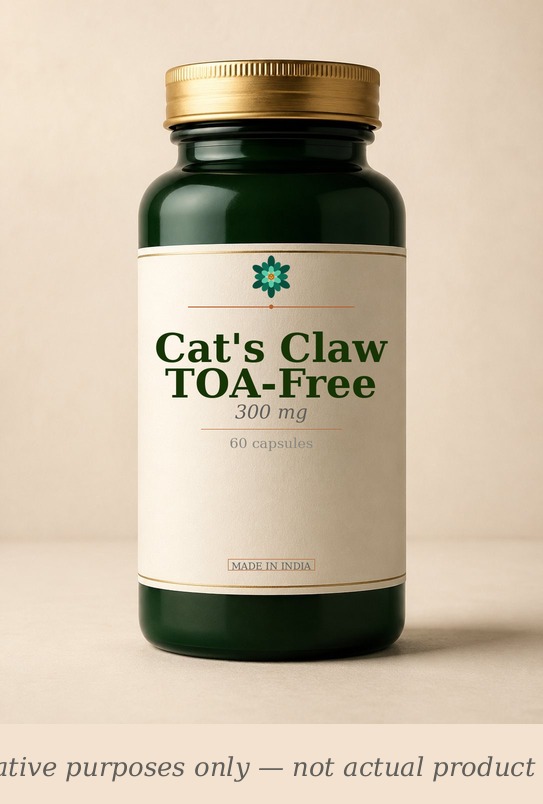
SacredBod's longer take on Cat's Claw TOA-Free — context the structured blocks above don't capture.
What It Is
Cat’s Claw TOA-Free delivers the pentacyclic oxindole alkaloid (POA) chemotype of Uncaria tomentosa — a woody vine native to the Amazon rainforest, known as Uña de Gato in Spanish and Una in traditional Peruvian medicine. Two distinct chemotypes exist: the POA chemotype (anti-inflammatory, immunomodulatory, DNA-repair enhancing) and the tetracyclic oxindole alkaloid (TOA) chemotype (may counteract POA benefits). Therapeutic products specify “TOA-free” to ensure only the beneficial POA alkaloids (pteropodine, isopteropodine, speciophylline, uncarine F) are present. In India, true TOA-free cat’s claw is not commercially available and must be imported.
How It Works
- NF-κB inhibition — POA alkaloids block NF-κB activation, reducing TNF-α, IL-1β and IL-6 production in macrophages and synovial cells. This is the primary mechanism for RA symptom reduction.
- T-cell modulation — Cat’s claw preserves CD4+ and CD8+ T cells and promotes Th2 polarisation, which counterbalances the excessive Th1 activity driving autoimmune joint destruction.
- DNA repair enhancement — A human volunteer study showed that cat’s claw aqueous extract significantly enhanced DNA repair capacity — a unique benefit among anti-inflammatory botanicals.
- COX-2 and free radical suppression — Cat’s claw selectively inhibits COX-2 (not COX-1) and scavenges free radicals, reducing inflammation without gastric toxicity.
Who Benefits Most
- Rheumatoid arthritis patients — the Mur 2002 RCT showed 53 % reduction in painful joints alongside standard DMARD therapy.
- Osteoarthritis sufferers — Miller 2005 demonstrated reduced knee pain and improved function.
- Individuals seeking immune-modulatory anti-inflammation — the Th1/Th2 balancing effect is unique among botanicals.
- Those interested in DNA protection — the DNA repair enhancement offers long-term cellular health benefits.
Dosage Guide
| Goal | Dose | Duration |
|---|
| Rheumatoid arthritis | 300 mg TOA-free extract/day | Minimum 6 months |
| Osteoarthritis | 300 mg/day | 4–8 weeks |
| Immune modulation / DNA support | 150–300 mg/day | Ongoing |
Take with food to reduce GI sensitivity. The TOA-free specification is critical — verify with the manufacturer that the product contains <0.05 % TOA alkaloids. Standard cat’s claw products may contain both chemotypes and be less effective.
Safety and Interactions
TOA-free cat’s claw is well tolerated. The Mur 2002 trial reported only minor dyspepsia and pruritus. Because it may stimulate immune function, caution is warranted with immunosuppressants, biologics and in organ transplant recipients. Theoretical anticoagulant interaction at high doses.
India-Specific Context
- Hindi/Sanskrit name: No classical equivalent; Uncaria tomentosa is an Amazonian plant not mentioned in Ayurvedic texts.
- Local availability: TOA-free cat’s claw is not available on Amazon.in. Standard cat’s claw (Nature’s Way, NOW Foods) can be imported via Amazon.in international sellers at ₹800–1,500 for 60–100 capsules. Verified TOA-free brands (Saventaro, Samento) must be imported via iHerb or Vitacost.
- Regulatory status: Not a Schedule H drug; sold as a dietary supplement. Import duty and GST apply.
- Ayurvedic parallel: The immune-modulatory and anti-inflammatory properties align with Guduchi (Tinospora cordifolia) — the premier Ayurvedic immunomodulatory Rasayana. Both herbs balance Th1/Th2 responses and reduce inflammatory cytokines. Modern integrative practitioners may combine cat’s claw with Guduchi for enhanced immune modulation.
- Conservation note: Uncaria tomentosa is sustainably harvested in Peru under government-regulated programs. Choose products with certification from sustainable harvest initiatives.
Traditional Use in Indian Medicine
Cat’s claw does not appear in classical Ayurvedic texts. However, the concept of using rainforest vines with thorny hooks for inflammatory conditions conceptually aligns with Guduchi (a climbing vine used for immune and inflammatory disorders) and Vriddhadaru (a climbing plant for musculoskeletal conditions). Modern Indian integrative rheumatologists sometimes prescribe imported cat’s claw alongside classical Ayurvedic formulations like Yograj Guggulu or Simhanada Guggulu for refractory inflammatory arthritis, though this combination has not been formally studied. The AYUSH Ministry’s framework for cross-traditional medicine may eventually facilitate clinical trials of Amazonian botanicals in Indian RA populations.