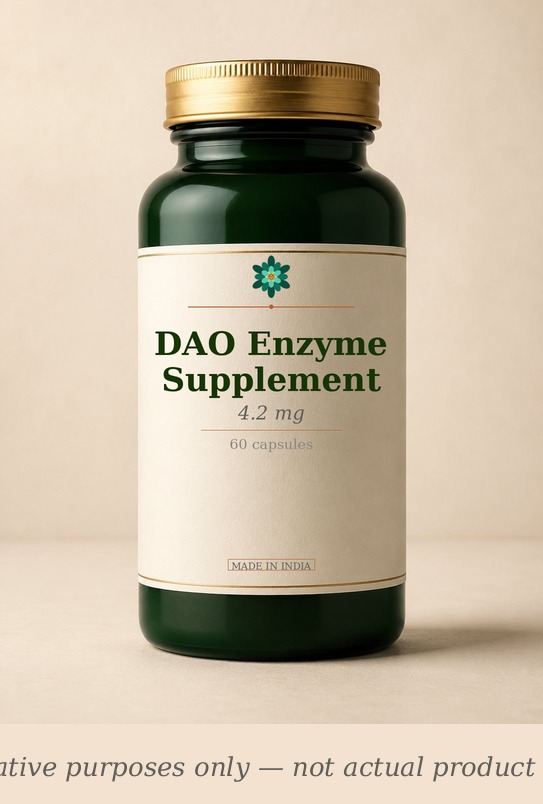
SacredBod's longer take on DAO Enzyme Supplement — context the structured blocks above don't capture.
What DAO Enzyme Supplement Is
Diamine oxidase (DAO) is a copper-containing enzyme produced primarily by the intestinal mucosa — the body’s first line of defence against dietary histamine. When you eat histamine-rich foods (aged cheese, cured meats, fermented vegetables, wine, leftovers), DAO in the gut lining breaks down the histamine before it can enter your bloodstream.
In histamine intolerance (HIT), DAO activity is insufficient — due to genetics (AOC1 gene SNPs), intestinal inflammation (celiac, Crohn’s, SIBO), medication use (NSAIDs, antibiotics, antidepressants), or nutritional deficiencies (copper, vitamin B6, vitamin C). The result is a backlog of histamine that causes headaches, hives, flushing, diarrhoea, nasal congestion, and rapid heartbeat.
DAO supplements provide exogenous enzyme that acts directly in the gut lumen, essentially “outsourcing” the histamine breakdown that your body cannot handle.
How It Works
- Gut-lumen histamine degradation — DAO capsules release active enzyme in the small intestine, where it catalyses the oxidation of histamine to inactive metabolites before absorption.
- Copper-dependent catalysis — DAO requires Cu²⁺ at its active site. Supplements are standardised for enzymatic activity (typically >14,500 KHDU/g).
- Symptom prevention — By preventing histamine absorption, DAO reduces the systemic load that triggers headaches, skin reactions, GI distress, and cardiovascular symptoms.
- Complementary to diet — DAO does not eliminate the need for dietary awareness but significantly expands food tolerance.
Who Benefits Most
- Histamine intolerance sufferers — The Schnedl pilot showed significant improvement in all 22 tracked symptoms.
- Food-triggered migraine patients — Many migraines are histamine-mediated; DAO before meals can reduce attack frequency.
- MCAS patients — Reduces the dietary histamine burden that triggers mast cell cascades.
- Those with intestinal inflammation — Celiac, Crohn’s, and SIBO patients often have reduced mucosal DAO.
- Genetic DAO deficiency — AOC1 SNPs (rs10156191, rs2052129) reduce enzyme production by 30–50%.
Dosage Guide
| Situation | Dose | Timing |
|---|
| Before histamine-rich meals | 4.2 mg DAO extract | 15–20 min before eating |
| Before every meal (strict protocol) | 4.2 mg 3× daily | Before breakfast, lunch, dinner |
| Maintenance | 4.2 mg 1–2× daily | Before main meals |
Take with a small amount of water 15–20 minutes before meals. Do not chew or crush enteric-coated capsules.
Safety & Interactions
- Alcohol: Strong DAO inhibitor; avoid or limit when using DAO supplements.
- NSAIDs: Ibuprofen, aspirin, and diclofenac inhibit DAO; use paracetamol instead if possible.
- Antidepressants: Some SSRIs and MAOIs inhibit DAO; consult psychiatrist.
- Pregnancy: Porcine DAO safety data is limited. Plant-based pea sprout DAO may be preferable.
India-Specific Context
- Availability: DAO supplements are not available on Amazon.in as of May 2026. This is a significant gap in India’s supplement market. Products like DAOSIN (Sciotec, Austria), Histamine Block (Seeking Health, USA), and Umbrellux DAO (USA) are available through international vendors. Plant-based pea sprout DAO (adiDAO Veg) is sold in Europe by DR Healthcare.
- Regulatory status: DAO is not a Schedule H drug in India. Import for personal use is generally tolerated but not guaranteed.
- Ayurvedic parallel: DAO has no direct Ayurvedic equivalent, but the concept of Agni (digestive fire) and Dhatu health aligns with intestinal enzyme function. Amalaki (vitamin C) and Pippali (Piper longum, a bioenhancer) are traditionally used to support digestive enzyme activity.
- Import cost: DAOSIN or Histamine Block costs approximately $25–40 for 60 capsules plus shipping and customs (roughly ₹3,000–5,000 total).
- Dietary relevance: Indian cuisine includes many histamine-rich foods — pickles, fermented lentils (idli/dosa batter), aged paneer, dried fish, and wine. DAO supplementation would be particularly valuable for Indian food culture but is currently inaccessible.
- Cofactor support: Since copper, vitamin B6, and vitamin C are DAO cofactors, Indians can support their endogenous DAO through diet (amla for vitamin C, lentils for B6, nuts/seeds for copper) even without enzyme supplements.