
What it is
Devil's claw is the dried tuber of Harpagophytum procumbens, a plant native to southern Africa. It has been used traditionally for pain, fever, and digestive complaints. The name comes from the hooked, claw-like appearance of its fruit.
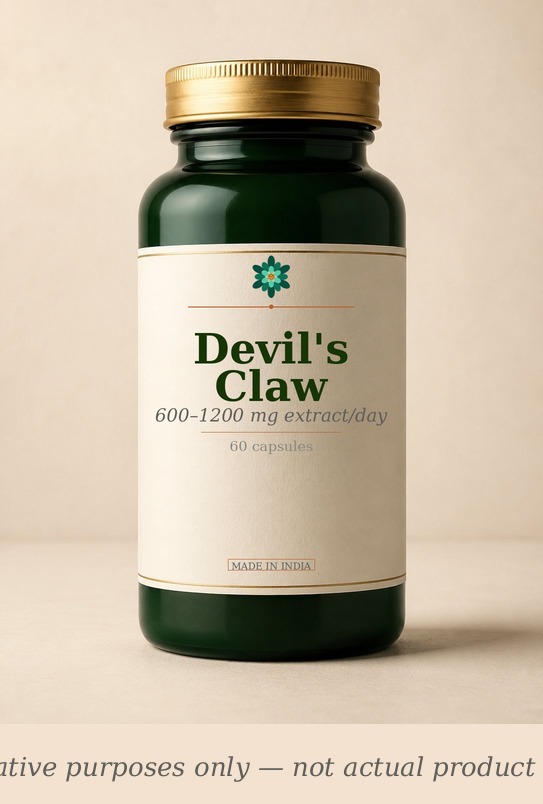
Harpagophytum procumbens · Grapple plant · Wood spider
600–1200 mg extract/day · vegan · gluten-free · 60 caps
Affiliate link · we earn from qualifying purchases. No paid placements.
Devil's claw is the dried tuber of Harpagophytum procumbens, a plant native to southern Africa. It has been used traditionally for pain, fever, and digestive complaints. The name comes from the hooked, claw-like appearance of its fruit.
The root contains iridoid glycosides, primarily harpagoside, which inhibit COX-2 and iNOS expression, reducing prostaglandin and nitric oxide production. It also appears to suppress NF-κB activation and reduce pro-inflammatory cytokines (TNF-α, IL-6).
Adults with mild-to-moderate osteoarthritis or chronic low back pain seeking a herbal anti-inflammatory alternative. Not suitable for severe inflammatory conditions requiring pharmaceutical intervention.
Avoid if you have a stomach ulcer or gallstones — devil's claw increases stomach acid and bile production. Avoid during pregnancy and breastfeeding. Use caution with anticoagulant medications. Not for people with heart rhythm disorders.
Pick a depth — minimum to maximal coverage
No full stack configured.
Click individual supplement pills above to buy each on Amazon India.
✓ Divided dosing maintains more stable anti-inflammatory activity throughout the day.
✓ Divided dosing maintains more stable anti-inflammatory activity throughout the day.
✓ Divided dosing maintains more stable anti-inflammatory activity throughout the day.
✓ Food reduces the risk of stomach upset and heartburn.
The root contains iridoid glycosides, primarily harpagoside, which inhibit COX-2 and iNOS expression, reducing prostaglandin and nitric oxide production.
Each bar = one cited trial. Effect varies by methodology, dose, and population.
Knee OA cohort (n≈60, VAS scale)
VAS pain scale 0–10. Lower = less pain.
see study
→ Systematic review of clinical trials: devil's claw showed significant reduction in pain and improvement in mobility for OA and low back pain, with good safety profile.
see study
→ Evidence-based systematic review found devil's claw had Grade B evidence for osteoarthritis and low back pain, with anti-inflammatory effects confirmed in vitro.
see study
→ In vitro study: devil's claw extract and harpagoside inhibited TNF-α release and COX-2 expression, confirming anti-inflammatory mechanisms.
C · Small-to-moderate RCTs show modest benefits for OA pain and low back pain. Systematic reviews assign Grade B evidence. Effect size is modest — not a replacement for NSAIDs in severe or acute inflammatory conditions.
A plain-English read of the literature behind this supplement. Not a clinical recommendation.
Key citations: PMID 17212570, PMID 17135164, PMID 22072539

How to use Devil's Claw specifically for knee pain — the right dose, timing, blood markers to track, and how to know if it is working.
A clinical evidence review of Devil's Claw — RCT data, effect sizes, evidence grade, and what the numbers mean for your specific situation.
Everything you need to know about Devil's Claw — mechanism, dose, safety, buying guide for India, and what the research actually says.
SacredBod's longer take on Devil's Claw — context the structured blocks above don't capture.
Devil’s claw — Harpagophytum procumbens — is a striking plant from the Kalahari Desert, named for the hooked, claw-like protrusions on its fruit. For centuries, indigenous peoples of southern Africa have used its tuberous roots for pain, fever, and digestive complaints. In modern herbal medicine, it has been adopted as an anti-inflammatory agent for osteoarthritis and chronic low back pain, with a body of clinical evidence that is modest but more substantial than many competing botanicals.
The pharmacological activity centers on iridoid glycosides, particularly harpagoside, which constitutes 0.5–3% of the dried root. In vitro studies have demonstrated that harpagoside and devil’s claw extract inhibit COX-2 and iNOS expression, reducing prostaglandin and nitric oxide production. A 2012 study in the Journal of Ethnopharmacology showed that devil’s claw extract and its isolated harpagoside inhibited TNF-α release and COX-2 expression in activated macrophages, providing a mechanistic basis for the traditional anti-inflammatory use.
The clinical evidence is supportive but not overwhelming. A 2006 systematic review in the Journal of Nutrition evaluated available clinical trials and concluded that devil’s claw showed significant reduction in pain and improvement in mobility for both osteoarthritis and low back pain, with a favorable safety profile compared to NSAIDs. A parallel 2006 evidence-based systematic review by the Natural Standard Research Collaboration assigned Grade B evidence for osteoarthritis and low back pain — meaning there is good scientific evidence for these indications, though not as robust as Grade A (strong scientific evidence).
The effect size is modest. Devil’s claw is not a potent analgesic and will not provide the rapid, dramatic relief of ibuprofen or diclofenac. Its value lies in chronic management of mild-to-moderate symptoms, particularly for patients who cannot tolerate NSAIDs due to gastrointestinal or cardiovascular concerns. The typical onset of benefit is 2–4 weeks, requiring more patience than pharmaceutical anti-inflammatories.
Safety considerations are specific and important. Devil’s claw increases stomach acid and bile production, making it contraindicated for people with active stomach ulcers or gallstones. It may also affect heart rhythm and should be avoided in people with cardiac arrhythmias. The anticoagulant interaction, while not consistently demonstrated, warrants caution. Pregnancy and breastfeeding are contraindicated due to traditional use as an oxytocic agent.
For consumers with mild-to-moderate osteoarthritis or chronic low back pain who prefer herbal approaches and do not have contraindicating conditions, devil’s claw is a reasonable option with a modest but genuine evidence base. It should be viewed as a slow-acting herbal anti-inflammatory, not a replacement for NSAIDs in severe or acute pain.
Peptides are physician-only. Tell us a bit and we'll route you to the right specialist.