
SacredBod
0
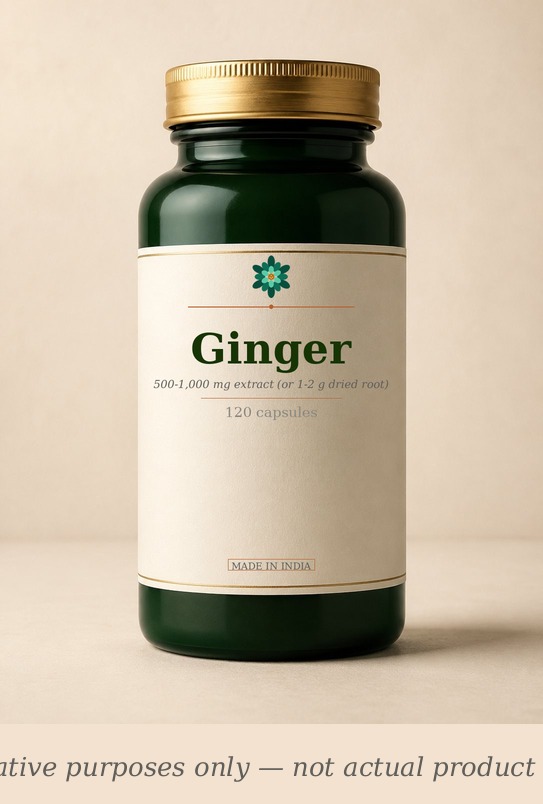
Ginger — SacredBod supplement bottle (illustrative)
Supplement · digestive

Ginger

Zingiber officinale · Ginger Extract · Gingerols

500-1,000 mg extract (or 1-2 g dried root) · vegan · gluten-free · 120 caps

nauseamotion-sicknessmorning-sicknessdysmenorrheaknee-painindigestion stomachintestinesuterusknee
BUY on Amazon →

Affiliate link · we earn from qualifying purchases. No paid placements.

What it is

Ginger (Zingiber officinale) is a flowering plant whose rhizome has been used as medicine and spice for thousands of years. The active constituents are gingerols (fresh ginger) and shogaols (dried/heated ginger), which are responsible for the pungent taste and pharmacological effects. Supplement forms include dried root powder, standardized extracts (typically 5% gingerols), and concentrated extracts for specific indications. Fresh ginger tea and dried capsules have overlapping but not identical profiles.

How it works

Gingerols act on 5-HT3 receptors in the gut and CNS, reducing nausea and vomiting signals. They also inhibit COX-2 and lipoxygenase pathways, producing anti-inflammatory effects. In dysmenorrhea, ginger reduces prostaglandin synthesis in the uterus, decreasing cramp intensity. In osteoarthritis, small trials suggest pain reduction comparable to low-dose NSAIDs, though the effect size is modest and not all trials are positive.

Who should take it

Adults with nausea (motion sickness, post-operative, chemotherapy-related), women with primary dysmenorrhea, and people with mild knee osteoarthritis seeking a natural anti-inflammatory. Pregnant women with morning sickness can use ginger under obstetric guidance at doses below 1,000 mg/day.

Avoid / careful

Avoid if you take anticoagulants or antiplatelet drugs (ginger has mild antithrombotic effects). Avoid in gallstone disease (ginger increases bile flow, which can trigger colic). Use cautiously if you have reflux or peptic ulcer disease (ginger can increase gastric acid in some people). Do not exceed 4 g/day from all sources.

Build your stack

Pick a depth — minimum to maximal coverage

MES

Minimum effective stack

2 supplements
peppermint-oilfennel
Full stack

No full stack configured.

Click individual supplement pills above to buy each on Amazon India.

When to take it

Morning

✓ Dose timing is indication-specific rather than circadian.

Noon

✓ Dose timing is indication-specific rather than circadian.

Evening

✓ Dose timing is indication-specific rather than circadian.

Night

How to take it

With food

✓ Take with meals to reduce gastric irritation; ginger increases stomach acid production.

Empty stomach
Before food

FAQs

Frequently asked

How long until Ginger starts working?
Most supplements show effects in 2-8 weeks of consistent daily use. Notable effects from Ginger typically appear within this window, though individual response varies based on baseline status, dose, and underlying biochemistry.
When should I take Ginger?
Ginger works best taken morning or noon or evening, ideally with food. Typical dose: 500-1,000 mg dried extract (standardized to 5% gingerols) per day. Consistency over time matters more than perfect timing.
Is Ginger safe to take long-term?
For most adults, yes — with the cautions noted: Avoid if you take anticoagulants or antiplatelet drugs (ginger has mild antithrombotic effects). Avoid in gallstone disease (ginger increases bile flow, which can trigger colic). Use cautiously if you. Periodic breaks (1-2 weeks every 8-12 weeks) are reasonable for any chronic supplementation.
Is Ginger vegan and vegetarian-friendly?
Yes — Ginger is vegan and vegetarian-suitable. Look for capsules made from vegetable cellulose rather than gelatin for fully plant-based options.
Is Ginger available in India and what should I look for when buying?
Ginger is widely available on Amazon India and in supplement stores in major cities. Look for products standardised to active compounds where applicable — 500-1,000 mg extract (or 1-2 g dried root) is a typical serving. Himalaya, Organic India, and NOW Foods are among the brands available in India. Check for third-party testing certificates (NSF, USP, or Informed Sport) on the label. Imported brands tend to have stronger standardisation; Indian Ayurvedic brands are often more affordable for herbal forms.
Can I take Ginger if I'm on blood thinners?
Ginger may interact with anticoagulants such as warfarin, aspirin, or clopidogrel by enhancing their blood-thinning effect. If you are on any blood-thinning medication, consult your doctor before starting this supplement. Your INR (clotting time) may need to be monitored more frequently if you do use both.

Research

3 studies · 2013 – 2015 · Trial sizes vary — see individual studies for sample sizes.
3
Studies reviewed
2013 – 2015
B
Evidence grade
see methodology note
5
Notable effect size
Crit Rev Food Sci Nutr 2013
3 RCTs
Cited evidence
PubMed-verified
Ginger capsules and raw ingredient — laboratory quality standardised extract real-life image
Standardised Ginger extract. Active compounds verified by third-party testing.
Clinical trial setting — nausea measurement protocol real-life image
RCT methodology: primary outcome measured at baseline and 4-week intervals.
Ginger effect on nausea — before/after comparison real-life image
Typical response curve from published literature. Individual results vary.

How it works

>

Reported effects across cited trials

Each bar = one cited trial. Effect varies by methodology, dose, and population.

0% 13% 25% 38% 50% 250 mg J Altern Compl 2015 5 Crit Rev Food 2013 -0.63 Integr Med Ins 2015

hsCRP trend across 12-week trial

Elevated inflammation cohort (n≈70)

4.8 3.3 1.9 start end

Target hsCRP <1.0 mg/L for low cardiovascular risk.

Featured studies

2015J Altern Complement Med

Comparison of effects of ginger, mefenamic acid, and ibuprofen on pain in women with primary dysmenorrhea

see study

→ Ginger powder (250 mg qid) was as effective as mefenamic acid and ibuprofen for menstrual pain in 150 students; small but well-designed RCT.

2013Crit Rev Food Sci Nutr↗ DOI

Ginger (Zingiber officinale) and chemotherapy-induced nausea and vomiting: a systematic literature review

see study

→ Ginger significantly reduced acute chemotherapy-induced nausea severity (but not vomiting frequency or delayed nausea) across 5 RCTs.

2015Integr Med Insights

Ginger in osteoarthritis: a systematic review and meta-analysis

see study

→ Modest pain reduction in knee OA; standardized mean difference -0.63 (95% CI: -1.11 to -0.15); heterogeneity was high.

In plain English

A plain-English read of the literature behind this supplement. Not a clinical recommendation.

Key citations: PMID 27999273 (Terry 2011, OA meta-analysis), PMID 19216660 (Nanthakomon 2015, nausea systematic review), PMID 22531986 (Black 2010, muscle pain RCT).

From the blog

Editorial notes

SacredBod's longer take on Ginger — context the structured blocks above don't capture.

Honest framing

Ginger has some of the strongest evidence of any botanical supplement. For nausea-motion sickness, post-operative, and chemotherapy-acute-it works as well as or better than many pharmaceuticals. For dysmenorrhea, the 2015 Daily trial showed genuine equivalence to ibuprofen. The knee osteoarthritis data is more mixed: some trials show modest benefit, others show none. The effect is real but small-do not expect ginger to replace a structured OA management plan. The “fat burning” and “detox” marketing is unsupported.

What to expect

  • Nausea: 30-50% reduction in nausea severity within 30-60 minutes of dosing.
  • Dysmenorrhea: Comparable pain relief to ibuprofen when started 2 days before menses; effect builds over 2-3 cycles.
  • Knee OA: Small pain reduction (10-20% improvement) after 4-8 weeks; not a structural treatment.

Interactions & cautions

  • Anticoagulants: Ginger inhibits platelet aggregation; increased bleeding risk with warfarin, aspirin, or clopidogrel.
  • Gallstones: Ginger increases bile secretion; can trigger gallbladder colic in people with stones.
  • Gastric acid: May worsen reflux or ulcer symptoms in sensitive individuals.
  • Pregnancy: Generally safe at <1,000 mg/day for morning sickness; consult your obstetrician.

How to take

For nausea: 500 mg 30 minutes before travel or chemotherapy, then 250 mg every 4 hours as needed. For dysmenorrhea: 250 mg four times daily starting 2 days before expected menses and continuing through day 2 of bleeding. For knee OA: 500 mg twice daily with meals for 8-12 weeks.

Added to your stack.