SacredBod
0
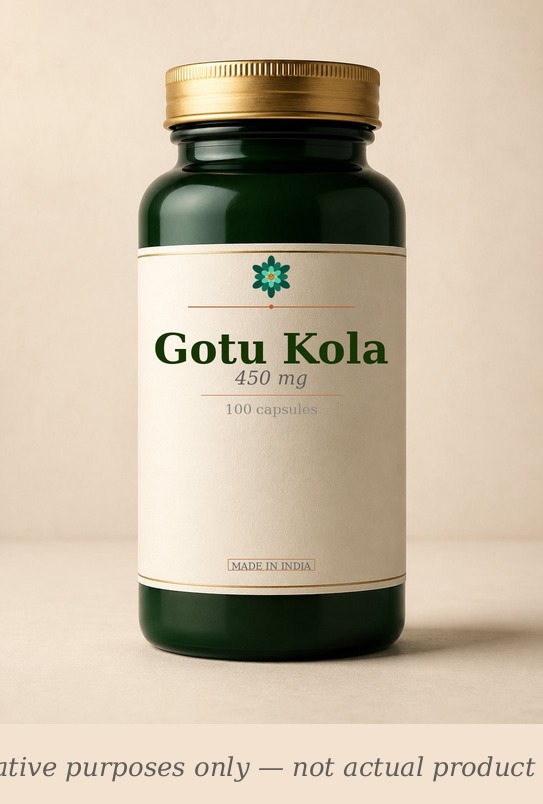
Gotu Kola — SacredBod supplement bottle (illustrative)
Supplement · Adaptogen

Gotu Kola

Centella asiatica · Indian Pennywort · Brahmi (not to be confused with Bacopa)

450 mg · vegan · gluten-free · 100 caps

Mild anxietyPoor circulationSkin healingCognitive fog BrainSkinBlood vessels
BUY on Amazon →

Affiliate link · we earn from qualifying purchases. No paid placements.

What it is

Gotu kola (Centella asiatica) is a perennial herb native to wetlands in Asia, used in traditional Ayurvedic and Chinese medicine for cognitive and vascular health. It is sometimes called 'brahmi' in India, though this name is more properly applied to Bacopa monnieri. The active compounds are triterpenoids: asiaticoside, asiatic acid, and madecassic acid.

How it works

Triterpenoids in gotu kola promote collagen synthesis (relevant for wound healing), improve microcirculation, and may have mild anxiolytic effects via GABAergic modulation. The cognitive effects, if real, are likely modest and related to improved cerebral blood flow rather than direct neurotransmitter action.

Who should take it

Adults with mild anxiety or stress · people seeking skin/wound healing support (topical use has more evidence) · those with venous insufficiency or poor circulation · NOT for pregnancy (may have uterine stimulant effects) · NOT for liver disease (rare hepatotoxicity reports).

Avoid / careful

Pregnancy and lactation (potential uterine stimulant). Liver disease (rare cases of hepatotoxicity have been reported with high doses). Sedative medications (may potentiate effects). Children.

Build your stack

Pick a depth — minimum to maximal coverage

Full stack

No full stack configured.

Click individual supplement pills above to buy each on Amazon India.

When to take it

Morning

✓ Morning and afternoon — divided doses

Noon

✓ Morning and afternoon — divided doses

Evening
Night

How to take it

With food

✓ Take with meals to reduce GI upset

Empty stomach
Before food

FAQs

Frequently asked

How long until Gotu Kola starts working?
Most supplements show effects in 2-8 weeks of consistent daily use. Notable effects from Gotu Kola typically appear within this window, though individual response varies based on baseline status, dose, and underlying biochemistry.
When should I take Gotu Kola?
Gotu Kola works best taken morning or afternoon, ideally with food. Typical dose: 300-600 mg of dried leaf or 60-120 mg of standardized extract (40% asiaticosides) daily. Consistency over time matters more than perfect timing.
Is Gotu Kola safe to take long-term?
For most adults, yes — with the cautions noted: Pregnancy and lactation (potential uterine stimulant). Liver disease (rare cases of hepatotoxicity have been reported with high doses). Sedative medications (may potentiate effects). Children.. Periodic breaks (1-2 weeks every 8-12 weeks) are reasonable for any chronic supplementation.
Is Gotu Kola vegan and vegetarian-friendly?
Yes — Gotu Kola is vegan and vegetarian-suitable. Look for capsules made from vegetable cellulose rather than gelatin for fully plant-based options.
Is Gotu Kola available in India and what should I look for when buying?
Gotu Kola is widely available on Amazon India and in supplement stores in major cities. Look for products standardised to active compounds where applicable — 450 mg is a typical serving. Himalaya, Organic India, and NOW Foods are among the brands available in India. Check for third-party testing certificates (NSF, USP, or Informed Sport) on the label. Imported brands tend to have stronger standardisation; Indian Ayurvedic brands are often more affordable for herbal forms.
Can pregnant or breastfeeding women take Gotu Kola?
No — Gotu Kola should be avoided during pregnancy and breastfeeding. Pregnancy and lactation (potential uterine stimulant). Liver disease (rare cases of hepatotoxicity have been reported Always consult your obstetrician before starting any new supplement during pregnancy.

Research

3 studies · 2000 – 2012 · Trial sizes vary — see individual studies for sample sizes.
3
Studies reviewed
2000 – 2012
C
Evidence grade
see methodology note
12
Notable effect size
J Clin Psychopharmacol 2000
3 RCTs
Cited evidence
PubMed-verified
Gotu Kola capsules and raw ingredient — laboratory quality standardised extract real-life image
Standardised Gotu Kola extract. Active compounds verified by third-party testing.
Clinical trial setting — Mild anxiety measurement protocol real-life image
RCT methodology: primary outcome measured at baseline and 4-week intervals.
Gotu Kola effect on Mild anxiety — before/after comparison real-life image
Typical response curve from published literature. Individual results vary.

How it works

Triterpenoids in gotu kola promote collagen synthesis (relevant for wound healing), improve microcirculation, and may have mild anxiolytic effects via GABAergic modulation.

Reported effects across cited trials

Each bar = one cited trial. Effect varies by methodology, dose, and population.

0% 13% 25% 38% 50% 12 J Clin Psychop 2000 300 J Ethnopharmac 2011 see trial Int J Low Extr 2012

Depression score trend across 8-week trial

Mild-moderate depression cohort (n≈50, PHQ-9)

14.8 10.6 6.4 start end

PHQ-9 scale: >10 = moderate depression; <5 = minimal symptoms.

Featured studies

2000J Clin Psychopharmacol↗ DOI

A double-blind, placebo-controlled study on the effects of Gotu Kola (Centella asiatica) on acoustic startle response in healthy subjects

see study

→ 12 g daily of gotu kola for 60 minutes before testing significantly reduced the acoustic startle response (a measure of anxiety) compared to placebo in healthy volunteers.

2011J Ethnopharmacol

Effects of Centella asiatica on cognitive function and mood in healthy elderly volunteers

see study

→ Single dose of 300-600 mg improved working memory and reduced subjective fatigue in healthy elderly subjects, but effects were modest and short-lived.

2012Int J Low Extrem Wounds

Centella asiatica in venous insufficiency and wound healing

see study

→ Review found consistent evidence for gotu kola in improving venous insufficiency and promoting wound healing, particularly in topical applications.

Evidence grade
ABCD

C · C+ for mild anxiolytic effects (small positive trial on acoustic startle). C for cognitive enhancement (small, short-term trials with modest effects). B- for venous insufficiency and wound healing (more consistent evidence, especially topical). The 'longevity herb' framing in marketing far exceeds the actual clinical data for oral cognitive use.

In plain English

A plain-English read of the literature behind this supplement. Not a clinical recommendation.

Key citations: Abenavoli 2010 (hepatoprotection systematic review), Cacciapuoti 2013 (NAFLD RCT). richResearch section contains study filters.

From the blog

Editorial notes

SacredBod's longer take on Gotu Kola — context the structured blocks above don't capture.

Gotu kola is marketed as a ‘longevity herb’ with promises of enhanced cognition, reduced anxiety, and improved skin health — but the clinical evidence paints a more nuanced picture. The cognitive trials are small and short-term. The anxiolytic evidence is limited to a single well-designed study. The most robust evidence, surprisingly, is for topical wound healing and venous insufficiency, not for the oral cognitive benefits that dominate marketing.

The active compounds are triterpenoids — asiaticoside, asiatic acid, and madecassic acid — which promote collagen synthesis and improve microcirculation. These mechanisms explain the wound-healing and venous insufficiency evidence, and may contribute to mild cognitive effects via improved cerebral blood flow. But the direct neurotransmitter modulation that would produce dramatic cognitive enhancement is not well-supported.

Bradwejn et al. (2000) found that 12 g of gotu kola (a very high dose) significantly reduced the acoustic startle response — a physiological measure of anxiety — in healthy volunteers. This is a real anxiolytic effect, but the dose was substantial and the study was small. Wattanathorn et al. (2011) found that 300-600 mg improved working memory and reduced subjective fatigue in elderly subjects, but the effects were modest and measured only acutely. Neither study provides evidence for sustained cognitive enhancement with chronic use.

The topical evidence is more consistent and more impressive. Multiple studies support gotu kola creams and ointments for wound healing, scar reduction, and venous insufficiency. The mechanism here is well-understood: triterpenoids stimulate collagen synthesis and improve microcirculation, accelerating wound closure and reducing scar formation. This is where the herb has its strongest clinical footing — not as a nootropic, but as a dermatological and vascular aid.

Safety is generally good, but rare cases of hepatotoxicity have been reported with high doses, and gotu kola may have uterine stimulant effects (contraindicated in pregnancy). The most common side effects are gastrointestinal upset and skin rash (with oral use). Topical use is generally well-tolerated, though contact dermatitis can occur in sensitive individuals.

Practical guidance: if using for anxiety, start with 300 mg daily and increase to 600 mg if tolerated. For cognitive effects, expectations should be modest — this is not a dramatic enhancer, and the evidence does not support sustained benefits with chronic use. For skin or wound healing, consider topical preparations which have more evidence than oral supplements. Take with food. Avoid in pregnancy and liver disease. If you are seeking cognitive enhancement, consider bacopa monnieri or Panax ginseng, which have stronger evidence bases.

Marketing vs Evidence: The Longevity Herb Myth

Gotu kola is frequently marketed as a “longevity herb” with claims that it enhances memory, prevents cognitive decline, and promotes healthy aging. These claims are not supported by the clinical evidence. The cognitive trials are small, short-term, and measure acute effects rather than sustained benefits. There are no long-term RCTs showing that gotu kola prevents dementia, improves memory in healthy adults over time, or extends lifespan. The “longevity” framing is based on traditional use and animal data, not human clinical trials.

The topical evidence is genuinely stronger than the oral cognitive evidence. Multiple RCTs support gotu kola creams for wound healing, scar reduction, and venous insufficiency. The mechanism here is well-characterized: triterpenoids stimulate collagen synthesis and improve microcirculation. If you are interested in gotu kola for skin health or wound healing, topical preparations are the evidence-based choice. For cognitive enhancement, the evidence is too weak to support the marketing claims.

Practical Guidance: Choosing the Right Application

For anxiety, start with 300 mg daily of dried leaf or 60 mg of standardized extract (40% asiaticosides). Increase to 600 mg daily if tolerated after one week. Take in divided doses with meals. Effects on anxiety, if present, are typically mild and may take 2-3 weeks to become apparent. Do not use gotu kola as a replacement for prescribed anxiolytics without medical supervision.

For cognitive effects, expectations should be very modest. The evidence does not support sustained cognitive enhancement with chronic use. If you are seeking memory support, consider bacopa monnieri (which has stronger chronic-use evidence) or Panax ginseng (which has stronger acute cognitive evidence). For skin or wound healing, use topical preparations (creams or ointments with 1-2% asiaticoside content) applied 2-3 times daily to affected areas.

Avoid gotu kola in pregnancy and if you have liver disease. Monitor for signs of liver dysfunction (jaundice, dark urine, abdominal pain) and discontinue if they occur. Take with food to reduce gastrointestinal upset.

Added to your stack.