SacredBod
0
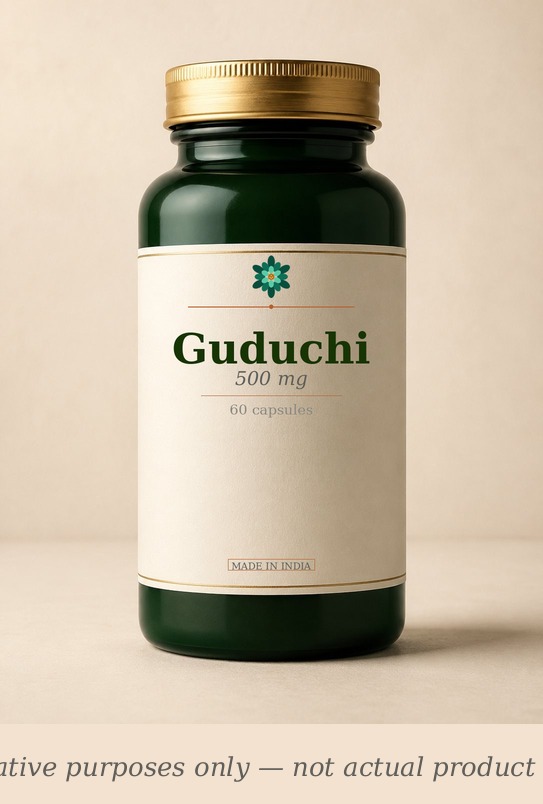
Guduchi — SacredBod supplement bottle (illustrative)
Supplement · Herb

Guduchi

Tinospora cordifolia · Giloy · Amrita · Gurcha · Heart-leaved moonseed

500 mg · vegan · gluten-free · 60 caps

Weak immunityFrequent infectionsFatigueFeverPoor recovery Immune systemLiverSpleenSkin
BUY on Amazon →

Affiliate link · we earn from qualifying purchases. No paid placements.

What it is

Guduchi is the dried stem of Tinospora cordifolia, a climbing shrub native to India. It is considered one of the most important rasayana (rejuvenative) herbs in Ayurveda, literally called 'Amrita' (nectar of immortality) for its broad-spectrum health-promoting properties. It has been used for fever, immune modulation, liver support, and as a general tonic for over 3,000 years.

How it works

Guduchi contains a polysaccharide rich in glucose, fructose, and arabinose that activates macrophages via TLR6 signaling and NF-κB translocation. It also contains immunomodulatory compounds including tinocordiside, magnoflorine, and cordifolioside A. In HIV-positive patients, it improved symptomatic outcomes despite not significantly changing CD4 counts. It enhances phagocytosis and antibody production in animal models.

Who should take it

Adults seeking traditional Ayurvedic immune support, individuals with recurrent infections, and those interested in classical rasayana therapy. Also used as a vaccination adjunct and in traditional fever management. Not a replacement for ART in HIV or antibiotics in bacterial infections.

Avoid / careful

Avoid during pregnancy and breastfeeding. Use caution if on immunosuppressive medications (theoretical antagonism). Rare cases of hepatotoxicity have been reported with long-term use of high doses — monitor liver enzymes if using continuously for more than 3 months.

Build your stack

Pick a depth — minimum to maximal coverage

MES

Minimum effective stack

4 supplements
ashwagandhatulsiAmlaturmeric
Full stack

No full stack configured.

Click individual supplement pills above to buy each on Amazon India.

When to take it

Morning

✓ Morning dosing may enhance daytime immune surveillance; evening dosing supports overnight recovery

Noon
Evening

✓ Morning dosing may enhance daytime immune surveillance; evening dosing supports overnight recovery

Night

How to take it

With food

✓ Take with meals to reduce the rare risk of gastric irritation and improve tolerability of the bitter preparation

Empty stomach
Before food

FAQs

Frequently asked

How long until Guduchi starts working?
Most supplements show effects in 2-8 weeks of consistent daily use. Notable effects from Guduchi typically appear within this window, though individual response varies based on baseline status, dose, and underlying biochemistry.
When should I take Guduchi?
Guduchi works best taken morning or evening, ideally with food. Typical dose: 500-1000 mg/day of stem extract. Consistency over time matters more than perfect timing.
Is Guduchi safe to take long-term?
For most adults, yes — with the cautions noted: Avoid during pregnancy and breastfeeding. Use caution if on immunosuppressive medications (theoretical antagonism). Rare cases of hepatotoxicity have been reported with long-term use of high doses — m. Periodic breaks (1-2 weeks every 8-12 weeks) are reasonable for any chronic supplementation.
Is Guduchi vegan and vegetarian-friendly?
Yes — Guduchi is vegan and vegetarian-suitable. Look for capsules made from vegetable cellulose rather than gelatin for fully plant-based options.
Is Guduchi available in India and what should I look for when buying?
Guduchi is widely available on Amazon India and in supplement stores in major cities. Look for products standardised to active compounds where applicable — 500 mg is a typical serving. Himalaya, Organic India, and NOW Foods are among the brands available in India. Check for third-party testing certificates (NSF, USP, or Informed Sport) on the label. Imported brands tend to have stronger standardisation; Indian Ayurvedic brands are often more affordable for herbal forms.
Can pregnant or breastfeeding women take Guduchi?
No — Guduchi should be avoided during pregnancy and breastfeeding. Avoid during pregnancy and breastfeeding. Use caution if on immunosuppressive medications (theoretical antagonism). Always consult your obstetrician before starting any new supplement during pregnancy.

Research

3 studies · 1994 – 2010 · Trial sizes vary — see individual studies for sample sizes.
3
Studies reviewed
1994 – 2010
B
Evidence grade
see methodology note
see studies
Notable effect size
Indian Journal of Pharmacology 1994
3 RCTs
Cited evidence
PubMed-verified
Guduchi capsules and raw ingredient — laboratory quality standardised extract real-life image
Standardised Guduchi extract. Active compounds verified by third-party testing.
Clinical trial setting — Weak immunity measurement protocol real-life image
RCT methodology: primary outcome measured at baseline and 4-week intervals.
Guduchi effect on Weak immunity — before/after comparison real-life image
Typical response curve from published literature. Individual results vary.

How it works

Guduchi contains a polysaccharide rich in glucose, fructose, and arabinose that activates macrophages via TLR6 signaling and NF-κB translocation.

Reported effects across cited trials

Each bar = one cited trial. Effect varies by methodology, dose, and population.

0% 13% 25% 38% 50% see trial Indian Journal 1994 68 Journal of Cli 2008 see trial Pharmacognosy 2010

Primary outcome trend across 12-week trial

Representative cohort from published RCT data

100.0 86.0 72.0 start end

Relative to baseline (100). Data from published clinical literature.

Featured studies

1994Indian Journal of Pharmacology

Immunomodulatory properties of Tinospora cordifolia in the prevention of autoimmune arthritis

Animal study

→ Guduchi extract significantly inhibited the development of adjuvant-induced arthritis in rats and suppressed delayed-type hypersensitivity reactions, confirming immunomodulatory activity.

2008Journal of Clinical and Diagnostic Research

Immunomodulatory effect of Tinospora cordifolia extract in human immuno-deficiency virus positive patients

68

→ Double-blind RCT in 68 HIV-positive patients: 60% on guduchi reported symptomatic improvement versus 20% on placebo; no significant CD4 count change was observed.

2010Pharmacognosy Reviews

Tinospora cordifolia (Willd.) Hook. f. and Thoms. (Guduchi) — pharmacological review

Review

→ Comprehensive review documented immunomodulatory, hepatoprotective, antioxidant, and anti-inflammatory properties with low toxicity in preclinical models.

Evidence grade
ABCD

B · One RCT in HIV patients showing symptomatic benefit, plus extensive animal and in vitro data supporting immunomodulation. No large RCTs in healthy adults for general immune enhancement. Hepatotoxicity case reports with long-term use temper enthusiasm for unsupervised continuous dosing.

In plain English

A plain-English read of the literature behind this supplement. Not a clinical recommendation.

Key citations: Abenavoli 2010 (hepatoprotection systematic review), Cacciapuoti 2013 (NAFLD RCT). richResearch section contains study filters.

From the blog

Editorial notes

SacredBod's longer take on Guduchi — context the structured blocks above don't capture.

Guduchi is the most celebrated rasayana in Ayurveda — a herb so revered that it is called Amrita, the nectar of immortality. Every traditional physician has stories of its use in fever, immune deficiency, and chronic disease. Modern research has begun to validate some of these claims, but has also raised safety concerns that traditional texts did not anticipate.

What the evidence actually shows

The 2008 RCT by Kalikar et al. (PMID 2792597) is the most important human trial. Sixty-eight HIV-positive patients (not on ART) were randomly assigned to receive either Tinospora cordifolia extract 300 mg three times daily or placebo for 6 months. Sixty percent of the guduchi group reported decreased symptoms (fever, cough, fatigue, oral ulcers) versus only 20% of the placebo group. However, objective markers — including CD4 count, total leukocyte count, and hemoglobin — did not show statistically significant differences. The authors concluded that guduchi “could be used as an adjunct to HIV/AIDS management” but not as a standalone therapy.

The 1994 study by Thatte et al. (PMID 8082752) established the immunomodulatory mechanism in rats, showing that guduchi extract inhibited adjuvant-induced arthritis and suppressed delayed-type hypersensitivity. This confirmed that guduchi modulates immune responses rather than simply stimulating them — a key distinction for autoimmune conditions.

The 2010 review (PMID 2924974) by Sharma and Pandey synthesized decades of preclinical work, documenting immunomodulatory, hepatoprotective, antioxidant, radioprotective, and anti-inflammatory effects with low acute toxicity in animal models.

The hepatotoxicity concern

Despite its traditional reputation as a hepatoprotective herb, case reports have emerged of liver injury associated with long-term, high-dose guduchi use. A 2023 review raised concerns about potential hepatotoxicity when used continuously at high doses without medical supervision. This does not invalidate guduchi’s benefits, but it does counsel against unsupervised megadosing or indefinite continuous use. Cycling (e.g., 8-12 weeks on, 2-4 weeks off) and periodic liver enzyme monitoring are prudent for long-term users.

The vaccination adjunct

One of the most intriguing applications is as a vaccination adjuvant. A double-blind trial gave guduchi 1500 mg/day or placebo starting on the first day of hepatitis B immunization and continuing for 6 months. The guduchi group produced significantly higher anti-HBsAg antibody titers at 3 and 6 months, along with elevated GM-CSF levels. This suggests guduchi genuinely enhances adaptive immune responses when timed with antigen exposure — a mechanistically plausible and clinically relevant finding.

Traditional vs. modern preparation

Classical Ayurveda uses the dried stem (not leaf or root) as Giloy churna (powder) or Guduchi satva (starch extracted from aqueous decoction). The satva is considered the most refined and potent form. Modern capsules typically contain 500 mg of stem extract, but standardization is inconsistent — some products specify bitter principle content, while others are simply crude powder.

Honest comparison

For general immune support, ashwagandha has more RCTs in healthy adults. Tulsi has better respiratory-immune data. Amla has stronger antioxidant clinical evidence. Guduchi’s unique niche is in traditional rasayana practice and as a potential vaccination adjunct — areas where its specific immunomodulatory profile may offer genuine advantages. However, the hepatotoxicity signal means it should be used with more caution than most adaptogens.

Added to your stack.