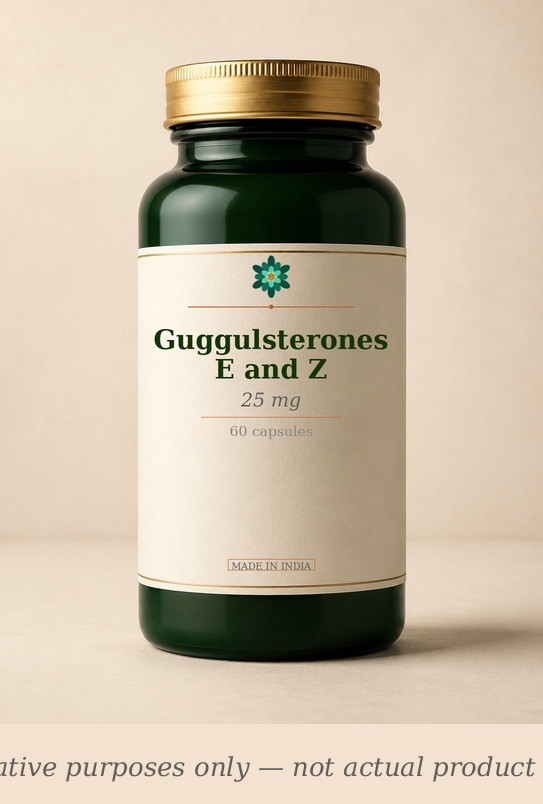
SacredBod's longer take on Guggulsterones E and Z — context the structured blocks above don't capture.
What It Is
Guggulsterones E and Z provides the two bioactive ketosteroid isomers — trans (E) and cis (Z) — that constitute the pharmacologically active fraction of Commiphora mukul resin. In Ayurveda, raw guggul (Guggulu) has been used for millennia as a Medohara (fat-reducing) and Kaphahara (mucus-clearing) agent. Modern extraction technology now allows standardisation to 2.5 % guggulsterone content, ensuring each capsule delivers a consistent, clinically relevant dose of the compounds responsible for metabolic and thyroid effects.
How It Works
- TGR5 activation → DIO2 upregulation — Guggulsterones bind the Takeda G-protein-coupled receptor 5 (TGR5), a bile acid receptor expressed in brown adipose tissue, skeletal muscle and the thyroid axis. TGR5 signalling increases cyclic AMP, which upregulates type 2 deiodinase (DIO2) — the selenoenzyme that converts inactive thyroxine (T4) into biologically active triiodothyronine (T3).
- FXR modulation — As a farnesoid X receptor (FXR) antagonist, guggulsterone reduces bile-acid-mediated feedback inhibition of cholesterol 7α-hydroxylase (CYP7A1), accelerating hepatic cholesterol clearance into bile.
- Thyroid receptor β1 agonism — In hepatocytes, guggulsterone enhances thyroid hormone receptor β1 (THRβ1) signalling, increasing metabolic rate and promoting favourable lipid profiles.
Who Benefits Most
- Adults with subclinical hypothyroidism and a sluggish metabolic rate.
- Individuals with elevated cholesterol or triglycerides seeking a botanical alternative or adjunct to statins.
- Those interested in Ayurvedic metabolic support with modern extract standardisation.
Dosage Guide
| Goal | Dose | Timing |
|---|
| Metabolic / thyroid support | 25 mg guggulsterones twice daily | With breakfast and dinner |
| Lipid management | 25–50 mg guggulsterones daily | Divided doses with meals |
Each 400 mg capsule of 2.5 % extract provides ~10 mg guggulsterones; two to three capsules are needed to reach the 25 mg target. Take with meals containing some fat to improve absorption of these lipophilic sterones.
Safety and Interactions
Guggulsterones are generally safe at standardised doses. Mild GI upset and skin rash are the most common side effects. Because guggulsterones may increase thyroid hormone activity, they should not be combined with levothyroxine or liothyronine without endocrinological supervision. They may also enhance the metabolism of certain drugs metabolised by CYP3A4.
India-Specific Context
- Sanskrit/Hindi name: Guggulu (गुग्गुलु), also known as Makshika Dhoop and Koushika in classical texts.
- Ayurvedic classical texts: Guggulu is mentioned extensively in Charaka Samhita (Chikitsa Sthana 26 — Medoroga Chikitsa), Sushruta Samhita and Ashtanga Hridaya as a Rasayana for fat metabolism and joint health.
- Indian brands: INLIFE markets a standardised 2.5 % guggulsterone extract on Amazon.in. Himalaya, Dabur and Baidyanath sell raw guggul or Yograj Guggulu / Triphala Guggulu classical formulations, but these are not standardised to guggulsterone content.
- Regulatory status: Not a Schedule H drug; available as a dietary supplement and Ayurvedic proprietary medicine.
- Quality note: Look for extracts standardised to 2.5 % guggulsterones (E+Z). Raw guggul powder or classical formulations do not guarantee meaningful guggulsterone intake.
Traditional Use in Indian Medicine
In Ayurveda, Guggulu is classified as Tikshna (sharp), Laghu (light) and Ruksha (dry), with a Katu (pungent) taste and Katu post-digestive effect. It is a primary ingredient in dozens of classical formulations including Triphala Guggulu, Kanchanara Guggulu and Yograj Guggulu. Charaka prescribed it for Medoroga (obesity/metabolic syndrome), Vatavyadhi (neuromuscular disorders) and Gulma (abdominal masses). The modern discovery that guggulsterones upregulate T3 production provides a molecular basis for the classical observation that Guggulu “kindles the digestive fire” (Agni Deepana) and reduces Kapha-Meda (fat tissue).