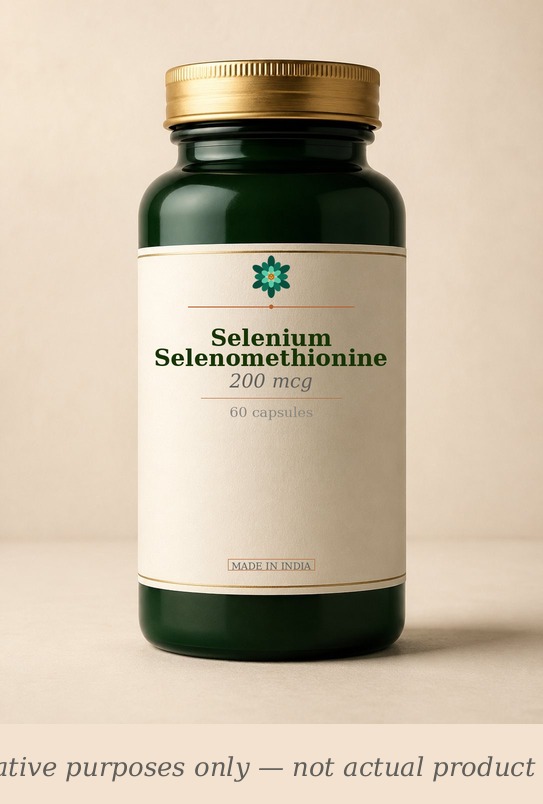
SacredBod's longer take on Selenium Selenomethionine — context the structured blocks above don't capture.
What It Is
Selenium Selenomethionine provides the organic, protein-bound form of selenium that the thyroid gland preferentially retains. The thyroid contains the highest concentration of selenium per gram of tissue of any organ in the body — a testament to its critical role in thyroid hormone synthesis, conversion and protection. Selenomethionine is incorporated directly into body proteins in place of methionine, giving it a longer biological half-life and superior bioavailability compared to inorganic sodium selenite.
How It Works
- Deiodinase cofactor — Selenium is an essential component of the three iodothyronine deiodinases (DIO1, DIO2, DIO3). DIO1 and DIO2 convert inactive T4 to active T3; DIO3 inactivates T4 to reverse T3. Without adequate selenium, peripheral T3 production falls even when T4 levels are normal.
- Antioxidant defence — During thyroid hormone synthesis, thyroid peroxidase (TPO) generates hydrogen peroxide (H2O2) as a substrate for iodination. Glutathione peroxidases (GPx1, GPx3, GPx4) — all selenoproteins — neutralise excess H2O2, preventing oxidative damage to thyrocytes that can trigger autoimmune responses.
- Immune modulation — Selenium supports regulatory T-cell activity and shifts cytokine balance away from pro-inflammatory Th1 responses. Clinical trials show 200 mcg/day selenomethionine significantly reduces TPO antibody titres in Hashimoto’s thyroiditis.
Who Benefits Most
- Hashimoto’s thyroiditis patients with elevated TPO or thyroglobulin antibodies.
- Subclinical hypothyroidism patients on the borderline of requiring levothyroxine.
- Levothyroxine users who still feel hypothyroid despite “normal” TSH — suggesting poor T4→T3 conversion.
- Individuals in selenium-deficient regions — parts of northeastern India, the Gangetic plain and areas with selenium-poor soil.
Dosage Guide
| Goal | Dose | Timing |
|---|
| Hashimoto’s / autoimmune thyroiditis | 200 mcg selenomethionine/day | Morning with protein-containing meal |
| Subclinical hypothyroidism | 100–200 mcg/day | As above |
| Maintenance / prevention | 100 mcg/day | As above |
Do not exceed 400 mcg/day from all sources (diet + supplements) to avoid selenosis. A protein-containing meal improves absorption and incorporation into body proteins.
Safety and Interactions
Selenium is extremely safe at 200 mcg/day. The only significant risk is chronic overdose (>900 mcg/day) causing selenosis — characterised by garlic breath, hair loss, neurological symptoms and GI distress. Selenomethionine may enhance T4→T3 conversion, so levothyroxine users should monitor TSH. Some chemotherapy protocols advise against high-dose selenium.
India-Specific Context
- Hindi/Sanskrit name: No classical equivalent; selenium was discovered in 1817 and is a trace element, not an herb.
- Local availability: Widely available on Amazon.in from Biotrex, HealthyHey and generic brands at ₹300–800 for 60–180 capsules. Look for “L-selenomethionine” or “selenomethionine” on the label — avoid sodium selenite if thyroid-specific benefits are the goal.
- Soil deficiency: Parts of India, particularly the northeastern states, Punjab, Haryana and the Indo-Gangetic plain, have selenium-deficient soils. Populations in these regions may have suboptimal selenium intake from grains and vegetables.
- Regulatory status: Not a Schedule H drug; sold as a dietary supplement. The Indian Council of Medical Research (ICMR) recommends 40 mcg/day for adults; therapeutic doses up to 200 mcg are considered safe.
- Dietary sources: Brazil nuts (1–2 nuts = ~100 mcg), seafood, eggs, sunflower seeds and wheat grown in selenium-rich soil.
Traditional Use in Indian Medicine
Selenium does not appear in classical Ayurvedic texts. However, the concept of Prana (vital energy) and Agni (metabolic fire) depends on micronutrient cofactors that were not named but were supplied through diverse, mineral-rich traditional diets. Modern Ayurvedic practitioners increasingly recognise selenium deficiency as a contributor to Agnimandya (diminished digestive fire) and Medoroga (metabolic disorder) in urban Indians eating refined, monoculture diets. Some integrative clinics now test serum selenium as part of comprehensive thyroid workups.