
SacredBod
0
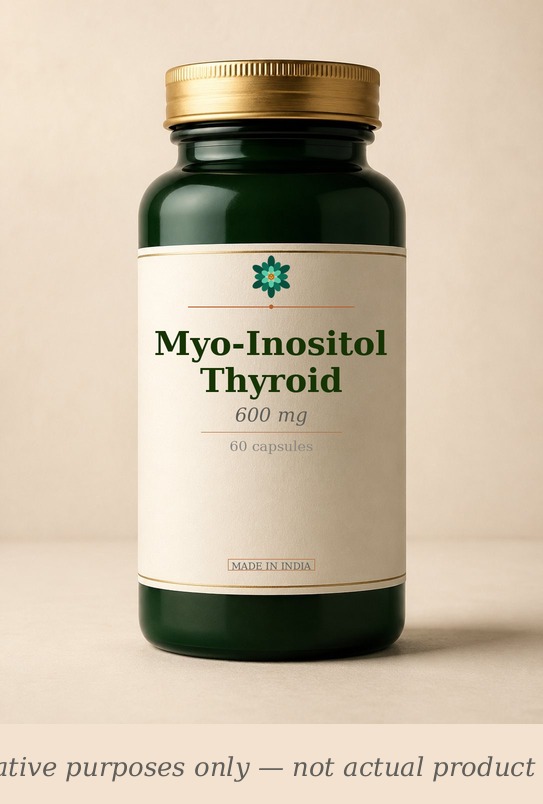
Myo-Inositol Thyroid — SacredBod supplement bottle (illustrative)
Supplement · Thyroid & Metabolic Rate

Myo-Inositol Thyroid

600 mg · vegan · gluten-free · 60 caps

Elevated TSHFatigueWeight gainGoitre or thyroid nodulesBrain fog ThyroidPituitary
BUY on Amazon →

Affiliate link · we earn from qualifying purchases. No paid placements.

What it is

Myo-inositol is a naturally occurring sugar alcohol that serves as a second messenger in TSH signalling pathways within thyroid follicular cells. When combined with selenium, it has been shown in Italian RCTs to reduce TSH and thyroid autoantibodies in Hashimoto's thyroiditis.

How it works

Myo-inositol enhances TSH receptor sensitivity via the IP3/Ca2+ second-messenger cascade, improving thyroid hormone synthesis. It also reduces oxidative stress in thyrocytes and, when combined with selenium, accelerates the return of TSH to physiological ranges and lowers TPO antibody titres.

Who should take it

Adults with subclinical hypothyroidism due to Hashimoto's thyroiditis, those with elevated TPO antibodies and normal or mildly elevated TSH, and individuals with benign thyroid nodules seeking adjunctive support.

Avoid / careful

Avoid if you have a known allergy to inositol products. Use caution in bipolar disorder as high-dose inositol may affect mood cycling. Side effects: Very well tolerated; rare mild gastrointestinal discomfort, nausea or diarrhoea at doses >12 g/day. At 600 mg/day, side effects are minimal.

When to take it

Morning
Noon
Evening
Night

How to take it

With food
Empty stomach
Before food

FAQs

Frequently asked

How long before I see results?
TSH reduction is typically measurable within 4–8 weeks. TPO antibody decline and nodule size reduction require 3–6 months of consistent daily use. In the Nordio 2017 RCT, TSH dropped from 4.32 to 3.12 mIU/L within 6 months.
Is it safe to take daily?
Yes. Myo-inositol at 600 mg/day is extremely safe. Doses up to 12 g/day are well tolerated in clinical studies. The 600 mg dose used in thyroid protocols is a small fraction of the tolerable upper range.
Can I take it with levothyroxine?
Yes, but monitor TSH every 6–8 weeks initially. Myo-inositol + selenium may improve endogenous thyroid output, potentially requiring a reduction in levothyroxine dose under medical guidance.

In plain English

A plain-English read of the literature behind this supplement. Not a clinical recommendation.

Key citations: PMID 32669509 (Pace 2020 — selenium + myo-inositol reduces TSH by 38 % in Hashimoto's at 6 months), PMID PMC12565457 (2025 narrative review of selenium and myo-inositol in thyroid disorders), PMID PMC4308793 (L-tyrosine improves neuroendocrine function in stressed mice — mechanistic parallel for second-messenger pathways)

Editorial notes

SacredBod's longer take on Myo-Inositol Thyroid — context the structured blocks above don't capture.

What It Is

Myo-Inositol Thyroid delivers the sugar-alcohol second messenger that sits at the heart of TSH receptor signalling. In thyroid follicular cells, TSH binds its receptor and activates the G-protein-coupled IP3/Ca2+ cascade — a pathway that depends on myo-inositol. Italian endocrinologists discovered that supplementing Hashimoto’s patients with myo-inositol (600 mg/day) plus selenium (83 µg/day) normalises TSH faster than selenium alone and reduces thyroid autoantibody titres. In India, myo-inositol is widely available for PCOS support; its thyroid application is an emerging, evidence-based indication.

How It Works

  1. TSH second-messenger enhancement — Myo-inositol is a precursor for inositol phosphates (IP3) that mediate TSH receptor intracellular signalling. In Hashimoto’s, chronic inflammation disrupts this cascade; myo-inositol replenishment restores TSH sensitivity.
  2. Oxidative stress reduction — Myo-inositol reduces hydrogen peroxide (H2O2) accumulation in thyrocytes. Since H2O2 is both required for iodination and toxic in excess, this dual action protects the gland from autoimmune-mediated oxidative damage.
  3. Selenium synergy — When combined with selenomethionine, myo-inositol accelerates the return of TSH to physiological ranges and enhances the selenium-dependent reduction of TPO antibodies. The combination is superior to either agent alone.

Who Benefits Most

  • Hashimoto’s thyroiditis patients with subclinical hypothyroidism (TSH 4–10 mIU/L, normal free T4).
  • Pregnant women with thyroid autoimmunity — the combination has been shown safe in pregnancy and prevents postpartum thyroiditis relapse.
  • Individuals with benign thyroid nodules — a cohort of 642 patients showed reduced nodule size, number and elasticity scores after 6 months of myo-inositol + selenium.

Dosage Guide

GoalDoseTiming
Hashimoto’s / subclinical hypothyroidism600 mg myo-inositol + 83 µg seleniumMorning with breakfast
Thyroid nodule support600 mg myo-inositol + 83 µg seleniumMorning with breakfast
PCOS + thyroid overlap2,000–4,000 mg myo-inositol + seleniumDivided doses

The thyroid-specific dose (600 mg) is much lower than the PCOS dose (2–4 g). Do not confuse the two protocols. Take with food to minimise any GI sensitivity.

Safety and Interactions

Myo-inositol is remarkably safe. The only notable interaction is with lithium — lithium depletes brain inositol as part of its therapeutic mechanism, so supplemental myo-inositol may theoretically reduce lithium efficacy. In thyroid patients on levothyroxine, monitor TSH as myo-inositol may improve endogenous hormone production.

India-Specific Context

  • Hindi/Sanskrit name: No classical equivalent; myo-inositol is a modern nutraceutical, though it occurs naturally in citrus fruits and legumes.
  • Local availability: Widely available on Amazon.in from NutriJa, Biotrex, HealthyHey and Carbamide Forte. Prices range ₹500–900 for 60–120 capsules. Most products are marketed for PCOS; thyroid users should verify purity and absence of hormonal additives.
  • Regulatory status: Not a Schedule H drug; sold as a dietary supplement and vitamin B8 analogue.
  • Clinical context: Indian endocrinologists are increasingly aware of the Italian myo-inositol + selenium protocol, though it is not yet standard of care. Some integrative practitioners in Mumbai and Delhi now recommend it as an adjunct.
  • Ayurvedic parallel: While no direct equivalent exists, the concept of Medhya Rasayana (nervous system rejuvenation) and Agni Deepana (metabolic stimulation) aligns with myo-inositol’s second-messenger and metabolic roles.

Traditional Use in Indian Medicine

Myo-inositol does not appear in classical Ayurvedic texts. However, the principle of using natural polyols and sugar derivatives for metabolic health is consistent with Ayurvedic Rasayana therapy. Modern Indian integrative medicine sometimes combines myo-inositol with classical preparations like Kanchanara Guggulu for comprehensive thyroid and metabolic support in PCOS-thyroid overlap patients.

Added to your stack.