
SacredBod
0
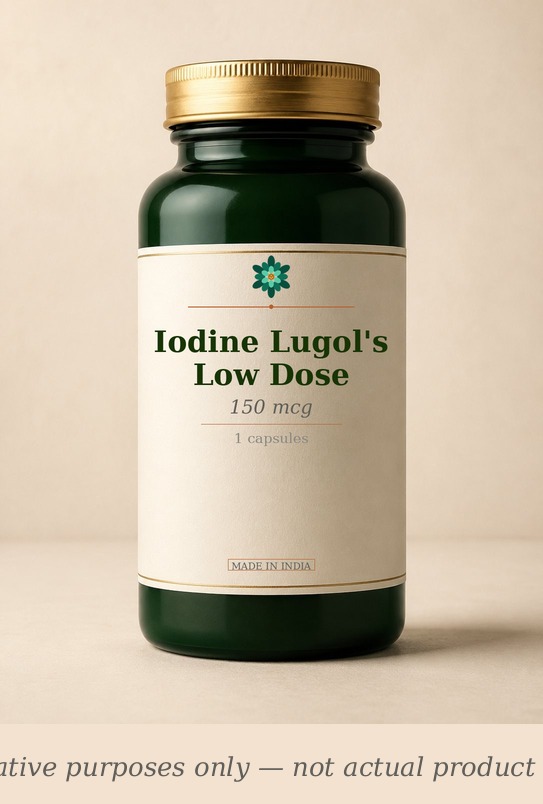
Iodine Lugol's Low Dose — SacredBod supplement bottle (illustrative)
Supplement · Thyroid & Metabolic Rate

Iodine Lugol's Low Dose

150 mcg · vegan · gluten-free · 1 caps

Subclinical hypothyroidism from iodine deficiencySimple goitreThyroid cystsFatigue in iodine-poor regionsBrain fog ThyroidBreast tissueBrain
BUY on Amazon →

Affiliate link · we earn from qualifying purchases. No paid placements.

What it is

Low-dose Lugol's solution provides a precise, physiological amount of iodine (150 mcg per drop) as molecular iodine and potassium iodide. It is designed for individuals with documented or suspected iodine deficiency — the most common preventable cause of hypothyroidism worldwide — without the risks of megadose iodine protocols.

How it works

Iodine is the structural backbone of thyroid hormones. Each T4 molecule contains 4 iodine atoms; each T3 contains 3. In deficiency, the thyroid cannot synthesise adequate hormone, TSH rises and the gland may enlarge (goitre). Physiological repletion (150 mcg/day) restores substrate availability for TPO-mediated organification and hormone synthesis.

Who should take it

Individuals with subclinical hypothyroidism due to iodine deficiency, those with simple goitre or thyroid cysts in iodine-poor regions, and pregnant women seeking to meet the 220 mcg/day iodine requirement. Not for Hashimoto's patients without medical supervision.

Avoid / careful

Avoid in active hyperthyroidism, uncontrolled Hashimoto's thyroiditis, thyroid autonomy (hot nodules) and during acute iodine excess. Use caution in pregnancy — dose should not exceed 220 mcg/day. Side effects: At 150 mcg/day, side effects are rare. Excess iodine (>500 mcg/day) can trigger Jod-Basedow hyperthyroidism or worsen Hashimoto's in susceptible individuals.

When to take it

Morning
Noon
Evening
Night

How to take it

With food
Empty stomach
Before food

FAQs

Frequently asked

How long before I see results?
In true iodine deficiency, TSH may normalise within 2–4 weeks of repletion. Goitre reduction takes 3–6 months. If autoimmunity is the primary driver, iodine alone will not help and may worsen antibody levels.
Is it safe to take daily?
At 150 mcg/day, yes — this is the WHO/ICMR recommended daily intake. The danger lies in megadose protocols (milligrams per day) popular in some alternative medicine circles. Stay within 150–220 mcg/day unless prescribed otherwise.
Can I take it with Hashimoto's?
Only under endocrinologist supervision. The Reinhardt 1998 study showed that 250 mcg/day caused thyroid dysfunction in 9 of 40 Hashimoto's patients. If you have Hashimoto's, test urinary iodine first; replete only if deficient and always pair with selenium.

In plain English

A plain-English read of the literature behind this supplement. Not a clinical recommendation.

Key citations: PMID 9703374 (Reinhardt 1998 — 250 mcg iodine in Hashimoto's: 9/40 developed thyroid dysfunction, caution required), PMID 2060151 (Chow 1991 — 500 mcg/day iodide caused small TSH rise in susceptible British women), PMID 41066039 (Di Cosmo 2026 — physiological iodine 50–150 mcg/day failed to improve non-autoimmune subclinical hypothyroidism in children, suggesting limited benefit when deficiency is not the cause)

Editorial notes

SacredBod's longer take on Iodine Lugol's Low Dose — context the structured blocks above don't capture.

What It Is

Iodine Lugol’s Low Dose delivers a precise 150 mcg of iodine per drop — the exact physiological amount the thyroid needs daily for hormone synthesis. Unlike the “iodine loading” or “high-dose iodine” protocols promoted in some alternative health circles (which use milligrams, not micrograms), this product follows WHO, ICMR and endocrinology society guidelines. In India, iodine deficiency was historically endemic — the universal salt iodisation (USI) program launched in 1962 dramatically reduced goitre rates, but pockets of deficiency persist in some states and among populations avoiding iodised salt.

How It Works

  1. Substrate for hormone synthesis — Thyroid peroxidase (TPO) uses iodide to iodinate tyrosine residues on thyroglobulin, forming monoiodotyrosine (MIT) and diiodotyrosine (DIT). Coupling of these residues creates T3 (1 MIT + 1 DIT) and T4 (2 DIT). Without adequate iodine, this assembly line slows.
  2. TSH normalisation — When iodine is deficient, the pituitary secretes more TSH to stimulate the struggling thyroid. Repletion removes this compensatory drive, lowering TSH.
  3. Goitre reduction — Chronic TSH stimulation causes thyroid hyperplasia and enlargement. With adequate iodine, TSH falls and the gland can regress over months.

Who Benefits Most

  • Individuals in iodine-poor regions — parts of northeastern India, tribal areas and regions where non-iodised rock salt is preferred.
  • Pregnant and breastfeeding women — requirements increase to 220–290 mcg/day; many Indian women do not meet this through diet alone.
  • Vegans avoiding iodised salt and seafood — the two main dietary iodine sources.
  • Those with simple (non-autoimmune) goitre or thyroid cysts — iodine repletion may reduce gland size.

Dosage Guide

PopulationDoseNotes
Adults (general)150 mcg/day (1 drop)With breakfast
Pregnant women220 mcg/day (~1.5 drops)Under obstetric guidance
Breastfeeding women290 mcg/day (~2 drops)Under medical supervision
Children90–120 mcg/dayPaediatric endocrinologist-guided

Use the dropper to place the dose in a glass of water or juice — do not take undiluted directly on the tongue as it can irritate mucous membranes. Store in a cool, dark place; iodine is light-sensitive.

Safety and Interactions

Physiological-dose iodine (150 mcg) is safe for virtually everyone except those with thyroid autonomy (hot nodules) or uncontrolled hyperthyroidism. The real danger is excess: doses >500 mcg/day can trigger the Jod-Basedow phenomenon (iodine-induced hyperthyroidism) or worsen Hashimoto’s by increasing H2O2-mediated oxidative stress. Always pair iodine with adequate selenium (200 mcg) to protect thyrocytes from peroxide damage.

India-Specific Context

  • Hindi/Sanskrit name: No classical equivalent; iodine was unknown in ancient India, though Saindhava Lavana (rock salt) from coastal regions naturally contained trace iodine.
  • Local availability: Lugol’s solution is available on Amazon.in from Bio Balance, Sankalp and generic sellers at ₹500–1,000 for 50–500 ml bottles. A 60 ml bottle at 150 mcg/drop provides ~400 doses — nearly 13 months of supply.
  • Regulatory status: Iodine is an essential nutrient, not a drug. Potassium iodide tablets are used in nuclear emergencies. Lugol’s solution is sold as a dietary supplement and laboratory reagent.
  • Public health context: India launched the National Iodine Deficiency Disorders Control Programme (NIDDCP) in 1962. Iodised salt coverage is now >90 %, but deficiency persists in pockets. The ICMR recommends 150 mcg/day for adults.
  • Caution for Hashimoto’s: The Reinhardt 1998 study (European Journal of Endocrinology) showed that even 250 mcg/day caused subclinical hypothyroidism in 7 of 40 Hashimoto’s patients. Indian endocrinologists generally advise caution with iodine supplementation in autoimmune thyroiditis.

Traditional Use in Indian Medicine

Iodine does not appear in classical Ayurvedic texts. However, the concept of Lavana (salt) as one of the six tastes (Shadrasa) and its role in Agni Deepana (kindling digestive fire) indirectly relates to iodine’s metabolic function. Coastal populations in India historically consumed Samudra Lavana (sea salt) rich in natural iodine, which likely protected them from goitre before the scientific discovery of iodine. Modern Ayurvedic practitioners may recommend iodine repletion alongside classical goitre formulas like Kanchanara Guggulu for integrated care.

Added to your stack.