
SacredBod
0
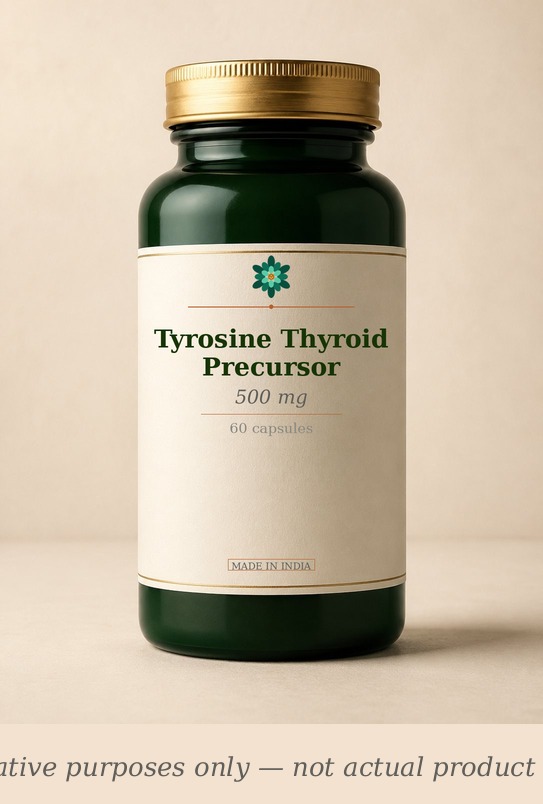
Tyrosine Thyroid Precursor — SacredBod supplement bottle (illustrative)
Supplement · Thyroid & Metabolic Rate

Tyrosine Thyroid Precursor

500 mg · vegan · gluten-free · 60 caps

FatigueBrain fogLow motivationCold intoleranceLow mood ThyroidAdrenal glandsBrain
BUY on Amazon →

Affiliate link · we earn from qualifying purchases. No paid placements.

What it is

L-Tyrosine is a conditionally essential amino acid that serves as the structural backbone of thyroid hormones. Within the thyroid follicle, TPO iodinates tyrosine residues on thyroglobulin to create monoiodotyrosine (MIT) and diiodotyrosine (DIT), which couple to form T3 and T4.

How it works

L-Tyrosine provides the substrate that thyroid peroxidase iodinates during hormone synthesis. It is also a precursor for dopamine, norepinephrine and epinephrine, supporting the adrenal axis and cognitive function often impaired in hypothyroidism. Supplementation may increase substrate availability when dietary protein intake is low.

Who should take it

Individuals with subclinical hypothyroidism, those on low-protein diets, vegetarians/vegans with marginal tyrosine intake and people experiencing hypothyroid-related brain fog and fatigue.

Avoid / careful

Avoid in hyperthyroidism, melanoma (tyrosine is a melanin precursor), phenylketonuria (PKU) and in those taking MAO inhibitors. Use caution in hypertension. Side effects: Generally well tolerated; rare mild headache, nausea or anxiety at doses >1,500 mg/day. May increase blood pressure in sensitive individuals due to catecholamine synthesis.

When to take it

Morning
Noon
Evening
Night

How to take it

With food
Empty stomach
Before food

FAQs

Frequently asked

How long before I see results?
Subjective improvements in energy, mental clarity and mood may appear within 2–4 weeks. Direct thyroid hormone changes are modest and require 2–3 months. L-tyrosine is best viewed as supportive substrate, not a primary hypothyroid treatment.
Is it safe to take daily?
Yes at 500–1000 mg/day. The body efficiently metabolises excess tyrosine. Avoid doses >2,000 mg/day unless medically supervised.
Can I take it with levothyroxine?
Yes, but space by at least 4 hours. Tyrosine may enhance endogenous hormone synthesis, potentially requiring levothyroxine dose adjustment. Monitor TSH every 6–8 weeks.

In plain English

A plain-English read of the literature behind this supplement. Not a clinical recommendation.

Key citations: PMID 18274206 (Palinkas 2007 — tyrosine vs T4/T3 in Antarctic residents: tyrosine improved mood and reduced TSH in winter), PMID 6428290 (Cooper 1984 — L-thyroxine therapy in subclinical hypothyroidism; contextualises the role of hormone precursors), PMID PMC4308793 (L-tyrosine improves neuroendocrine function and restores T3/T4 in chronically stressed mice)

Editorial notes

SacredBod's longer take on Tyrosine Thyroid Precursor — context the structured blocks above don't capture.

What It Is

Tyrosine Thyroid Precursor provides the conditionally essential amino acid that forms the structural backbone of every thyroid hormone molecule. T3 contains three iodine atoms attached to a tyrosine-derived backbone; T4 contains four. Without adequate tyrosine — and the iodine that attaches to it — the thyroid cannot manufacture hormone regardless of how healthy the gland is. In India, L-tyrosine supplements are widely available for cognitive and stress support; their role as a thyroid substrate is less recognised but biochemically fundamental.

How It Works

  1. Thyroglobulin iodination — Within thyroid follicular cells, the enzyme thyroid peroxidase (TPO) uses hydrogen peroxide to attach iodine atoms to tyrosine residues on the large glycoprotein thyroglobulin. This creates monoiodotyrosine (MIT) and diiodotyrosine (DIT).
  2. Hormone coupling — Two DIT molecules couple to form T4. One MIT and one DIT couple to form T3. These hormones are stored in colloid and released when TSH signals the follicular cell.
  3. Neurotransmitter support — Tyrosine is also the precursor for L-DOPA, dopamine, norepinephrine and epinephrine. Hypothyroid patients frequently experience depression, low motivation and brain fog; tyrosine supports the catecholamine systems that underlie these symptoms.

Who Benefits Most

  • Subclinical hypothyroid patients with low dietary protein intake.
  • Vegetarians and vegans who may have marginal tyrosine intake from plant sources.
  • Individuals with hypothyroid-related brain fog, fatigue and low mood.
  • Those seeking a foundational thyroid substrate alongside iodine, selenium and zinc.

Dosage Guide

GoalDoseTiming
Thyroid substrate support500 mg/dayMorning on empty stomach
Cognitive + thyroid support500–1000 mg/dayMorning on empty stomach
Stress-related low catecholamines1000–1500 mg/dayDivided doses

Take on an empty stomach for maximal absorption. If GI upset occurs, take with a small carbohydrate snack. Do not combine with protein-rich meals, as other amino acids compete for transport.

Safety and Interactions

L-tyrosine is safe at 500–1000 mg/day. The main concern is the theoretical hypertensive risk when combined with MAO inhibitors (due to catecholamine accumulation). Individuals with melanoma should avoid tyrosine supplementation as it is a melanin precursor. Those with PKU cannot metabolise tyrosine’s precursor phenylalanine and should not supplement.

India-Specific Context

  • Hindi/Sanskrit name: No classical equivalent; L-tyrosine is a modern isolated amino acid.
  • Local availability: Widely available on Amazon.in from Trexgenics (TyroBest-500), NOW Foods, NutriJa and Nutriosys at ₹500–1,300 for 60–120 capsules. Trexgenics explicitly markets their product for “thyroid, stress, neurotransmitter and brain function support.”
  • Regulatory status: Not a Schedule H drug; sold as a dietary supplement and amino acid.
  • Dietary sources: Cheese, soy products, chicken, turkey, fish, peanuts, almonds, avocados, bananas and pumpkin seeds. Indian vegetarian diets provide moderate tyrosine from dairy, legumes and nuts.
  • Clinical context: Indian endocrinologists rarely prescribe L-tyrosine for hypothyroidism, as levothyroxine is the established standard. However, integrative practitioners may recommend it as adjunctive support, particularly for patients with persistent fatigue and brain fog despite “normal” TSH on levothyroxine.
  • Ayurvedic parallel: While no direct equivalent exists, the concept of Medhya Rasayana (brain rejuvenation) and Balya (strength-promoting) herbs aligns with tyrosine’s dual role in thyroid and cognitive function. Classical practitioners might view tyrosine supplementation through the lens of Ojas (vital essence) restoration.

Traditional Use in Indian Medicine

L-tyrosine does not appear in classical Ayurvedic texts. However, the principle of using specific dietary constituents to support glandular function is embedded in Ayurvedic Pathya (dietary rules). Foods rich in tyrosine — dairy (Kshira), nuts (Shimbidhanya) and certain fruits (Phala) — have been recommended for Bala (strength) and Medha (intellect) for millennia. Modern supplementation simply concentrates this amino acid to therapeutic doses that may be difficult to achieve through diet alone, particularly for vegetarians with low protein intake.

Added to your stack.