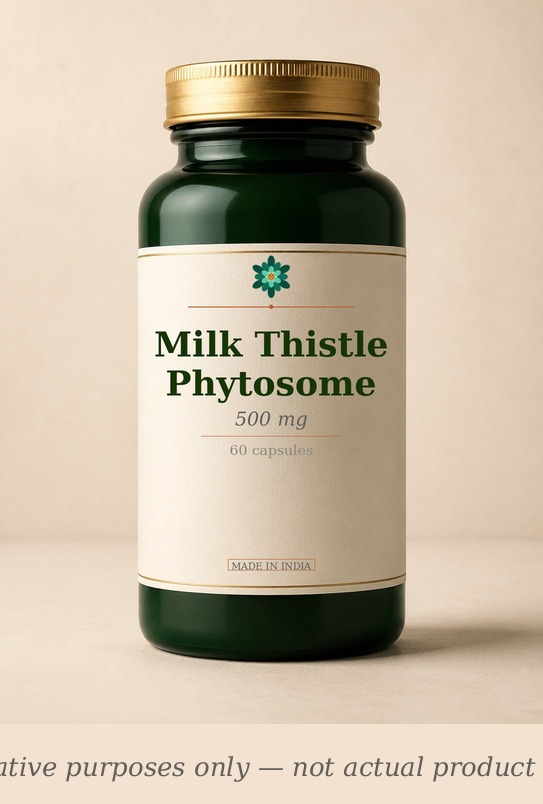
SacredBod's longer take on Milk Thistle Phytosome — context the structured blocks above don't capture.
What It Is
Milk Thistle Phytosome — commercially known as Siliphos® or IdB 1016 — is a patented molecular complex developed by Indena (Italy) in which silybin (the primary active flavonolignan of milk thistle) is bound to phosphatidylcholine in a 1:1 ratio. Standard silymarin extracts have poor oral bioavailability (<20–50% absorption) because silybin is highly lipophobic. The phytosome technology transforms silybin into a lipid-compatible complex that crosses intestinal membranes efficiently, achieving plasma levels 4–10 times higher than uncomplexed silymarin. In India, true Siliphos capsules are scarce; most products are standard silymarin (e.g., Carbamide Forte, HealthVit) or imported silybin-phytosome complexes like Enzymatic Therapy Silybin Advanced.
How It Works
Silybin is a potent free-radical scavenger, iron chelator, and membrane stabiliser. It inhibits NF-κB activation, reduces Kupffer cell-mediated inflammation, and stimulates ribosomal RNA polymerase I — promoting hepatocyte protein synthesis and regeneration. The phytosome complex ensures these mechanisms operate at clinically relevant tissue concentrations. In a landmark pharmacokinetic study, 9 healthy volunteers receiving IdB 1016 (360 mg silybin equivalent) showed plasma silybin levels consistently higher than those receiving equivalent doses of standard silymarin at all time points. A pilot RCT in 20 patients with chronic active hepatitis demonstrated that 240 mg silybin b.i.d. (as IdB 1016) significantly reduced AST (−25%), ALT (−29%), GGT (−20%) and total bilirubin (−30%) within just 7 days.
Who Benefits Most
Adults with NAFLD/NASH, chronic viral or alcoholic hepatitis, cirrhosis, or those on hepatotoxic medications (e.g., statins, acetaminophen, anti-tubercular drugs) seeking superior liver protection. It is particularly valuable when standard silymarin has produced insufficient results. Not a substitute for antiviral therapy in hepatitis B/C.
Dosage Guide
- Phytosome capsules: 500 mg once or twice daily with meals (providing ~160–180 mg silybin)
- Standardised silymarin fallback: 400–600 mg daily if phytosome unavailable
- Cycle: Continuous daily use is safe and recommended
Safety and Interactions
Extremely well tolerated. At very high doses (15–20 g/day), mild asymptomatic hyperbilirubinaemia may occur due to UGT1A1 inhibition — this resolves upon cessation. Theoretical interactions with warfarin and CYP2C9 substrates exist but are not clinically significant at standard doses.
India-Specific Context
True Siliphos is not manufactured in India and is available only as imports (Thorne Research, Enzymatic Therapy) at premium prices (₹2,500–₹5,000 for 60–90 capsules). The domestic market is dominated by standard silymarin 400 mg capsules from Carbamide Forte, HealthVit and Himalaya (₹300–₹600). Milk thistle is cultivated in Kashmir but most commercial extract is imported. It is not a scheduled drug. For Indian consumers unable to source phytosome, high-dose standard silymarin (600 mg/day) combined with Picrorhiza kurroa (Kutki) offers a domestic alternative with comparable traditional hepatoprotective credentials.