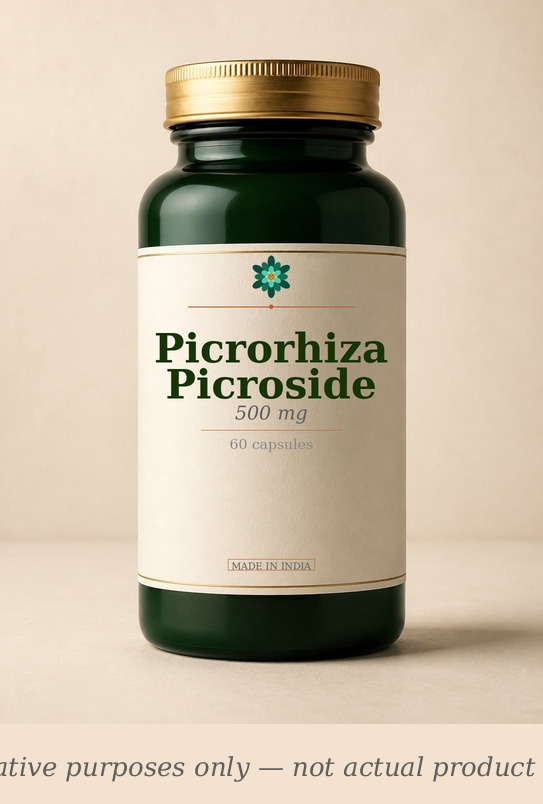
SacredBod's longer take on Picrorhiza Picroside — context the structured blocks above don't capture.
What It Is
Picrorhiza kurroa Royle ex Benth. — known as Kutki (Sanskrit/Hindi), Katuki or Kutaki — is a small perennial herb native to the Himalayan alpine regions of India, Nepal and Tibet. It has been a premier hepatoprotective and bitter tonic (tikta rasa) in Ayurveda for over 3,000 years, appearing in classical texts like the Charaka Samhita and Sushruta Samhita for jaundice (kamala), liver disorders (yakrit roga) and fever. The rhizome contains picroside I and II (collectively called kutkin or picroliv), iridoid glycosides that are the primary active constituents. In India, Kutki is widely cultivated in Himachal Pradesh and Uttarakhand and is a staple of domestic Ayurvedic brands like Bharat Natural, Morsan Nutraveda, Satya Naturals and Vedik-Ayurveda.
How It Works
Picrosides exert hepatoprotection through multiple pathways: (1) free-radical scavenging and lipid peroxidation inhibition, (2) hepatocyte membrane stabilisation, (3) choleretic (bile-stimulating) action that promotes detoxification, and (4) anti-inflammatory cytokine modulation. A landmark 1996 double-blind trial at KEM Hospital, Mumbai, randomised 33 patients with acute viral hepatitis (HBsAg negative) to receive either Kutki root powder 375 mg TDS or placebo for 2 weeks. The Kutki group showed significantly faster bilirubin normalisation (27.4 days vs 75.9 days), and greater reductions in SGOT and SGPT. A 2023 study isolated picroside II as a key hepatoprotective principle against D-galactosamine/LPS-induced liver injury in mice. In an NAFLD animal model, a standardised P. kurroa extract demonstrated hepatoprotective effects comparable to silymarin.
Who Benefits Most
Adults with acute or chronic viral hepatitis, NAFLD, drug-induced liver injury, or cholestatic conditions with jaundice. It is the domestic Indian equivalent of milk thistle and is often preferred by Ayurvedic practitioners for pitta-dominant liver heat and bile stasis.
Dosage Guide
- Standardised extract capsules/tablets: 500 mg once or twice daily with meals
- Traditional Ayurvedic dose: 0.5–1 g root powder with honey or ghee
- Cycle: Continuous daily use is safe and traditional
Safety and Interactions
Extremely well tolerated. Mild laxative effect may occur due to its bitter, purgative nature (rechana property in Ayurveda). Contraindicated in bile duct obstruction and during pregnancy. Use cautiously with immunosuppressants.
India-Specific Context
Kutki is one of India’s most important indigenous hepatoprotective herbs. On Amazon.in, it is abundantly available as capsules and tablets from domestic Ayurvedic brands priced ₹300–₹800 for 60–180 count. It is not a Schedule H drug. In Ayurveda, its tikta (bitter) rasa, laghu (light) and ruksha (dry) guna, and katuvipaka make it ideal for kapha and pitta liver disorders, though it may aggravate vata in excess. It is a key ingredient in classical formulations like Arogyavardhini Vati and Katukyadi churna.