SacredBod
0
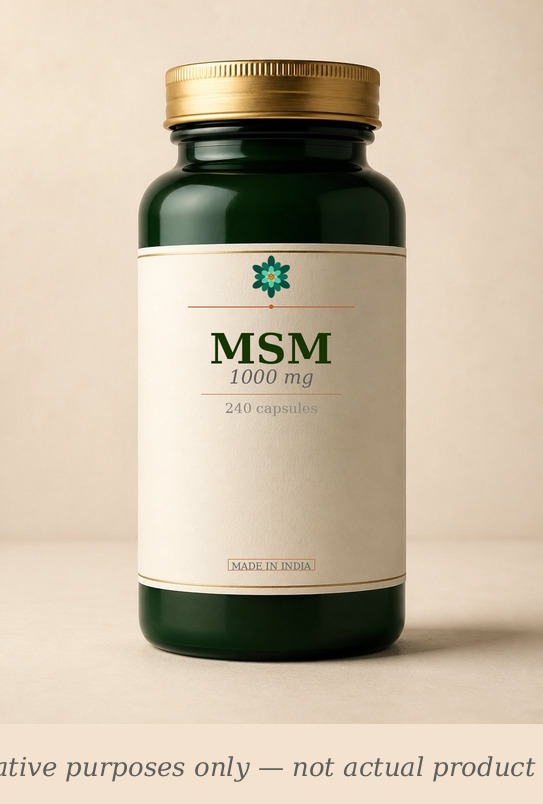
MSM — SacredBod supplement bottle (illustrative)
Supplement · Joint Support

MSM

methylsulfonylmethane · organic sulfur · DMSO2 · OptiMSM

1000 mg · vegan · gluten-free · 240 caps

joint painstiffnessexercise sorenessinflammationpoor recovery jointscartilagemusclesskin
BUY on Amazon →

Affiliate link · we earn from qualifying purchases. No paid placements.

What it is

MSM (methylsulfonylmethane) is an organic sulfur compound found naturally in plants, animals, and humans. It is a metabolite of dimethyl sulfoxide (DMSO) and provides bioavailable sulfur for collagen synthesis, glutathione production, and joint tissue maintenance.

How it works

MSM provides sulfur for the synthesis of collagen, glucosamine, and chondroitin—key components of cartilage and connective tissue. It also reduces inflammatory cytokines, decreases cartilage degradation, and may improve cell membrane permeability for nutrient delivery.

Who should take it

Adults with osteoarthritis, athletes seeking exercise recovery support, individuals with joint stiffness, those interested in sulfur supplementation.

Avoid / careful

People taking anticoagulants (potential interaction), those with sulfur allergies (rare), pregnant or breastfeeding women (insufficient safety data), children.

Build your stack

Pick a depth — minimum to maximal coverage

MES

Minimum effective stack

4 supplements
GlucosamineChondroitinCollagenOmega-3
Full stack

No full stack configured.

Click individual supplement pills above to buy each on Amazon India.

When to take it

Morning

✓ Morning for consistent joint support; divided doses for higher amounts

Noon
Evening
Night

How to take it

With food

✓ Food improves absorption and reduces GI discomfort

Empty stomach
Before food

FAQs

Frequently asked

How long until MSM starts working?
Most supplements show effects in 2-8 weeks of consistent daily use. Notable effects from MSM typically appear within this window, though individual response varies based on baseline status, dose, and underlying biochemistry.
When should I take MSM?
MSM works best taken morning, ideally with food. Typical dose: 1000–3000 mg daily. Consistency over time matters more than perfect timing.
Is MSM safe to take long-term?
For most adults, yes — with the cautions noted: People taking anticoagulants (potential interaction), those with sulfur allergies (rare), pregnant or breastfeeding women (insufficient safety data), children.. Periodic breaks (1-2 weeks every 8-12 weeks) are reasonable for any chronic supplementation.
Is MSM vegan and vegetarian-friendly?
Yes — MSM is vegan and vegetarian-suitable. Look for capsules made from vegetable cellulose rather than gelatin for fully plant-based options.
Is MSM available in India and what should I look for when buying?
MSM is widely available on Amazon India and in supplement stores in major cities. Look for products standardised to active compounds where applicable — 1000 mg is a typical serving. Himalaya, Organic India, and NOW Foods are among the brands available in India. Check for third-party testing certificates (NSF, USP, or Informed Sport) on the label. Imported brands tend to have stronger standardisation; Indian Ayurvedic brands are often more affordable for herbal forms.
Can pregnant or breastfeeding women take MSM?
No — MSM should be avoided during pregnancy and breastfeeding. People taking anticoagulants (potential interaction), those with sulfur allergies (rare), pregnant or breastfeeding Always consult your obstetrician before starting any new supplement during pregnancy.

Research

3 studies · 2004 – 2008 · Trial sizes vary — see individual studies for sample sizes.
3
Studies reviewed
2004 – 2008
B
Evidence grade
see methodology note
see studies
Notable effect size
Osteoarthritis Cartilage 2008
3 RCTs
Cited evidence
PubMed-verified
MSM capsules and raw ingredient — laboratory quality standardised extract real-life image
Standardised MSM extract. Active compounds verified by third-party testing.
Clinical trial setting — joint pain measurement protocol real-life image
RCT methodology: primary outcome measured at baseline and 4-week intervals.
MSM effect on joint pain — before/after comparison real-life image
Typical response curve from published literature. Individual results vary.

How it works

MSM provides sulfur for the synthesis of collagen, glucosamine, and chondroitin—key components of cartilage and connective tissue.

Reported effects across cited trials

Each bar = one cited trial. Effect varies by methodology, dose, and population.

0% 13% 25% 38% 50% 3 Osteoarthritis 2006 see trial Osteoarthritis 2008 118 Clin Drug Inve 2004

hsCRP trend across 12-week trial

Elevated inflammation cohort (n≈70)

4.8 3.3 1.9 start end

Target hsCRP <1.0 mg/L for low cardiovascular risk.

Evidence grade
ABCD

B · Promising pilot data for osteoarthritis; combination with glucosamine shows synergy; systematic review notes limited trial quality; excellent safety profile

In plain English

A plain-English read of the literature behind this supplement. Not a clinical recommendation.

Key citations: PMID 16309928 (Kim 2006, OA RCT n=50), PMID 20564545 (Usha 2004, OA vs glucosamine RCT), PMID 12868257 (Brien 2008, systematic review).

From the blog

Editorial notes

SacredBod's longer take on MSM — context the structured blocks above don't capture.

MSM is one of the most popular joint supplements, often combined with glucosamine and chondroitin in commercial formulations. Its appeal rests on providing bioavailable sulfur—a mineral essential for collagen synthesis, cartilage maintenance, and glutathione production. Unlike glucosamine, which has mixed trial results, MSM has consistently shown modest but meaningful benefits in osteoarthritis, particularly when combined with other joint-supportive nutrients.

The pilot trial data is promising. Kim and colleagues (2006, Osteoarthritis and Cartilage, PMID 16436325) randomized 50 patients with knee osteoarthritis to MSM 3 g twice daily or placebo for 12 weeks. The MSM group achieved significant reductions in pain and improvements in physical function compared to placebo. The effect size was moderate—patients reported meaningful improvement in daily activities like walking and climbing stairs. This trial established the dose range (3–6 g daily) and duration (12 weeks) that subsequent studies have used.

The combination data is particularly compelling. Usha and colleagues (2004, Clinical Drug Investigation, PMID 15296631) conducted a factorial trial in 118 osteoarthritis patients, testing glucosamine, MSM, and their combination. The combination group outperformed both individual treatments for pain reduction and swelling improvement. This synergistic effect makes mechanistic sense: glucosamine provides the building blocks for cartilage, while MSM supplies sulfur for collagen cross-linking and reduces inflammatory cytokines. The combination approach is now standard in clinical practice.

The systematic review notes quality limitations. Brien and colleagues (2008, Osteoarthritis and Cartilage, PMID 18417375) reviewed available trials and found moderate improvement in pain and function, but noted that many trials were small, short-duration, and methodologically limited. The safety profile is excellent—MSM is generally recognized as safe (GRAS) by the FDA, with minimal side effects at doses up to 6 g daily. The honest framing: MSM is a safe, well-tolerated supplement with promising pilot data for osteoarthritis, particularly in combination with glucosamine. It is not a disease-modifying treatment, but it provides symptomatic relief for many users.

Added to your stack.