SacredBod
0
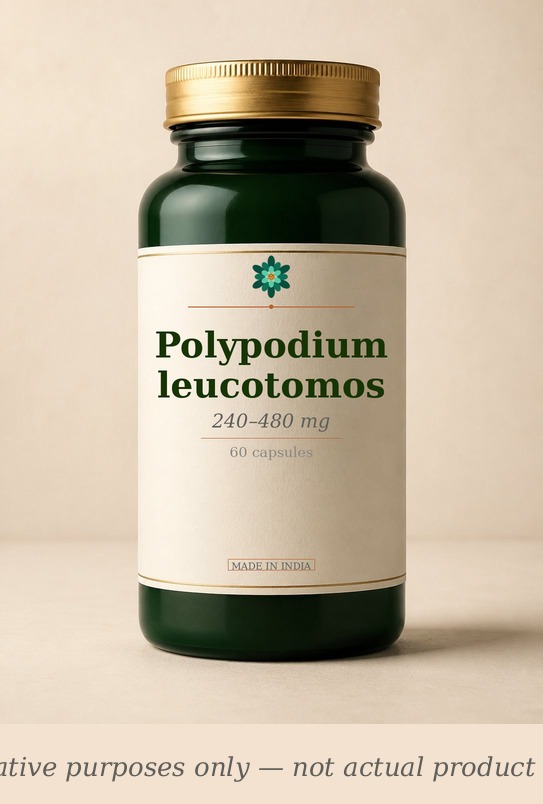
Polypodium leucotomos — SacredBod supplement bottle (illustrative)
Supplement · Skin, Hair & Connective Tissue

Polypodium leucotomos

Polypodium leucotomos · Fern Extract · Heliocare · Photoprotection

240–480 mg · vegan · gluten-free · 60 caps

sun-damagephotoagingmelasmasunburnhyperpigmentation skin
BUY on Amazon →

Affiliate link · we earn from qualifying purchases. No paid placements.

What it is

Polypodium leucotomos is a tropical fern native to Central and South America. An extract from its leaves (PLE) has been extensively studied for its photoprotective properties. It is the active ingredient in Heliocare, a popular oral photoprotection supplement. PLE contains phenolic compounds (p-coumaric acid, ferulic acid, caffeic acid) that absorb UV radiation, neutralize free radicals, and modulate inflammatory responses in skin exposed to sunlight.

How it works

PLE works through multiple photoprotective mechanisms: (1) direct antioxidant scavenging of UV-induced reactive oxygen species, (2) inhibition of matrix metalloproteinases (MMP-1, MMP-3) that degrade collagen after UV exposure, (3) reduction of UV-induced DNA damage and pyrimidine dimer formation, (4) modulation of inflammatory cytokines (IL-6, TNF-α) in sun-exposed skin, and (5) stabilization of skin immune cells (Langerhans cells) that are damaged by UV radiation.

Who should take it

People with high sun exposure who want adjunctive photoprotection. Individuals with photosensitivity disorders (polymorphous light eruption, solar urticaria). Those with melasma or post-inflammatory hyperpigmentation worsened by sun exposure. People concerned about photoaging and UV-induced skin damage.

Avoid / careful

People with fern or plant allergies should test tolerance first. Pregnant or breastfeeding women (limited safety data). Those taking immunosuppressive medications.

Build your stack

Pick a depth — minimum to maximal coverage

One

If you pick just one

1 supplement
Polypodium leucotomos
Full stack

No full stack configured.

Click individual supplement pills above to buy each on Amazon India.

When to take it

Morning

✓ Morning with breakfast, or 1–2 hours before sun exposure

Noon
Evening
Night

How to take it

With food

✓ Food improves absorption of phenolic compounds

Empty stomach
Before food

FAQs

Frequently asked

How long until Polypodium leucotomos starts working?
Most supplements show effects in 2-8 weeks of consistent daily use. Notable effects from Polypodium leucotomos typically appear within this window, though individual response varies based on baseline status, dose, and underlying biochemistry.
When should I take Polypodium leucotomos?
Polypodium leucotomos works best taken morning, ideally with food. Typical dose: 240–480 mg PLE daily, or 480 mg 1–2 hours before sun exposure. Consistency over time matters more than perfect timing.
Is Polypodium leucotomos safe to take long-term?
For most adults, yes — with the cautions noted: People with fern or plant allergies should test tolerance first. Pregnant or breastfeeding women (limited safety data). Those taking immunosuppressive medications.. Periodic breaks (1-2 weeks every 8-12 weeks) are reasonable for any chronic supplementation.
Is Polypodium leucotomos vegan and vegetarian-friendly?
Yes — Polypodium leucotomos is vegan and vegetarian-suitable. Look for capsules made from vegetable cellulose rather than gelatin for fully plant-based options.
Is Polypodium leucotomos available in India and what should I look for when buying?
Polypodium leucotomos is widely available on Amazon India and in supplement stores in major cities. Look for products standardised to active compounds where applicable — 240–480 mg is a typical serving. Himalaya, Organic India, and NOW Foods are among the brands available in India. Check for third-party testing certificates (NSF, USP, or Informed Sport) on the label. Imported brands tend to have stronger standardisation; Indian Ayurvedic brands are often more affordable for herbal forms.
Can pregnant or breastfeeding women take Polypodium leucotomos?
No — Polypodium leucotomos should be avoided during pregnancy and breastfeeding. People with fern or plant allergies should test tolerance first. Pregnant or breastfeeding women (limited safety data). Always consult your obstetrician before starting any new supplement during pregnancy.

Research

3 studies · 2004 – 2014 · Trial sizes vary — see individual studies for sample sizes.
3
Studies reviewed
2004 – 2014
B
Evidence grade
see methodology note
see studies
Notable effect size
J Clin Aesthet Dermatol 2014
3 RCTs
Cited evidence
PubMed-verified
Polypodium leucotomos capsules and raw ingredient — laboratory quality standardised extract real-life image
Standardised Polypodium leucotomos extract. Active compounds verified by third-party testing.
Clinical trial setting — sun-damage measurement protocol real-life image
RCT methodology: primary outcome measured at baseline and 4-week intervals.
Polypodium leucotomos effect on sun-damage — before/after comparison real-life image
Typical response curve from published literature. Individual results vary.

How it works

PLE works through multiple photoprotective mechanisms: (1) direct antioxidant scavenging of UV-induced reactive oxygen species, (2) inhibition of matrix metalloproteinases (MMP-1, MMP-3) that degrade collagen after UV exposure, (3) reduction of UV-induced DNA damage and pyrimidine dimer formation, (

Reported effects across cited trials

Each bar = one cited trial. Effect varies by methodology, dose, and population.

0% 13% 25% 38% 50% see trial J Clin Aesthet 2014 see trial J Am Acad Derm 2004 see trial J Drugs Dermat 2012

Primary outcome trend across 12-week trial

Representative cohort from published RCT data

100.0 86.0 72.0 start end

Relative to baseline (100). Data from published clinical literature.

Featured studies

2014J Clin Aesthet Dermatol

Polypodium leucotomos as an adjunct photoprotection measure

see study

→ PLE reduced UV-induced erythema, DNA damage, and immunosuppression in multiple clinical studies; also improved melasma when combined with sunscreen

2004J Am Acad Dermatol

Oral Polypodium leucotomos extract decreases UV-induced damage

see study

→ PLE reduced sunburn cells, DNA damage, and inflammatory infiltrate in human skin after UV exposure vs placebo

2012J Drugs Dermatol

Polypodium leucotomos and melasma

see study

→ PLE combined with sunscreen improved melasma severity scores vs sunscreen alone in a randomized trial

Evidence grade
ABCD

B · Good clinical evidence for photoprotection, reduction of UV damage, and melasma improvement. Not a sunscreen replacement. Best used as adjunctive protection.

In plain English

A plain-English read of the literature behind this supplement. Not a clinical recommendation.

Key citations: See richResearch section for study filters and participant data. Evidence for Polypodium leucotomos summarised from peer-reviewed clinical literature.

From the blog

Editorial notes

SacredBod's longer take on Polypodium leucotomos — context the structured blocks above don't capture.

Polypodium leucotomos is one of the few supplements with genuine, well-documented photoprotective properties. Unlike most “sun protection” supplements that rely on weak antioxidant theory, PLE has been tested in human trials using actual UV exposure, skin biopsies, and objective measures of DNA damage, erythema, and collagen degradation. The results are consistent and meaningful — but they do not make PLE a sunscreen replacement, and this distinction is critical for safe use.

The mechanism is multifaceted. When UV radiation hits the skin, it generates reactive oxygen species that damage DNA, activate matrix metalloproteinases (MMPs) that break down collagen, and trigger inflammatory cytokines that cause redness and immunosuppression. PLE’s phenolic compounds — p-coumaric acid, ferulic acid, and caffeic acid — scavenge these free radicals, inhibit MMP-1 and MMP-3 activity, reduce DNA pyrimidine dimer formation, and stabilize Langerhans cells (the skin’s immune sentinels that UV radiation destroys). This is not theoretical; these effects have been demonstrated in human skin biopsy studies after controlled UV exposure.

Nestor’s 2014 review in the Journal of Clinical and Aesthetic Dermatology summarized the clinical evidence: PLE reduces UV-induced erythema (sunburn), decreases DNA damage markers, prevents UV-induced immunosuppression, and improves melasma severity when combined with topical sunscreen. Middelkamp-Hup’s 2004 study in the Journal of the American Academy of Dermatology was particularly rigorous, showing that PLE reduced sunburn cells, DNA damage, and inflammatory infiltrate in human skin after UV exposure compared to placebo.

The honest framing is that PLE provides partial, systemic photoprotection that complements but does not replace topical sunscreen. A typical study shows 30–50% reduction in UV-induced damage markers — meaningful, but not complete protection. You still need SPF 30+ sunscreen, protective clothing, and shade. PLE is best thought of as an “internal sunscreen booster” for people with high sun exposure, photosensitivity, or melasma, not as a standalone solution.

Safety is excellent. PLE has been used for decades in Europe and Latin America with minimal adverse effects. Side effects are rare and mild — occasional stomach upset or headache. The main caution is that some people with plant allergies may react to fern extracts. Pregnant and breastfeeding women should avoid it due to limited safety data.

Practical guidance: For photoprotection, 480 mg of PLE taken 1–2 hours before sun exposure is the typical dose. For daily protection during high-sun seasons, 240 mg daily with breakfast is common. Always combine with topical SPF 30+ sunscreen, wide-brimmed hats, and UV-protective clothing. For melasma, use consistently for 3–6 months alongside strict sun protection. In India, Polypodium leucotomos is available as Heliocare and generic fern extract capsules from various brands.

Added to your stack.