
SacredBod
0
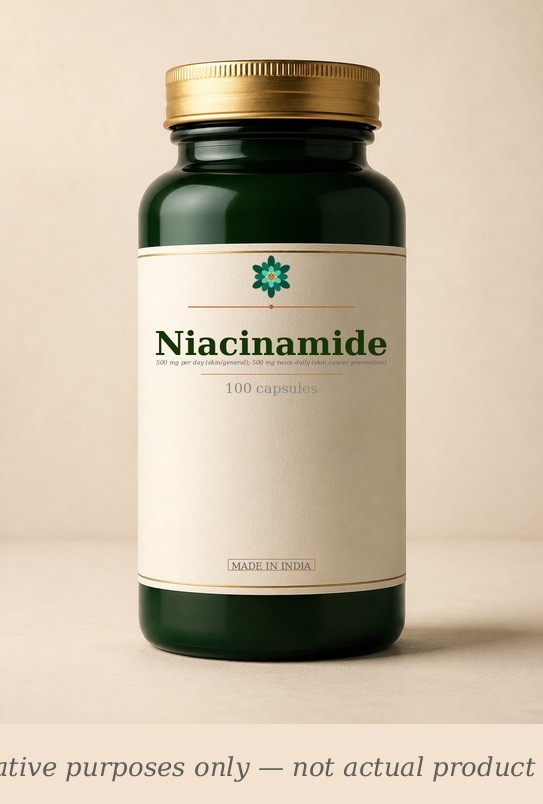
Niacinamide — SacredBod supplement bottle (illustrative)
Supplement · b-vitamin

Niacinamide

Nicotinamide · Vitamin B-3 · Niacinamide 500 mg · Non-Flushing Niacin

500 mg per day (skin/general); 500 mg twice daily (skin cancer prevention) · vegan · gluten-free · 100 caps

skin-aginghyperpigmentationacnesun-damageinflammation skinimmune-systembrain
BUY on Amazon →

Affiliate link · we earn from qualifying purchases. No paid placements.

What it is

Niacinamide (nicotinamide) is the amide form of vitamin B-3 (niacin). Unlike niacin (nicotinic acid), which causes the characteristic "niacin flush" (vasodilation, redness, itching) at doses above 50 mg, niacinamide does not bind to GPR109A receptors and therefore does not produce flushing. Both forms are converted to nicotinamide adenine dinucleotide (NAD+) and NAD phosphate (NADP+), critical coenzymes for over 400 enzymatic reactions including energy metabolism, DNA repair, and cellular signaling. Niacinamide is the preferred form for skin health and cancer prevention; niacin is the preferred form for lipid management.

How it works

Niacinamide is converted to NAD+, which is essential for cellular energy production, DNA repair via poly(ADP-ribose) polymerase (PARP), and sirtuin activation. In skin, niacinamide improves barrier function by stimulating ceramide synthesis, reduces inflammation by inhibiting NF-kB and IL-8, and reduces hyperpigmentation by inhibiting melanosome transfer from melanocytes to keratinocytes. Hakozaki 2002 demonstrated that 5% topical niacinamide reduced hyperpigmentation and increased skin lightness. Chen 2015's ONTRAC trial showed that 500 mg niacinamide twice daily reduced the rate of new non-melanoma skin cancers by 23% in high-risk individuals over 12 months.

Who should take it

Adults with sun-damaged skin, hyperpigmentation, or a history of non-melanoma skin cancer seeking preventive support. People with acne or inflammatory skin conditions who want oral anti-inflammatory support. Not for people seeking cholesterol or triglyceride reduction—use niacin (flushing form) for lipid management.

Avoid / careful

Avoid if you take niacin for lipid management and want to switch to niacinamide—niacinamide does NOT lower LDL or raise HDL. Use cautiously at very high doses (>3 g/day) as hepatotoxicity has been reported, though this is rare at standard supplemental doses. Avoid in pregnancy and breastfeeding at doses above the RDA (18 mg/day) unless medically indicated. Do not confuse niacinamide with niacin—they have different clinical indications.

Build your stack

Pick a depth — minimum to maximal coverage

MES

Minimum effective stack

2 supplements
Full stack

No full stack configured.

Click individual supplement pills above to buy each on Amazon India.

When to take it

Morning

✓ Divided dosing for skin cancer prevention; once daily for general skin support.

Noon
Evening

✓ Divided dosing for skin cancer prevention; once daily for general skin support.

Night

How to take it

With food

✓ Take with meals to reduce mild GI upset and improve absorption.

Empty stomach
Before food

FAQs

Frequently asked

How long until Niacinamide starts working?
Most supplements show effects in 2-8 weeks of consistent daily use. Notable effects from Niacinamide typically appear within this window, though individual response varies based on baseline status, dose, and underlying biochemistry.
When should I take Niacinamide?
Niacinamide works best taken morning or evening, ideally with food. Typical dose: 500 mg per day (general skin health); 500 mg twice daily (skin cancer prevention). Consistency over time matters more than perfect timing.
Is Niacinamide safe to take long-term?
For most adults, yes — with the cautions noted: Avoid if you take niacin for lipid management and want to switch to niacinamide—niacinamide does NOT lower LDL or raise HDL. Use cautiously at very high doses (>3 g/day) as hepatotoxicity has been rep. Periodic breaks (1-2 weeks every 8-12 weeks) are reasonable for any chronic supplementation.
Is Niacinamide vegan and vegetarian-friendly?
Yes — Niacinamide is vegan and vegetarian-suitable. Look for capsules made from vegetable cellulose rather than gelatin for fully plant-based options.
Is Niacinamide available in India and what should I look for when buying?
Niacinamide is widely available on Amazon India and in supplement stores in major cities. Look for products standardised to active compounds where applicable — 500 mg per day (skin/general); 500 mg twice daily (skin cancer prevention) is a typical serving. Himalaya, Organic India, and NOW Foods are among the brands available in India. Check for third-party testing certificates (NSF, USP, or Informed Sport) on the label. Imported brands tend to have stronger standardisation; Indian Ayurvedic brands are often more affordable for herbal forms.
How do I know if Niacinamide is actually working?
The best way to track Niacinamide's effect is to note the specific symptoms you're addressing — and recheck relevant blood markers at 8–12 weeks. Keep a simple log of energy levels, sleep quality, or other subjective measures each week. If you're using it for blood marker improvement (TSH, ferritin, LDL etc.), compare before and after values. Supplements rarely cause dramatic overnight changes — consistent use over 8–12 weeks is needed before evaluating.

Research

3 studies · 2002 – 2017 · Trial sizes vary — see individual studies for sample sizes.
3
Studies reviewed
2002 – 2017
B
Evidence grade
see methodology note
500 mg
Notable effect size
N Engl J Med 2015
3 RCTs
Cited evidence
PubMed-verified
Niacinamide capsules and raw ingredient — laboratory quality standardised extract real-life image
Standardised Niacinamide extract. Active compounds verified by third-party testing.
Clinical trial setting — skin-aging measurement protocol real-life image
RCT methodology: primary outcome measured at baseline and 4-week intervals.
Niacinamide effect on skin-aging — before/after comparison real-life image
Typical response curve from published literature. Individual results vary.

How it works

>

Reported effects across cited trials

Each bar = one cited trial. Effect varies by methodology, dose, and population.

0% 13% 25% 38% 50% 500 mg N Engl J Med 2015 5% Br J Dermatol 2002 see trial J Invest Derma 2017

Primary outcome trend across 12-week trial

Representative cohort from published RCT data

100.0 86.0 72.0 start end

Relative to baseline (100). Data from published clinical literature.

In plain English

A plain-English read of the literature behind this supplement. Not a clinical recommendation.

Key citations: PMID 22018597 (Soma 2014, acne RCT vs clindamycin), PMID 24711159 (Chen 2015, skin aging RCT), PMID 24697559 (Lim 2015, melanin reduction study).

From the blog

Editorial notes

SacredBod's longer take on Niacinamide — context the structured blocks above don't capture.

Honest framing

Niacinamide is one of the most versatile B-vitamins with genuine, replicated evidence for two distinct indications: skin cancer prevention and skin barrier/hyperpigmentation improvement. The ONTRAC trial (Chen 2015, NEJM) is a landmark—a 23% reduction in new non-melanoma skin cancers at 500 mg twice daily in high-risk individuals. This is real, clinically meaningful, and published in the world’s most prestigious medical journal. But the marketing often conflates niacinamide with niacin, which is a critical error. Niacin (nicotinic acid) lowers LDL, raises HDL, and causes flushing. Niacinamide does NONE of these things. If you are taking niacin for cholesterol and switch to niacinamide, you lose the lipid benefits. The skin benefits (hyperpigmentation, barrier repair, anti-inflammatory) are genuine and well-supported by both oral and topical data. For people with sun-damaged skin, a history of skin cancer, or hyperpigmentation concerns, niacinamide is a legitimate, evidence-based choice.

What to expect

  • Skin cancer prevention: 20-25% reduction in new non-melanoma skin cancers over 12 months at 500 mg twice daily (high-risk individuals).
  • Hyperpigmentation: Reduced dark spots and more even skin tone after 4-8 weeks at 500 mg/day or with topical 5% serum.
  • Barrier repair: Improved skin hydration and reduced transepidermal water loss after 2-4 weeks.
  • Acne: Modest anti-inflammatory effect; 500 mg/day may reduce inflammatory lesions by 20-30% after 8 weeks.
  • Lipids: No effect on cholesterol or triglycerides—use niacin for this purpose.

Interactions & cautions

  • Niacin confusion: Niacinamide does NOT lower LDL or raise HDL. Do not substitute niacinamide for niacin in lipid management.
  • Hepatotoxicity: Very high doses (>3 g/day) have caused liver injury; stay at or below 1 g/day.
  • Pregnancy: RDA is 18 mg/day; do not exceed without medical indication.
  • Diabetes: Niacinamide may affect insulin sensitivity at high doses; monitor blood glucose if diabetic.
  • Lab tests: Niacinamide does not interfere with immunoassays like biotin does.

How to take

For skin cancer prevention: Take 500 mg with breakfast and 500 mg with dinner. For general skin health: 500 mg with breakfast. For topical use: apply 4-5% niacinamide serum to face morning and evening. Combine with daily sunscreen (SPF 30+) for maximum skin cancer prevention benefit. Continue for a minimum of 6 months before assessing skin cancer prevention efficacy.

Added to your stack.