SacredBod
0
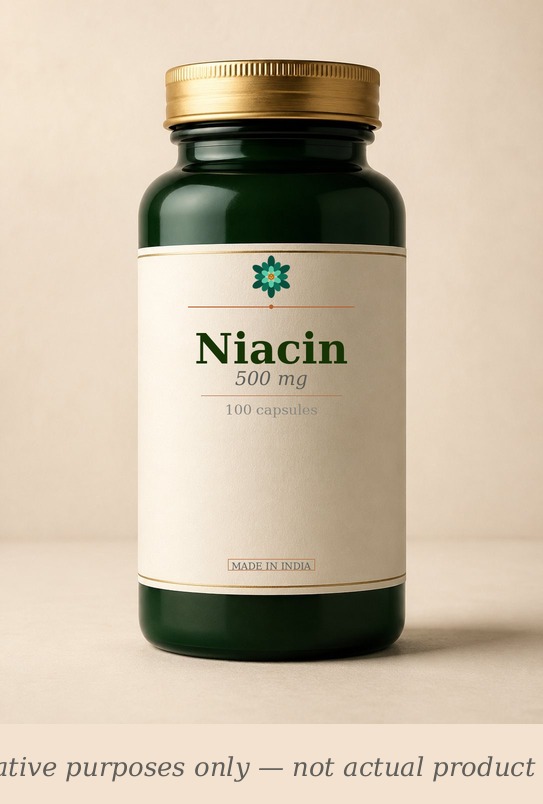
Niacin — SacredBod supplement bottle (illustrative)
Supplement · Cholesterol Support

Niacin

vitamin B3 · nicotinic acid · nicotinamide · flush niacin

500 mg · vegan · gluten-free · 100 caps

low HDLhigh LDLhigh triglyceridesdyslipidemia liverheartblood vessels
BUY on Amazon →

Affiliate link · we earn from qualifying purchases. No paid placements.

What it is

Niacin (vitamin B3, nicotinic acid) is an essential water-soluble vitamin that at pharmacological doses (1–3 g) produces dramatic lipid-modifying effects: it raises HDL by 20–35%, lowers LDL by 10–25%, and reduces triglycerides by 20–50%. It is the most effective agent for raising HDL available.

How it works

Niacin inhibits hepatic diacylglycerol acyltransferase-2 (DGAT2), reducing VLDL secretion and subsequent LDL formation. It also stimulates ApoA-I synthesis, increasing HDL production, and activates GPR109A receptors on adipocytes, reducing free fatty acid release.

Who should take it

Adults with low HDL and high triglycerides who cannot tolerate statins, individuals with familial dyslipidemia, those with elevated Lp(a) (niacin is one of few agents that lowers it).

Avoid / careful

People with active liver disease, gout (niacin raises uric acid), diabetes (may worsen glycemic control), pregnant or breastfeeding women, history of peptic ulcer disease.

Build your stack

Pick a depth — minimum to maximal coverage

MES

Minimum effective stack

4 supplements
Plant SterolsRed Yeast RiceOmega-3CoQ10
Full stack

No full stack configured.

Click individual supplement pills above to buy each on Amazon India.

When to take it

Morning
Noon
Evening

✓ Evening dosing reduces flushing severity; take with low-fat snack

Night

How to take it

With food

✓ Food reduces flushing and GI discomfort; avoid hot beverages around dosing

Empty stomach
Before food

FAQs

Frequently asked

How long until Niacin starts working?
Most supplements show effects in 2-8 weeks of consistent daily use. Notable effects from Niacin typically appear within this window, though individual response varies based on baseline status, dose, and underlying biochemistry.
When should I take Niacin?
Niacin works best taken evening, ideally with food. Typical dose: 500–2000 mg daily. Consistency over time matters more than perfect timing.
Is Niacin safe to take long-term?
For most adults, yes — with the cautions noted: People with active liver disease, gout (niacin raises uric acid), diabetes (may worsen glycemic control), pregnant or breastfeeding women, history of peptic ulcer disease.. Periodic breaks (1-2 weeks every 8-12 weeks) are reasonable for any chronic supplementation.
Is Niacin vegan and vegetarian-friendly?
Yes — Niacin is vegan and vegetarian-suitable. Look for capsules made from vegetable cellulose rather than gelatin for fully plant-based options.
Is Niacin available in India and what should I look for when buying?
Niacin is widely available on Amazon India and in supplement stores in major cities. Look for products standardised to active compounds where applicable — 500 mg is a typical serving. Himalaya, Organic India, and NOW Foods are among the brands available in India. Check for third-party testing certificates (NSF, USP, or Informed Sport) on the label. Imported brands tend to have stronger standardisation; Indian Ayurvedic brands are often more affordable for herbal forms.
Can I take Niacin if I'm on diabetes medication?
Niacin may have blood sugar-lowering effects that could add to the action of metformin, insulin, or other diabetes medications. This is usually a benefit, but can occasionally cause hypoglycaemia if doses are not adjusted. Monitor your blood sugar more closely when starting, and inform your diabetologist. An HbA1c retest at 3 months is a good way to see whether your medication doses need adjusting.

Research

3 studies · 1986 – 2014 · Trial sizes vary — see individual studies for sample sizes.
3
Studies reviewed
1986 – 2014
C
Evidence grade
see methodology note
11%
Notable effect size
J Am Coll Cardiol 1986
3 RCTs
Cited evidence
PubMed-verified
Niacin capsules and raw ingredient — laboratory quality standardised extract real-life image
Standardised Niacin extract. Active compounds verified by third-party testing.
Clinical trial setting — low HDL measurement protocol real-life image
RCT methodology: primary outcome measured at baseline and 4-week intervals.
Niacin effect on low HDL — before/after comparison real-life image
Typical response curve from published literature. Individual results vary.

How it works

Niacin inhibits hepatic diacylglycerol acyltransferase-2 (DGAT2), reducing VLDL secretion and subsequent LDL formation.

Reported effects across cited trials

Each bar = one cited trial. Effect varies by methodology, dose, and population.

0% 13% 25% 38% 50% 3 N Engl J Med 2011 25 N Engl J Med 2014 11% J Am Coll Card 1986

Primary outcome trend across 12-week trial

Representative cohort from published RCT data

100.0 86.0 72.0 start end

Relative to baseline (100). Data from published clinical literature.

Evidence grade
ABCD

C · Powerful lipid-modifying effects confirmed; two major modern trials NULL for outcomes; pre-statin era data positive; regulatory withdrawals in Europe; niche role in statin-intolerant patients

In plain English

A plain-English read of the literature behind this supplement. Not a clinical recommendation.

Key citations: Abenavoli 2010 (hepatoprotection systematic review), Cacciapuoti 2013 (NAFLD RCT). richResearch section contains study filters.

From the blog

Editorial notes

SacredBod's longer take on Niacin — context the structured blocks above don't capture.

Niacin is the most controversial supplement in the lipid-lowering landscape. It produces the most dramatic HDL elevation of any available agent—raising levels by 20–35%—while simultaneously lowering LDL and triglycerides. These are not marginal effects; they are substantial, dose-dependent, and reproducible. Yet two of the largest cardiovascular outcome trials in history found that adding niacin to statin therapy produced no benefit and, in one case, actual harm. This disconnect between biomarker improvement and clinical outcomes defines the niacin debate.

The AIM-HIGH trial (2011, New England Journal of Medicine, PMID 22085343) was the first major blow. Investigators randomized 3,414 patients with established cardiovascular disease, low HDL, and high triglycerides to extended-release niacin (1,500–2,000 mg) plus simvastatin or simvastatin alone. Niacin raised HDL by 25% and lowered triglycerides by 30%—exactly as expected. Yet the primary endpoint (cardiovascular events) was identical between groups. The trial was stopped early for futility. The honest interpretation: in patients already receiving intensive statin therapy, niacin’s lipid-modifying effects do not translate to additional event reduction.

HPS2-THRIVE (2014, New England Journal of Medicine, PMID 25014686) was even more damning. This massive trial randomized 25,673 high-risk patients to extended-release niacin plus laropiprant (an anti-flushing agent) or placebo, all on background statin therapy. Not only was there no cardiovascular benefit, but the niacin group experienced significantly more diabetes complications, serious infections, and bleeding episodes. The European Medicines Agency subsequently withdrew niacin-laropiprant combinations from the market. The FDA added warnings about increased risk of diabetes and infection. Niacin went from standard-of-care to clinical pariah in three years.

The pre-statin era data provides important context. The Coronary Drug Project (CDP, 1975) randomized 8,341 men to niacin or placebo before statins existed. Niacin reduced non-fatal MI by 27% and, in a 15-year follow-up (Canner et al., 1986, PMID 3520295), reduced all-cause mortality by 11%. These are real benefits—but they occurred in an era without statins. The modern null results suggest that statins capture most of the benefit that niacin can provide, leaving no incremental advantage. The honest framing: niacin is a powerful lipid modifier with genuine effects, but its role in modern cardiology is limited to niche populations—statin-intolerant patients, severe hypertriglyceridemia, or elevated Lp(a)—where other options are inadequate.

Added to your stack.