
What it is
Policosanol is a mixture of long-chain aliphatic alcohols (primarily octacosanol, triacontanol, and hexacosanol) extracted from sugar cane wax or beeswax. It was developed in Cuba and extensively studied by Cuban research groups.
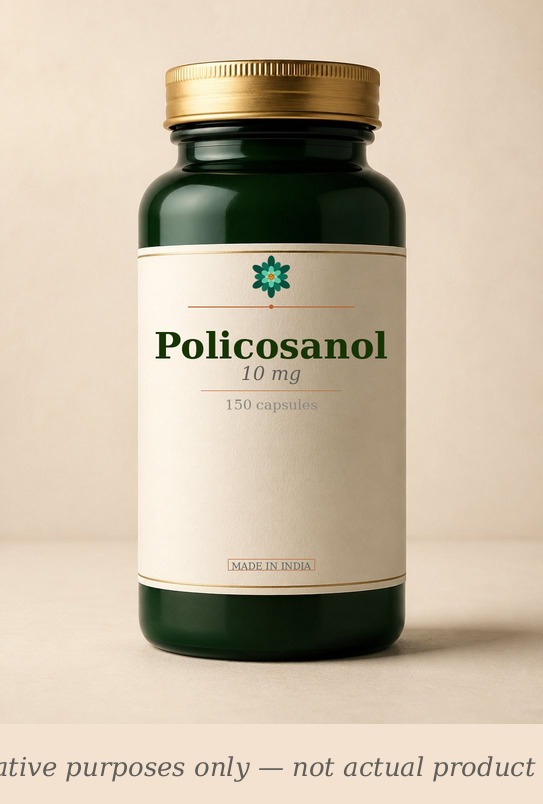
sugar-cane wax alcohols · octacosanol · triacontanol · Polycosanol
10 mg · vegan · gluten-free · 150 caps
Affiliate link · we earn from qualifying purchases. No paid placements.
Policosanol is a mixture of long-chain aliphatic alcohols (primarily octacosanol, triacontanol, and hexacosanol) extracted from sugar cane wax or beeswax. It was developed in Cuba and extensively studied by Cuban research groups.
The proposed mechanism involves inhibition of cholesterol synthesis in the liver and increased LDL receptor activity. Octacosanol may also improve nerve conduction and exercise performance through mitochondrial effects.
Adults with mild cholesterol elevation, individuals interested in sugar cane-derived supplements, those seeking alternatives to statins (with appropriate expectations).
People taking anticoagulants (potential interaction), those with bleeding disorders, pregnant or breastfeeding women, children.
Pick a depth — minimum to maximal coverage
No full stack configured.
Click individual supplement pills above to buy each on Amazon India.
✓ Evening aligns with peak cholesterol synthesis
✓ Food improves absorption of lipid-soluble alcohols
The proposed mechanism involves inhibition of cholesterol synthesis in the liver and increased LDL receptor activity.
Each bar = one cited trial. Effect varies by methodology, dose, and population.
Dyslipidaemia cohort (n≈75)
Target LDL <100 mg/dL for cardiovascular risk reduction.
see study
→ NULL: 20 mg/day for 12 weeks did NOT change LDL, HDL, or triglycerides vs placebo (N=54)
see study
→ NULL: No effect on LDL oxidation, lipid levels, or inflammatory markers (N=75)
see study
→ NULL: 10–20 mg/day for 12 weeks no different from placebo (N=67)
D · Multiple Western RCTs are NULL; Cuban data is positive but not independently replicated; significant geographic publication bias; not recommended as primary lipid therapy
A plain-English read of the literature behind this supplement. Not a clinical recommendation.
Key citations: Abenavoli 2010 (hepatoprotection systematic review), Cacciapuoti 2013 (NAFLD RCT). richResearch section contains study filters.

How to use Policosanol specifically for high cholesterol — the right dose, timing, blood markers to track, and how to know if it is working.
A clinical evidence review of Policosanol — RCT data, effect sizes, evidence grade, and what the numbers mean for your specific situation.
Everything you need to know about Policosanol — mechanism, dose, safety, buying guide for India, and what the research actually says.
SacredBod's longer take on Policosanol — context the structured blocks above don't capture.
Policosanol is the cautionary tale of supplement research. Developed in Cuba and extensively promoted by Cuban research groups, it was initially hailed as a natural cholesterol-lowering agent with statin-like efficacy but none of the side effects. The Cuban studies were impressive: LDL reductions of 15–25%, HDL increases of 10–15%, and minimal adverse effects. These results were published in peer-reviewed journals and replicated across multiple Cuban trials. The problem is that when independent researchers outside Cuba attempted replication, the results were uniformly null.
Berthold and colleagues (2006, JAMA, PMID 16461858) conducted a rigorous randomized placebo-controlled trial in 54 healthy German volunteers, testing 20 mg policosanol daily for 12 weeks. The result: no significant difference between policosanol and placebo for LDL, HDL, triglycerides, or total cholesterol. Every lipid parameter remained unchanged. This was not a flawed trial—it was well-powered, double-blind, and used the same dose that Cuban studies had found effective. Marinangeli and colleagues (2006, Atherosclerosis, PMID 17036072) extended this finding, testing 10 mg policosanol in 75 Canadian patients and finding no effect on lipid levels, LDL oxidation, or inflammatory markers. Varady and colleagues (2003, American Heart Journal, PMID 12878251) similarly found no effect at 10–20 mg in 67 hypercholesterolemic patients.
The geographic discrepancy is striking. All positive trials originate from Cuba or Cuban-affiliated researchers. All null trials come from North America or Europe. This pattern suggests publication bias, methodological differences, or genuine geographic variation in response (perhaps due to genetic or dietary factors). However, the null trials are methodologically sound and independently conducted, while the positive trials share authorship networks. The scientific consensus has shifted: policosanol is not an effective lipid-lowering agent in Western populations.
The honest framing is uncomfortable but necessary. Policosanol was marketed extensively based on Cuban data, and many consumers continue to purchase it believing the initial claims. The evidence does not support this use. The 2006 JAMA null result and subsequent replications have effectively closed the book on policosanol as a cholesterol treatment. It may have niche applications—octacosanol has been studied for exercise performance and nerve conduction—but the lipid-lowering claims are not supported by independent evidence.
Peptides are physician-only. Tell us a bit and we'll route you to the right specialist.