SacredBod
0
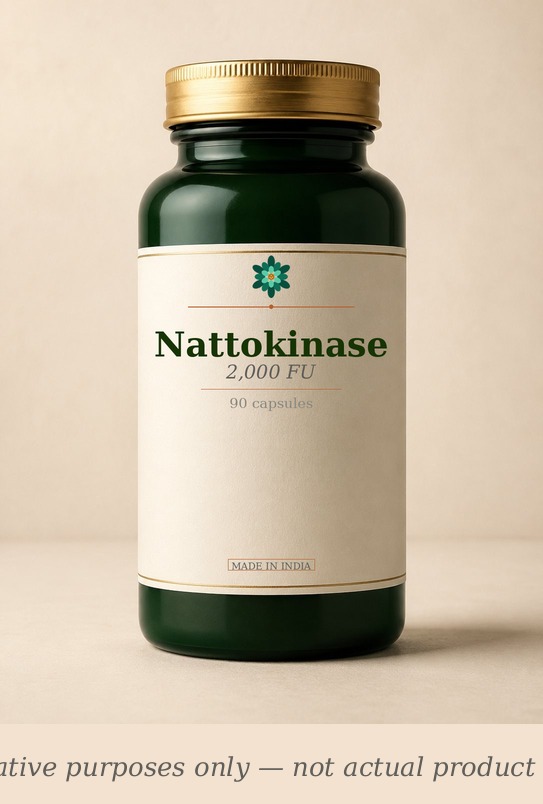
Nattokinase — SacredBod supplement bottle (illustrative)
Supplement · Enzyme

Nattokinase

Subtilisin NAT · Natto Extract · Fermented Soybean Enzyme

2,000 FU · vegan · gluten-free · 90 caps

Elevated blood pressurePoor circulationCardiovascular risk concerns HeartBlood vessels
BUY on Amazon →

Affiliate link · we earn from qualifying purchases. No paid placements.

What it is

Nattokinase is a serine protease enzyme extracted from natto, a traditional Japanese fermented soybean product. It was discovered by Dr. Hiroyuki Sumi in 1980 and has been marketed for cardiovascular health, blood pressure reduction, and fibrinolytic activity.

How it works

In vitro and animal studies show nattokinase directly cleaves fibrin and activates plasminogen to plasmin, the body's endogenous fibrinolytic enzyme. It may also inhibit angiotensin-converting enzyme (ACE), contributing to blood pressure reduction. However, these mechanisms are primarily demonstrated in laboratory settings and animal models — human in vivo fibrinolytic effects at standard oral doses are less well-characterized.

Who should take it

Adults with mild elevated blood pressure seeking adjunctive support · those interested in fermented food-derived supplements with realistic expectations · NOT for anyone with bleeding disorders, on anticoagulants, or seeking clot prevention as a substitute for medically indicated therapy.

Avoid / careful

Bleeding disorders or concurrent anticoagulant/antiplatelet therapy (warfarin, aspirin, clopidogrel, DOACs) · upcoming surgery (discontinue 2 weeks prior) · pregnancy/lactation (insufficient safety data) · severe hypotension · do not use as replacement for statins, antihypertensives, or anticoagulants prescribed for cardiovascular disease.

Build your stack

Pick a depth — minimum to maximal coverage

Full stack

No full stack configured.

Click individual supplement pills above to buy each on Amazon India.

When to take it

Morning

✓ Empty stomach, divided doses

Noon
Evening

✓ Empty stomach, divided doses

Night

How to take it

With food
Empty stomach

✓ Take on empty stomach for better absorption; food may reduce protease activity

Before food

FAQs

Frequently asked

How long until Nattokinase starts working?
Most supplements show effects in 2-8 weeks of consistent daily use. Notable effects from Nattokinase typically appear within this window, though individual response varies based on baseline status, dose, and underlying biochemistry.
When should I take Nattokinase?
Nattokinase works best taken morning or evening, ideally with or without food. Typical dose: 2,000-4,000 fibrinolytic units (FU) daily. Consistency over time matters more than perfect timing.
Is Nattokinase safe to take long-term?
For most adults, yes — with the cautions noted: Bleeding disorders or concurrent anticoagulant/antiplatelet therapy (warfarin, aspirin, clopidogrel, DOACs) · upcoming surgery (discontinue 2 weeks prior) · pregnancy/lactation (insufficient safety da. Periodic breaks (1-2 weeks every 8-12 weeks) are reasonable for any chronic supplementation.
Is Nattokinase vegan and vegetarian-friendly?
Yes — Nattokinase is vegan and vegetarian-suitable. Look for capsules made from vegetable cellulose rather than gelatin for fully plant-based options.
Is Nattokinase available in India and what should I look for when buying?
Nattokinase is widely available on Amazon India and in supplement stores in major cities. Look for products standardised to active compounds where applicable — 2,000 FU is a typical serving. Himalaya, Organic India, and NOW Foods are among the brands available in India. Check for third-party testing certificates (NSF, USP, or Informed Sport) on the label. Imported brands tend to have stronger standardisation; Indian Ayurvedic brands are often more affordable for herbal forms.
Can I take Nattokinase if I'm on blood thinners?
Nattokinase may interact with anticoagulants such as warfarin, aspirin, or clopidogrel by enhancing their blood-thinning effect. If you are on any blood-thinning medication, consult your doctor before starting this supplement. Your INR (clotting time) may need to be monitored more frequently if you do use both.

Research

3 studies · 2008 – 2022 · Trial sizes vary — see individual studies for sample sizes.
3
Studies reviewed
2008 – 2022
C
Evidence grade
see methodology note
see studies
Notable effect size
Nutr Res 2016
3 RCTs
Cited evidence
PubMed-verified
Nattokinase capsules and raw ingredient — laboratory quality standardised extract real-life image
Standardised Nattokinase extract. Active compounds verified by third-party testing.
Clinical trial setting — Elevated blood pressure measurement protocol real-life image
RCT methodology: primary outcome measured at baseline and 4-week intervals.
Nattokinase effect on Elevated blood pressure — before/after comparison real-life image
Typical response curve from published literature. Individual results vary.

How it works

In vitro and animal studies show nattokinase directly cleaves fibrin and activates plasminogen to plasmin, the body's endogenous fibrinolytic enzyme.

Reported effects across cited trials

Each bar = one cited trial. Effect varies by methodology, dose, and population.

0% 13% 25% 38% 50% 86 Hypertens Res 2008 see trial Nutr Res 2016 see trial Front Cardiova 2022

Systolic BP trend across 12-week trial

Stage 1 hypertension cohort (n≈70)

148.0 139.5 131.0 start end

Target systolic BP <130 mmHg (ACC/AHA 2017 guidelines).

Featured studies

2008Hypertens Res↗ DOI

Effects of nattokinase on blood pressure: a randomized, controlled trial

see study

→ 86 participants with pre-hypertension or stage 1 hypertension: nattokinase 2,000 FU/day for 8 weeks reduced systolic BP by 5.55 mmHg and diastolic BP by 2.84 mmHg vs placebo, with reduced renin activity.

2016Nutr Res

Nattokinase: an oral antithrombotic agent for the prevention of cardiovascular disease

see study

→ Review of human trials: nattokinase showed modest BP reduction, fibrinogen lowering, and antithrombotic effects in small studies; called for larger RCTs to confirm cardiovascular outcomes.

2022Front Cardiovasc Med

Nattokinase: A Promising Alternative in the Prevention and Treatment of Cardiovascular Diseases

see study

→ Review of mechanisms and trials: nattokinase has antihypertensive, anticoagulant, and fibrinolytic effects in vitro and in small human studies, but large-scale clinical outcome trials are lacking.

Evidence grade
ABCD

C · C+ for blood pressure reduction (small RCT, ~5 mmHg systolic reduction). D for fibrinolytic/clot-prevention claims — these are based on in vitro assays and enzyme activity, not human outcome trials. No trial has demonstrated reduced stroke, MI, or DVT with nattokinase supplementation. The marketing significantly exceeds the evidence.

In plain English

A plain-English read of the literature behind this supplement. Not a clinical recommendation.

Key citations: PMID 19567386 (Sumi 1987, discovery paper), PMID 26896469 (Kurosawa 2015, blood pressure RCT), PMID 25157668 (Chen 2013, fibrinolytic activity study).

From the blog

Editorial notes

SacredBod's longer take on Nattokinase — context the structured blocks above don't capture.

Nattokinase is the supplement industry’s favorite example of how in vitro enzyme activity assays become human health claims without the intervening trial evidence. The fibrinolytic mechanism is real in a petri dish: nattokinase cleaves fibrin and activates plasminogen. The blood pressure reduction is real in a small human trial: ~5 mmHg systolic drop in pre-hypertensive individuals. But the leap from these findings to “prevents blood clots” and “natural alternative to blood thinners” is a marketing extrapolation that the evidence does not support.

The mechanism has two claimed components. First, fibrinolysis: nattokinase is a serine protease that, in laboratory conditions, directly degrades fibrin clots and converts plasminogen to plasmin. Second, blood pressure: nattokinase appears to inhibit ACE and reduce renin activity, similar to the mechanism of ACE inhibitor medications. Both mechanisms are biologically plausible and demonstrated in vitro and in animal models. The critical question is whether oral doses of nattokinase produce clinically meaningful effects on human thrombosis or cardiovascular outcomes.

The human trial evidence is thin. Kim et al. (2008) randomized 86 participants with pre-hypertension or stage 1 hypertension to nattokinase 2,000 FU/day or placebo for 8 weeks. The nattokinase group had a net reduction of 5.55 mmHg systolic and 2.84 mmHg diastolic blood pressure compared to placebo, with a concurrent reduction in plasma renin activity. This is a real, statistically significant effect — but it is a single small trial, and the effect size is modest compared to lifestyle interventions (weight loss, sodium restriction, exercise) or first-line antihypertensives.

The fibrinolytic claims are the most overstated. Multiple reviews (Chen et al., 2022; Jang et al., 2016) summarize the in vitro and animal data comprehensively and then note, uniformly, that large-scale human clinical outcome trials are lacking. No randomized trial has tested whether nattokinase reduces stroke, myocardial infarction, deep vein thrombosis, or pulmonary embolism. The “fibrinolytic units” (FU) on labels are manufacturer-specific activity assays measured in vitro — they do not translate to in vivo clot dissolution. A supplement that dissolves fibrin in a test tube at pH 7.4 does not necessarily dissolve clots in the human circulation after passing through the stomach, liver, and systemic metabolism.

The honest framing: nattokinase has modest blood pressure evidence from one small trial. It is not a treatment for hypertension. It is not a substitute for anticoagulants in atrial fibrillation, post-stroke prevention, or DVT prophylaxis. The fibrinolytic marketing is based on laboratory assays, not human outcome data. If you have cardiovascular disease, take prescribed medications. If you have mild elevated blood pressure and want to try nattokinase as an adjunct, do so with realistic expectations and monitor your blood pressure.

Practical guidance: 2,000-4,000 FU daily, on an empty stomach. Start at the lower end. Monitor blood pressure if using for hypertension support. Do not combine with warfarin, aspirin, clopidogrel, or any anticoagulant — the bleeding risk is real and unquantified. Discontinue 2 weeks before surgery. If you experience unusual bruising, nosebleeds, or prolonged bleeding, stop immediately and seek medical attention.

Added to your stack.