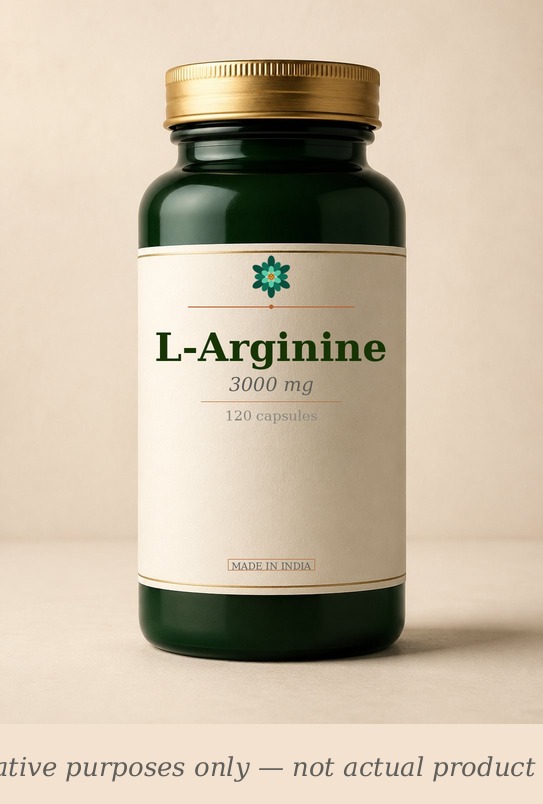
L-arginine was the original nitric oxide booster — the mechanism is elegant, the marketing was enthusiastic, and the clinical reality is more complicated. Arginine is the direct substrate for endothelial nitric oxide synthase (eNOS), which produces NO that dilates blood vessels and improves bl...'t rise proportionally with dose, and why many arginine exercise trials in trained athletes have been disappointing.
The 1999 Chen trial is the most-cited positive study for erectile dysfunction: 50 men with organic ED took 5 g/day for 6 weeks. 31% of the arginine group reported improved erections vs 12% placebo — a real but modest effect. For mild vascular ED, this is a reasonable first-line natural approach. For anything more severe, PDE5 inhibitors are far more effective.
The exercise data is weaker. Multiple trials in trained athletes show minimal to no endurance or strength benefit. The 2006 Wilson trial in peripheral arterial disease (PAD) patients found no improvement in walking distance at 3 g/day for 6 months. The vascular effect is real but doesn't always translate to performance.
The modern consensus has shifted to L-citrulline. Citrulline bypasses first-pass metabolism, is converted to arginine in the kidneys, and achieves higher plasma arginine levels at lower doses. The Pérez-Guisado 2010 trial (cited in the l-citrulline file) showed citrulline malate reduced fatigue and improved ATP recovery during severe training.
Practical guidance: if you're specifically targeting erectile dysfunction, arginine at 5 g/day has modest evidence. For vascular health, exercise performance, or general NO support, citrulline is the better choice. If you already have arginine, it won't hurt — but don't expect dramatic results.
Keystone references: Chen et al. 1999 (BJU Int, PMID 10444158 — erectile dysfunction); Wilson et al. 2006 (J Nutr, PMID 16988130 — null PAD trial); Pérez-Guisado & Jakeman 2010 (J Strength Cond Res, PMID 20386132 — citrulline malate exercise trial, showing why citrulline superseded arginine).