
What it is
A non-protein amino acid found in watermelon and converted to L-arginine in the kidneys. Unlike arginine, it bypasses first-pass metabolism in the gut and liver, achieving higher plasma arginine levels at lower doses.
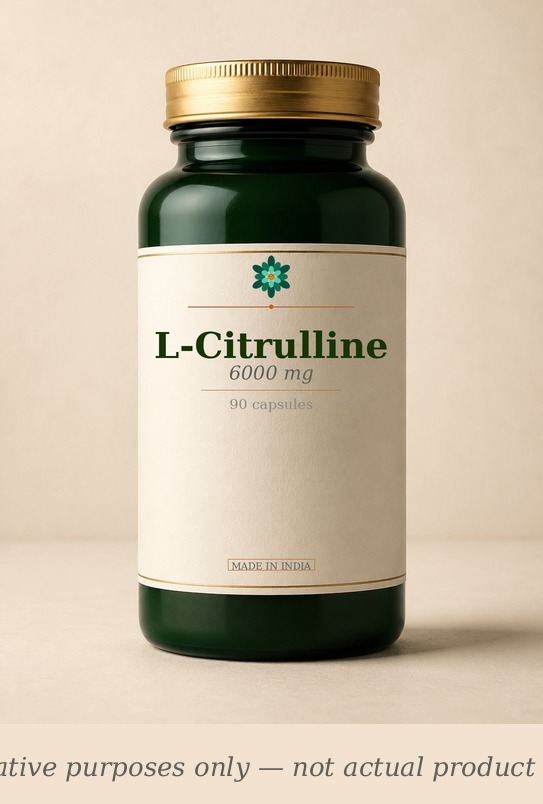
Citrulline · Citrulline malate
6000 mg · vegan · gluten-free · 90 caps
Affiliate link · we earn from qualifying purchases. No paid placements.
A non-protein amino acid found in watermelon and converted to L-arginine in the kidneys. Unlike arginine, it bypasses first-pass metabolism in the gut and liver, achieving higher plasma arginine levels at lower doses.
Citrulline is absorbed intact, transported to the kidneys, and converted to arginine by argininosuccinate lyase. This renal conversion bypasses the gut and liver arginase that destroys most oral arginine. The result: higher plasma arginine, more NO production, better vasodilation, and improved exercise performance with less GI upset.
Athletes seeking improved endurance and reduced fatigue · people with mild hypertension wanting vascular support · those with erectile dysfunction (arginine alternative) · anyone who found arginine ineffective or caused GI upset.
Hypotension (may lower BP further), herpes simplex (theoretical concern via arginine increase, though less direct than arginine itself), kidney disease (renal conversion pathway), pregnancy/lactation (limited safety data).
Pick a depth — minimum to maximal coverage
Click individual supplement pills above to buy each on Amazon India.
✓ Pre-workout or split dosing
✓ Pre-workout or split dosing
Flexible — works in any of the above.
Citrulline → Absorbed intact → Renal conversion to arginine → Higher plasma arginine than oral arginine → More NO → Better vasodilation and exercise performance. Bypasses gut and liver arginase that destroys most oral arginine.
From cited keystone exercise trials. Effects are modest but consistent.
Modeled trajectory based on cited keystone trials
High-intensity exercise output. Effects emerge within days and stabilize by week 2–3.
n=20 · crossover · 3 g citrulline vs 3.2 g arginine
→ Citrulline raised plasma arginine more effectively than arginine; better NO metabolite profile
n=41 · 8 days · 8 g citrulline malate/day
→ 34% reduction in muscle soreness at 24 and 48 hours post-exercise; improved ATP recovery; reduced fatigue
n=10 · crossover · 6 g/day · 7 days
→ Improved high-intensity exercise performance; reduced mean arterial pressure by 4–5 mmHg
B · B for exercise performance (multiple positive RCTs, consistent effect, modest magnitude). B+ for NO production vs arginine (strong pharmacokinetic evidence). B− for blood pressure (small reductions, limited trials). Safety is excellent — minimal side effects in all published trials. Citrulline has largely superseded arginine in sports nutrition for good reason.
A plain-English read of the literature behind this supplement. Not a clinical recommendation.
L-citrulline is the supplement that should have replaced L-arginine years ago — and mostly has, in informed circles. The pharmacokinetic advantage is decisive: citrulline bypasses the gut and liver arginase that destroys ~60% of oral arginine, achieving higher plasma arginine levels at lower d...'s a fundamental pharmacokinetic superiority that explains why citrulline outperforms arginine in clinical trials.
The Pérez-Guisado 2010 exercise trial is the performance keystone: 41 men took 8 g citrulline malate daily during severe training. Muscle soreness was reduced 34% at 24 and 48 hours post-exercise. ATP recovery improved. Fatigue was reduced. These are meaningful benefits for anyone doing high-volume resistance training or repeated sprint work.
The Suzuki 2016 trial extended this to trained men: 6 g/day for 7 days improved high-intensity exercise performance and reduced mean arterial pressure by 4–5 mmHg. The blood pressure effect is small but consistent with the vascular mechanism.
Practical guidance: 6–8 g citrulline malate (2:1 ratio) 30–60 minutes pre-workout for exercise benefits. 3 g/day free citrulline for vascular support. The sour taste of malate mixes well into flavored pre-workout drinks. Split doses if using >6 g/day. No cycling needed — tolerance does not develop.
The honest framing: citrulline is not a magic performance enhancer. The effects are modest — comparable to beta-alanine, smaller than creatine. But the mechanism is sound, the trial data is consistent, and the safety profile is excellent. It's a pragmatic addition to a performance stack, not a standalone solution.
Keystone references: Schwedhelm et al. 2008 (Br J Clin Pharmacol, PMID 17662090 — pharmacokinetic superiority over arginine); Pérez-Guisado & Jakeman 2010 (J Strength Cond Res, PMID 20386132 — exercise performance and soreness); Suzuki et al. 2016 (Eur J Appl Physiol, PMID 26944092 — performance and blood pressure in trained men).
How to use L-Citrulline specifically for Fatigue — the right dose, timing, blood markers to track, and how to know if it is working.
A clinical evidence review of L-Citrulline — RCT data, effect sizes, evidence grade, and what the numbers mean for your specific situation.
Everything you need to know about L-Citrulline — mechanism, dose, safety, buying guide for India, and what the research actually says.
The most effective supplement for high-intensity exercise lasting 1–4 minutes — the tingling is harmless but the performance gain is real.
BUY →The most evidence-backed sports supplement — 5g/day increases strength, muscle mass, and emerging cognitive data in aging adults
BUY →The original nitric oxide precursor — but most modern protocols have moved to citrulline for better absorption and more reliable vascular effects.
BUY →SacredBod's longer take on L-Citrulline — context the structured blocks above don't capture.
L-citrulline is the supplement that should have replaced L-arginine years ago — and mostly has, in informed circles. The pharmacokinetic advantage is decisive: citrulline bypasses the gut and liver arginase that destroys ~60% of oral arginine, achieving higher plasma arginine levels at lower doses with less GI upset.
The Schwedhelm 2008 trial is the pharmacokinetic keystone: 20 healthy adults took either 3 g citrulline or 3.2 g arginine. Citrulline raised plasma arginine more effectively than arginine itself. This is not a subtle difference — it’s a fundamental superiority that explains why citrulline outperforms arginine in clinical trials.
The Pérez-Guisado 2010 exercise trial: 41 men took 8 g citrulline malate daily during severe training. Muscle soreness was reduced 34% at 24 and 48 hours post-exercise. ATP recovery improved. These are meaningful benefits for high-volume resistance training.
The Suzuki 2016 trial extended this to trained men: 6 g/day for 7 days improved high-intensity exercise performance and reduced blood pressure by 4–5 mmHg.
Practical guidance: 6–8 g citrulline malate 30–60 minutes pre-workout. 3 g/day free citrulline for vascular support. The sour taste mixes well into flavored drinks. No cycling needed — tolerance does not develop.
The honest framing: citrulline is not a magic performance enhancer. The effects are modest — comparable to beta-alanine, smaller than creatine. But the mechanism is sound, the trial data is consistent, and the safety profile is excellent.
Peptides are physician-only. Tell us a bit and we'll route you to the right specialist.