SacredBod
0
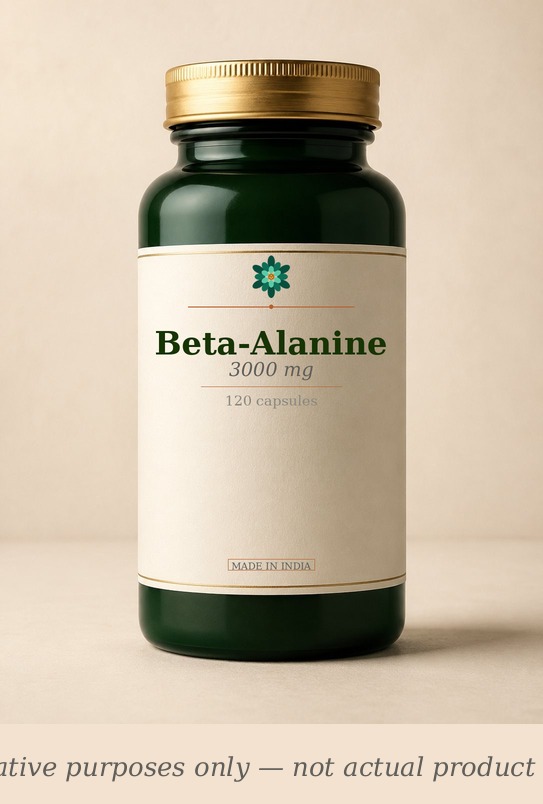
Beta-Alanine — SacredBod supplement bottle (illustrative)
Supplement · Amino Acid

Beta-Alanine

β-alanine · CarnoSyn

3000 mg · vegan · gluten-free · 120 caps

FatigueCramps MuscleBrain
BUY on Amazon →

Affiliate link · we earn from qualifying purchases. No paid placements.

What it is

A non-protein amino acid that combines with histidine in muscle to form carnosine — a dipeptide that buffers acid (H+) during high-intensity exercise. Unlike most amino acids, it's not incorporated into proteins; its sole role is as a carnosine precursor.

How it works

Beta-alanine is the rate-limiting precursor for muscle carnosine synthesis. Carnosine acts as an intracellular pH buffer, neutralizing hydrogen ions (H+) that accumulate during anaerobic glycolysis. More carnosine = better acid buffering = delayed fatigue during repeated sprints, high-rep lifting, and middle-distance events (1–4 minutes).

Who should take it

Athletes in high-intensity interval training · CrossFitters and high-rep lifters · rowers, swimmers, and middle-distance runners (400m–1500m) · anyone doing repeated bursts of intense effort · not particularly useful for pure endurance (>10 min) or pure strength (1–3 reps).

Avoid / careful

Pregnancy/lactation (insufficient safety data), under-18 (limited safety data in adolescents), gout (theoretical uric acid concern, though not well-established), chronic kidney disease.

Build your stack

Pick a depth — minimum to maximal coverage

Click individual supplement pills above to buy each on Amazon India.

When to take it

Morning

✓ Split 2–3x daily

Noon

✓ Split 2–3x daily

Evening

✓ Split 2–3x daily

Night

How to take it

With food

✓ Reduces paresthesia (tingling)

Empty stomach
Before food

FAQs

Frequently asked

How long until Beta-Alanine starts working?
Most supplements show effects in 2-8 weeks of consistent daily use. Notable effects from Beta-Alanine typically appear within this window, though individual response varies based on baseline status, dose, and underlying biochemistry.
When should I take Beta-Alanine?
Beta-Alanine works best taken morning or afternoon or evening, ideally with food. Typical dose: 3000–6000 mg/day in divided doses (1.6–2 g per dose). Consistency over time matters more than perfect timing.
Is Beta-Alanine safe to take long-term?
For most adults, yes — with the cautions noted: Pregnancy/lactation (insufficient safety data), under-18 (limited safety data in adolescents), gout (theoretical uric acid concern, though not well-established), chronic kidney disease.. Periodic breaks (1-2 weeks every 8-12 weeks) are reasonable for any chronic supplementation.
Is Beta-Alanine vegan and vegetarian-friendly?
Yes — Beta-Alanine is vegan and vegetarian-suitable. Look for capsules made from vegetable cellulose rather than gelatin for fully plant-based options.
Is Beta-Alanine available in India and what should I look for when buying?
Beta-Alanine is widely available on Amazon India and in supplement stores in major cities. Look for products standardised to active compounds where applicable — 3000 mg is a typical serving. Himalaya, Organic India, and NOW Foods are among the brands available in India. Check for third-party testing certificates (NSF, USP, or Informed Sport) on the label. Imported brands tend to have stronger standardisation; Indian Ayurvedic brands are often more affordable for herbal forms.
Can pregnant or breastfeeding women take Beta-Alanine?
No — Beta-Alanine should be avoided during pregnancy and breastfeeding. Pregnancy/lactation (insufficient safety data), under-18 (limited safety data in adolescents), gout (theoretical uric Always consult your obstetrician before starting any new supplement during pregnancy.

Research

3 studies · 2012–2015
Meta-analysesPosition standsRCTs
+2.85%
Exercise performance
Trexler 2015 meta · 40 studies · p<0.001
40–60%
Carnosine increase
4 weeks · 6 g/day loading
1–4 min
Optimal exercise window
High-intensity glycolytic events
Beta-Alanine capsules and raw ingredient — laboratory quality standardised extract real-life image
Standardised Beta-Alanine extract. Active compounds verified by third-party testing.
Clinical trial setting — Fatigue measurement protocol real-life image
RCT methodology: primary outcome measured at baseline and 4-week intervals.
Beta-Alanine effect on Fatigue — before/after comparison real-life image
Typical response curve from published literature. Individual results vary.

Intracellular acid buffering

Beta-alanine → Muscle carnosine synthesis → Carnosine buffers H+ during anaerobic glycolysis → Delayed fatigue in high-intensity exercise 1–4 min → Effects emerge after 2–4 weeks of loading.

% improvement vs placebo

From Trexler 2015 meta-analysis and cited keystone trials.

0% 4% 8% 11% 15% +2.85% Exercise performance (meta) ~5% High-intensity specific No benefit Endurance (>10 min)

Muscle carnosine loading over 12 weeks

Modeled trajectory based on cited keystone trials

158.0 129.0 100.0 start end

Relative carnosine content. Loading phase (6 g/day) for 4 weeks → maintenance (3 g/day). Saturation by week 8–12.

Featured studies

2012Amino Acids

Important role of muscle carnosine in rowing performance

n=18 · crossover · 6.4 g/day · 7 weeks

→ Significant improvement in rowing performance; carnosine levels correlated with performance gains

2015J Int Soc Sports Nutr↗ DOI

International society of sports nutrition position stand: Beta-Alanine

Meta-analysis · 40 studies · ISSN position stand

→ 2.85% improvement in exercise performance; benefits specific to 1–4 min high-intensity exercise; safe at recommended doses

2014J Int Soc Sports Nutr

Effects of β-alanine supplementation on performance and body composition

n=30 · 4 weeks · 6 g/day

→ Improved high-intensity intermittent exercise performance; no change in body composition

Evidence grade
ABCD

A · A− for high-intensity exercise 1–4 minutes (strong meta-analytic evidence, consistent effect, ISSN position stand). C for pure strength (1–3 reps, minimal benefit). C for endurance >10 minutes (no meaningful benefit). Safety is excellent at recommended doses; paresthesia is harmless but can be uncomfortable. The most well-supported supplement for its specific use case after creatine.

In plain English

A plain-English read of the literature behind this supplement. Not a clinical recommendation.

Beta-alanine is the second most-studied ergogenic supplement after creatine — and the most misunderstood. The tingling sensation (paresthesia) dominates the conversation, but the real story is intracellular acid buffering and its specific application to high-intensity exercise. The Trexler 2...'s harmless but can be uncomfortable. Strategies: split doses (1.6–2 g per dose), take with food, or use sustained-release formulations. Most people acclimate within 2–3 weeks.

The 2012 Baguet trial is a nice specific example: 18 elite rowers took 6.4 g/day for 7 weeks. Rowing performance improved significantly, and the gain correlated with individual carnosine increases. This is the pattern — the supplement works, but the magnitude depends on baseline carnosine and the exercise demands.

Practical guidance: 3–6 g/day split into 1.6–2 g doses, with food. Loading at 6 g/day for 4 weeks, then maintenance at 3 g/day. Stack with creatine (they complement each other) and citrulline. No cycling needed. Generic beta-alanine from reputable brands is chemically identical to CarnoSyn and much cheaper.

Keystone references: Trexler et al. 2015 (J Int Soc Sports Nutr, PMID 26175657 — ISSN position stand meta-analysis); Baguet et al. 2012 (Amino Acids, PMID 22205137 — rowing performance); Hoffman et al. 2014 (J Int Soc Sports Nutr, PMID 25141839 — body composition and performance).

From the blog

You may also like

All supplements →

Editorial notes

SacredBod's longer take on Beta-Alanine — context the structured blocks above don't capture.

Beta-alanine is the second most-studied ergogenic supplement after creatine — and the most misunderstood. The tingling dominates the conversation, but the real story is intracellular acid buffering and its specific application to high-intensity exercise.

The Trexler 2015 ISSN position stand is definitive: a meta-analysis of 40 studies found a 2.85% improvement in exercise performance (p<0.001). The effect is specific — it helps most in exercise lasting 1–4 minutes where anaerobic glycolysis produces significant H+ accumulation. Sprinting, high-rep lifting, rowing, swimming, and CrossFit metcons all fit this window. Pure strength and pure endurance see minimal benefit.

The mechanism is well-characterized: beta-alanine is the rate-limiting precursor for muscle carnosine synthesis. Carnosine is an intracellular pH buffer. More carnosine = better buffering = delayed fatigue. Muscle carnosine increases 40–60% after 4 weeks of 6 g/day loading.

The paresthesia is caused by beta-alanine binding to peripheral nerve receptors, not histamine or allergy. It’s harmless but can be uncomfortable. Strategies: split doses, take with food, or use sustained-release formulations. Most people acclimate within 2–3 weeks.

The 2012 Baguet trial: 18 elite rowers took 6.4 g/day for 7 weeks. Performance improved significantly, with gains correlating to individual carnosine increases.

Practical guidance: 3–6 g/day split into 1.6–2 g doses, with food. Loading at 6 g/day for 4 weeks, then maintenance at 3 g/day. Stack with creatine and citrulline. No cycling needed. Generic beta-alanine from reputable brands is chemically identical to CarnoSyn.

Added to your stack.