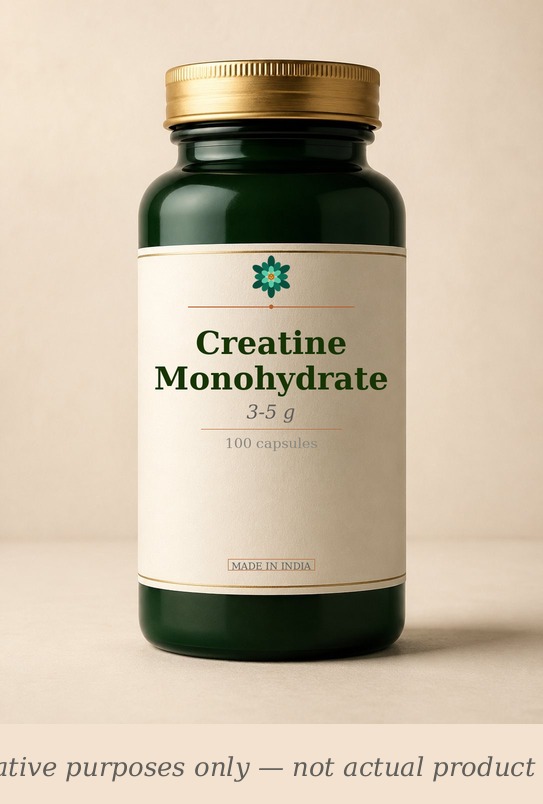
SacredBod's longer take on Creatine Monohydrate — context the structured blocks above don't capture.
Creatine monohydrate is the most extensively studied nutritional supplement in sports science — and arguably the most effective. Over 1,000 peer-reviewed studies have examined its effects on strength, power, muscle mass, and more recently, cognitive function. The International Society of Sports Nutrition (ISSN) has issued multiple position stands confirming its safety and efficacy. Despite this robust evidence base, creatine remains surrounded by myths: that it causes kidney damage, that it requires cycling, that it causes dehydration, or that “micronized” or “buffered” forms are superior. None of these claims are supported by the scientific literature.
The mechanism is elegant in its simplicity. Creatine phosphate (phosphocreatine) serves as an immediate phosphate donor to regenerate ATP from ADP during high-intensity exercise. Muscle stores of phosphocreatine are depleted within 10-15 seconds of maximal effort — this is why you cannot sprint at full speed for more than a few seconds. By increasing muscle creatine stores by 20-40% through supplementation, you extend the capacity for high-intensity effort and accelerate recovery between bouts. This translates directly to more reps, more sets, and greater training volume — the primary driver of muscle hypertrophy.
The strength and muscle data is overwhelming. A 2025 comprehensive review by Antonio and colleagues in the Journal of the International Society of Sports Nutrition synthesized decades of research and concluded that creatine monohydrate is “the most effective ergogenic nutritional supplement currently available to athletes in terms of increasing high-intensity exercise capacity and lean body mass during training.” Meta-analyses consistently show effect sizes of 0.1-0.3 on strength outcomes — small to moderate in statistical terms, but meaningful in practical terms for athletes. The 2023 ISSN position stand by Kreider and colleagues confirmed these findings across diverse populations including adolescents, older adults, and clinical populations.
The cognitive data is newer and more modest but genuinely promising. A 2024 systematic review by Rawson and colleagues found that creatine supplementation may improve cognitive processing, working memory, and executive function in older adults, particularly when combined with exercise. The mechanism involves creatine’s role in brain energy metabolism — the brain consumes 20% of the body’s energy and has its own phosphocreatine system. Vegetarians and vegans, who have lower baseline creatine levels due to dietary absence, may experience the largest cognitive benefits from supplementation. However, the cognitive evidence is less robust than the athletic performance data, with smaller trials and more heterogeneity.
The safety profile is excellent in healthy individuals. The kidney damage myth persists despite decades of evidence to the contrary. Multiple long-term studies (up to 5 years) have found no adverse effects on kidney function in healthy adults. Creatine does increase serum creatinine levels, but this is a reflection of increased muscle creatine stores, not kidney impairment. The dehydration myth is similarly unfounded — creatine increases intracellular water content, which may actually reduce dehydration risk. The honest caveat: people with pre-existing kidney disease should use creatine only under medical supervision, as impaired renal function may reduce creatinine clearance.
Formulation debates are largely marketing noise. Creatine monohydrate is the most studied, most effective, and cheapest form. “Micronized” creatine is simply monohydrate with smaller particle size — it dissolves more easily in water but has no demonstrated superiority for absorption or efficacy. Buffered creatine (Kre-Alkalyn), creatine ethyl ester, and liquid creatine have all been marketed as superior but have failed to outperform monohydrate in head-to-head trials. The honest framing: buy plain creatine monohydrate from a reputable brand and ignore the formulation marketing.
Practical guidance: Take 3-5 g of creatine monohydrate daily, mixed with water, juice, or a protein shake. A loading phase of 20 g/day (divided into 4 doses) for 5-7 days accelerates muscle saturation but is not necessary — steady daily dosing achieves the same result in 3-4 weeks. Take with carbohydrates to enhance uptake via insulin-mediated transport. No cycling is required; continuous daily use maintains muscle stores. Expect 1-3 kg of water weight gain in the first week due to intracellular water retention — this is normal and not fat gain. For cognitive benefits in aging, the same 3-5 g daily dose is used, but allow 4-8 weeks before assessing mental clarity changes.
Quality and product selection is straightforward. Look for products that specify “creatine monohydrate” and ideally “Creapure” (a German-manufactured form with high purity). Avoid proprietary blends that do not disclose creatine dose. Third-party testing (NSF Certified for Sport, Informed Sport) is valuable for athletes subject to drug testing. In the Indian market, AS-IT-IS, Optimum Nutrition, and MuscleBlaze offer quality creatine monohydrate products at reasonable prices. Powder is more cost-effective than capsules; capsules are convenient for travel.
Comparative positioning within the sports supplement landscape is clear: creatine is foundational. If you take only one sports supplement, it should be creatine monohydrate. Protein powder is second in importance for muscle building. Pre-workout formulas, BCAAs, and other ergogenics are optional adjuncts. The honest framing: creatine is not a magic muscle pill — it enables harder training, which leads to greater adaptations. Without consistent resistance training, creatine will produce minimal visible results beyond water retention.
Storage and handling is simple. Creatine monohydrate powder is stable for years when kept dry. Mix with cold or room temperature liquid — hot liquids may cause some degradation. Pre-mixing creatine in water the night before is fine; it does not degrade rapidly in solution. Some people find creatine causes mild stomach upset when taken on an empty stomach — taking with food resolves this. The characteristic gritty texture of creatine in water is normal and does not indicate poor quality.