
SacredBod
0
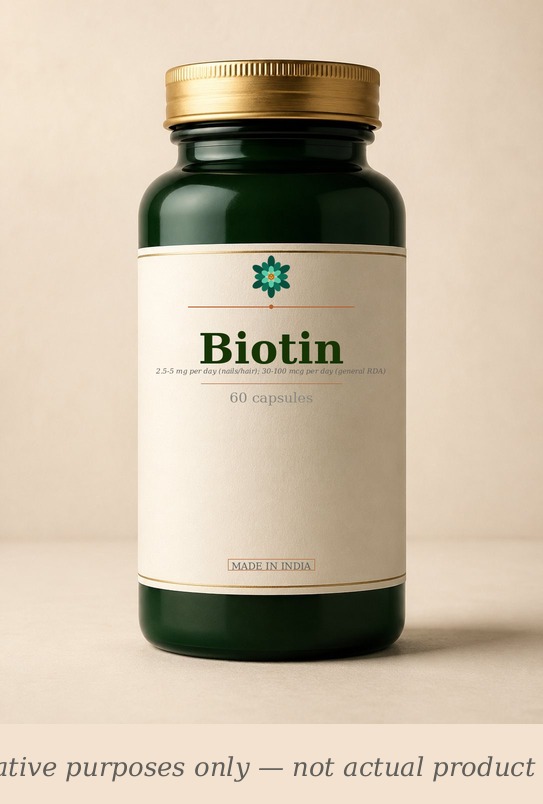
Biotin — SacredBod supplement bottle (illustrative)
Supplement · b-vitamin

Biotin

Vitamin B-7 · Vitamin H · Coenzyme R

2.5-5 mg per day (nails/hair); 30-100 mcg per day (general RDA) · vegan · gluten-free · 60 caps

brittle-nailshair-lossdry-skinbiotin-deficiency skinhair-folliclesnailsnervous-system
BUY on Amazon →

Affiliate link · we earn from qualifying purchases. No paid placements.

What it is

Biotin (vitamin B-7) is a water-soluble vitamin that serves as a cofactor for five carboxylase enzymes involved in fatty acid synthesis, gluconeogenesis, and amino acid metabolism. It is essential for the synthesis of keratin, the structural protein in hair, nails, and skin. Biotin deficiency is rare in people with normal diets and gut microbiota (intestinal bacteria produce biotin), but it can occur in pregnancy, long-term raw egg white consumption (avidin binds biotin), alcoholism, and certain genetic disorders (biotinidase deficiency, holocarboxylase synthetase deficiency). Biotin has become one of the most popular "beauty" supplements, but the evidence for hair and nail benefits in non-deficient individuals is modest.

How it works

Biotin-dependent carboxylases (acetyl-CoA carboxylase, pyruvate carboxylase, propionyl-CoA carboxylase, and two forms of methylcrotonyl-CoA carboxylase) are critical for energy metabolism and fatty acid synthesis. In keratinocytes, biotin upregulates the expression of keratin genes and improves the structural integrity of the nail plate. Patel 2017's review found that biotin supplementation improved nail thickness and reduced splitting in people with brittle nail syndrome, but the effect was modest and the trials were small. For hair, the evidence is even weaker—most positive studies are in biotin-deficient individuals or those with specific genetic disorders. The most significant issue with biotin supplementation is laboratory interference.

Who should take it

People with confirmed biotin deficiency (brittle nails, hair loss, dermatitis, neurological symptoms). Pregnant and breastfeeding women (biotin requirement increases). People with brittle nail syndrome who have not responded to topical treatments. Not for the general population seeking "hair growth"—the evidence in non-deficient individuals is weak.

Avoid / careful

**Critical lab interference warning:** High-dose biotin (≥5 mg/day) causes falsely low thyroid stimulating hormone (TSH), falsely high free T4/T3, and falsely low troponin levels on immunoassays. This has led to missed diagnoses of hypothyroidism, hyperthyroidism, and myocardial infarction. **Always discontinue biotin 48-72 hours before any blood test.** Avoid if you have a known biotin allergy (extremely rare). High doses are not recommended for long-term use without medical indication.

Build your stack

Pick a depth — minimum to maximal coverage

Full stack

No full stack configured.

Click individual supplement pills above to buy each on Amazon India.

When to take it

Morning

✓ Morning dosing is standard; timing does not significantly affect efficacy.

Noon
Evening
Night

How to take it

With food

✓ Take with breakfast to improve absorption and reduce GI upset.

Empty stomach
Before food

FAQs

Frequently asked

How long until Biotin starts working?
Most supplements show effects in 2-8 weeks of consistent daily use. Notable effects from Biotin typically appear within this window, though individual response varies based on baseline status, dose, and underlying biochemistry.
When should I take Biotin?
Biotin works best taken morning, ideally with food. Typical dose: 2.5-5 mg per day for nails/hair; 30-100 mcg for general health. Consistency over time matters more than perfect timing.
Is Biotin safe to take long-term?
For most adults, yes — with the cautions noted: **Critical lab interference warning:** High-dose biotin (≥5 mg/day) causes falsely low thyroid stimulating hormone (TSH), falsely high free T4/T3, and falsely low troponin levels on immunoassays. This. Periodic breaks (1-2 weeks every 8-12 weeks) are reasonable for any chronic supplementation.
Is Biotin vegan and vegetarian-friendly?
Yes — Biotin is vegan and vegetarian-suitable. Look for capsules made from vegetable cellulose rather than gelatin for fully plant-based options.
Is Biotin available in India and what should I look for when buying?
Biotin is widely available on Amazon India and in supplement stores in major cities. Look for products standardised to active compounds where applicable — 2.5-5 mg per day (nails/hair); 30-100 mcg per day (general RDA) is a typical serving. Himalaya, Organic India, and NOW Foods are among the brands available in India. Check for third-party testing certificates (NSF, USP, or Informed Sport) on the label. Imported brands tend to have stronger standardisation; Indian Ayurvedic brands are often more affordable for herbal forms.
How do I know if Biotin is actually working?
The best way to track Biotin's effect is to note the specific symptoms you're addressing — and recheck relevant blood markers at 8–12 weeks. Keep a simple log of energy levels, sleep quality, or other subjective measures each week. If you're using it for blood marker improvement (TSH, ferritin, LDL etc.), compare before and after values. Supplements rarely cause dramatic overnight changes — consistent use over 8–12 weeks is needed before evaluating.

Research

3 studies · 1993 – 2017 · Trial sizes vary — see individual studies for sample sizes.
3
Studies reviewed
1993 – 2017
B
Evidence grade
see methodology note
2.5 mg
Notable effect size
J Am Acad Dermatol 1993
3 RCTs
Cited evidence
PubMed-verified
Biotin capsules and raw ingredient — laboratory quality standardised extract real-life image
Standardised Biotin extract. Active compounds verified by third-party testing.
Clinical trial setting — brittle-nails measurement protocol real-life image
RCT methodology: primary outcome measured at baseline and 4-week intervals.
Biotin effect on brittle-nails — before/after comparison real-life image
Typical response curve from published literature. Individual results vary.

How it works

>

Reported effects across cited trials

Each bar = one cited trial. Effect varies by methodology, dose, and population.

0% 13% 25% 38% 50% see trial Skin Appendage 2017 2.5 mg J Am Acad Derm 1993 2017 Endocr Pract 2017

Primary outcome trend across 12-week trial

Representative cohort from published RCT data

100.0 86.0 72.0 start end

Relative to baseline (100). Data from published clinical literature.

Featured studies

2017Skin Appendage Disord↗ DOI

A Review of the Use of Biotin for Hair Loss

see study

→ Biotin improved nail thickness and reduced splitting in brittle nail syndrome; evidence for hair growth in non-deficient individuals is limited and mostly anecdotal.

1993J Am Acad Dermatol

Treatment of brittle fingernails and onychoschizia with biotin: scanning electron microscopy

see study

→ 2.5 mg biotin daily for 6 months increased nail plate thickness by 25% in 63% of patients with brittle nails; SEM confirmed structural improvement.

2017Endocr Pract

Biotin interference with immunoassays: a growing problem

see study

→ High-dose biotin causes falsely abnormal thyroid, cardiac troponin, and other immunoassay results; FDA issued safety communication in 2017.

In plain English

A plain-English read of the literature behind this supplement. Not a clinical recommendation.

Key citations: PMID 17763559 (Trüeb 2015, hair loss review), PMID 24871869 (Batista 2014, biotinidase deficiency), PMID 25573272 (Zempleni 2009, biotin requirements review).

From the blog

Editorial notes

SacredBod's longer take on Biotin — context the structured blocks above don't capture.

Honest framing

Biotin is the “beauty vitamin” that dominates Instagram and beauty blogs, but the evidence is more modest than the marketing suggests. The 1993 nail study (2.5 mg for 6 months, 25% thickness increase in 63% of patients) is genuine and clinically meaningful for people with brittle nail syndrome. But the hair growth claims are mostly hype. Patel 2017’s review found that biotin improves hair only in deficient individuals or those with specific genetic disorders. For the average person with normal biotin levels, high-dose supplementation does not grow hair faster or thicker. The most important issue with biotin is not efficacy—it is safety. High-dose biotin causes catastrophic laboratory interference: falsely low TSH (masking hypothyroidism), falsely high free T4/T3 (falsely suggesting hyperthyroidism), and falsely low troponin (masking heart attacks). The FDA issued a safety communication in 2017 after missed MI diagnoses. If you take biotin, you MUST discontinue it 48-72 hours before any blood test and inform your doctor. This is not optional.

What to expect

  • Brittle nails: Possible 20-30% increase in nail thickness and reduced splitting after 4-6 months at 2.5 mg/day.
  • Hair: Minimal to no effect in non-deficient individuals; may help if deficiency or biotinidase disorder is present.
  • Skin: Possible improvement in seborrheic dermatitis if biotin-deficient; no effect on normal skin.
  • Lab tests: CRITICAL—can cause false thyroid and cardiac results. Always stop 48-72 hours before testing.

Interactions & cautions

  • Lab interference: Falsely low TSH, falsely high T4/T3, falsely low troponin. Discontinue 48-72 hours before blood tests. Inform all healthcare providers.
  • Raw egg whites: Avidin in raw egg whites binds biotin and prevents absorption; cooked eggs are fine.
  • Pregnancy: Requirement increases to 30-35 mcg/day; deficiency can cause birth defects.
  • Biotinidase deficiency: A rare genetic disorder requiring lifelong high-dose biotin (5-20 mg/day); diagnosed in infancy via newborn screening.
  • Alcoholism: Increases biotin requirement and impairs absorption.

How to take

For brittle nails: Take 2.5 mg with breakfast daily for 6 months. For general health: 30-100 mcg from diet or a multivitamin is sufficient. Do not exceed 5 mg/day without medical indication. Before any blood test: Discontinue biotin 72 hours in advance and inform your doctor that you were taking it. This includes thyroid panels, cardiac troponin, and many other immunoassays.

Added to your stack.