SacredBod
0
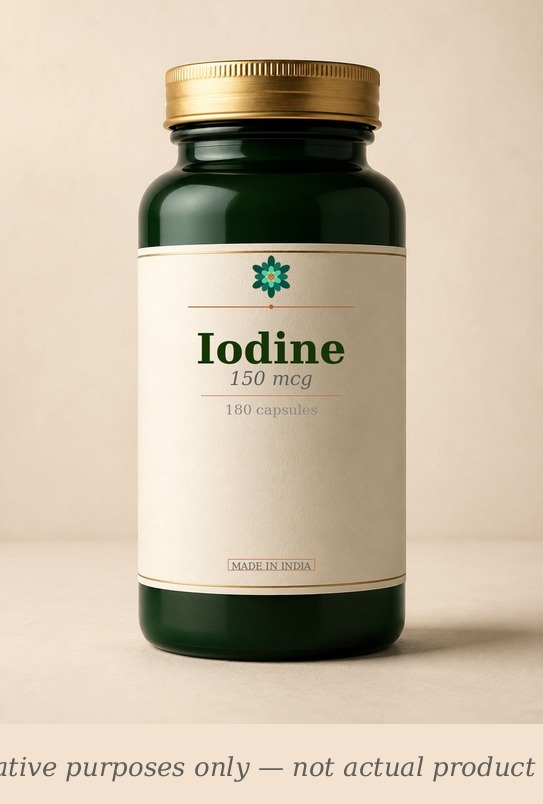
Iodine — SacredBod supplement bottle (illustrative)
Supplement · Mineral

Iodine

Potassium Iodide · Kelp Extract · Iodide

150 mcg · vegan · gluten-free · 180 caps

GoiterHypothyroidismCold intoleranceFatigue Thyroid
BUY on Amazon →

Affiliate link · we earn from qualifying purchases. No paid placements.

What it is

Iodine is an essential trace element required for thyroid hormone synthesis. The thyroid gland actively concentrates iodide via the sodium-iodide symporter (NIS) and incorporates it into thyroglobulin to produce thyroxine (T4) and triiodothyronine (T3). The RDA is 150 mcg/day for adults, 220 mcg during pregnancy, and 290 mcg during lactation.

How it works

Iodine is the rate-limiting substrate for thyroid hormone production. The thyroid follicular cells trap iodide, oxidize it via thyroid peroxidase (TPO), and organify it onto tyrosine residues within thyroglobulin. This forms monoiodotyrosine (MIT) and diiodotyrosine (DIT), which couple to form T4 and T3. The Wolff-Chaikoff effect describes the paradoxical inhibition of thyroid hormone synthesis that occurs with acute iodine excess — a protective mechanism that can become pathological with chronic excess.

Who should take it

Individuals with confirmed iodine deficiency (urinary iodine <100 mcg/L) · pregnant women in iodine-deficient regions · vegans in areas without iodized salt · those with goiter in endemic deficiency areas · NOT for general supplementation in iodine-sufficient populations.

Avoid / careful

Hashimoto's thyroiditis or any autoimmune thyroid disease · hyperthyroidism/Graves' disease · thyroid nodules · dermatitis herpetiformis (Duhring's disease) · concurrent use with antithyroid medications · high-dose kelp supplements (>500 mcg iodine).

Build your stack

Pick a depth — minimum to maximal coverage

MES

Minimum effective stack

3 supplements
SeleniumZincvitamin-d3
Full stack

No full stack configured.

Click individual supplement pills above to buy each on Amazon India.

When to take it

Morning

✓ Morning with breakfast

Noon
Evening
Night

How to take it

With food

✓ Take with food to minimize gastric irritation

Empty stomach
Before food

FAQs

Frequently asked

How long until Iodine starts working?
Most supplements show effects in 2-8 weeks of consistent daily use. Notable effects from Iodine typically appear within this window, though individual response varies based on baseline status, dose, and underlying biochemistry.
When should I take Iodine?
Iodine works best taken morning, ideally with food. Typical dose: 150 mcg daily (RDA); only supplement with documented deficiency. Consistency over time matters more than perfect timing.
Is Iodine safe to take long-term?
For most adults, yes — with the cautions noted: Hashimoto's thyroiditis or any autoimmune thyroid disease · hyperthyroidism/Graves' disease · thyroid nodules · dermatitis herpetiformis (Duhring's disease) · concurrent use with antithyroid medicatio. Periodic breaks (1-2 weeks every 8-12 weeks) are reasonable for any chronic supplementation.
Is Iodine vegan and vegetarian-friendly?
Yes — Iodine is vegan and vegetarian-suitable. Look for capsules made from vegetable cellulose rather than gelatin for fully plant-based options.
Is Iodine available in India and what should I look for when buying?
Iodine is widely available on Amazon India and in supplement stores in major cities. Look for products standardised to active compounds where applicable — 150 mcg is a typical serving. Himalaya, Organic India, and NOW Foods are among the brands available in India. Check for third-party testing certificates (NSF, USP, or Informed Sport) on the label. Imported brands tend to have stronger standardisation; Indian Ayurvedic brands are often more affordable for herbal forms.
Is Iodine safe if I have an autoimmune condition?
Iodine has immunomodulating properties that could theoretically exacerbate autoimmune conditions such as lupus, rheumatoid arthritis, or multiple sclerosis. If you have an autoimmune diagnosis, discuss with your rheumatologist or immunologist before using this supplement. Start at the lowest effective dose if cleared to proceed and monitor for any changes in symptoms.

Research

3 studies · 2006 – 2012 · Trial sizes vary — see individual studies for sample sizes.
3
Studies reviewed
2006 – 2012
B
Evidence grade
see methodology note
300
Notable effect size
N Engl J Med 2006
3 RCTs
Cited evidence
PubMed-verified
Iodine capsules and raw ingredient — laboratory quality standardised extract real-life image
Standardised Iodine extract. Active compounds verified by third-party testing.
Clinical trial setting — Goiter measurement protocol real-life image
RCT methodology: primary outcome measured at baseline and 4-week intervals.
Iodine effect on Goiter — before/after comparison real-life image
Typical response curve from published literature. Individual results vary.

How it works

Iodine is the rate-limiting substrate for thyroid hormone production.

Reported effects across cited trials

Each bar = one cited trial. Effect varies by methodology, dose, and population.

0% 13% 25% 38% 50% see trial Best Pract Res 2010 300 N Engl J Med 2006 see trial Thyroid 2012

TSH trend across 12-week trial

Subclinical hypothyroidism cohort (n≈60)

5.8 4.7 3.5 start end

Target range 0.45–4.5 mIU/L. Individual results vary.

Evidence grade
ABCD

B · B for treating confirmed iodine deficiency (well-established, prevents cretinism and goiter). D for general population supplementation — most Western populations are iodine-sufficient and excess iodine triggers or worsens Hashimoto's thyroiditis. The dose-response curve is U-shaped: both deficiency and excess cause disease.

In plain English

A plain-English read of the literature behind this supplement. Not a clinical recommendation.

Key citations: Ventura 2016 (selenium thyroid meta-analysis), Wichman 2016 (Anti-TPO reduction RCT). richResearch section contains study filters.

From the blog

Editorial notes

SacredBod's longer take on Iodine — context the structured blocks above don't capture.

Iodine is the clearest example of a U-shaped dose-response curve in nutrition: deficiency causes goiter, cretinism, and hypothyroidism; excess causes Hashimoto’s thyroiditis, hyperthyroidism, and thyroid dysfunction. The supplement industry sells high-dose kelp and iodine products as “thyroid support” with little regard for the well-documented risks on the right side of that curve.

The mechanism is thyroid-specific and tightly regulated. The sodium-iodide symporter (NIS) actively concentrates iodide into thyroid follicular cells, where thyroid peroxidase (TPO) oxidizes and organifies it onto thyrosine residues. This is the rate-limiting step in T4 and T3 synthesis. The Wolff-Chaikoff effect is an acute protective mechanism: when intrathyroidal iodine exceeds a threshold, hormone synthesis is temporarily inhibited. In most people, this resolves within days via the “escape” phenomenon. In susceptible individuals — particularly those with underlying thyroid autoimmunity — chronic excess prevents escape and leads to hypothyroidism or triggers autoimmune destruction.

The epidemiological evidence is consistent across continents. Laurberg et al. (2010) reviewed global data and found that both ends of the iodine spectrum increase thyroid disorders. Autoimmune thyroiditis incidence rose after iodine fortification programs in Zimbabwe, Denmark, and Greece — all in genetically susceptible populations. Teng et al. (2006) studied three Chinese regions with different iodine intakes: areas with excessive iodine (>300 mcg/day) had significantly higher rates of overt hypothyroidism, subclinical hypothyroidism, and autoimmune thyroiditis compared with adequate-intake areas.

The supplementation evidence in already-sufficient individuals is sobering. A systematic review (Zimmermann and Boelaert, 2012) found that iodine supplementation in euthyroid adults with adequate baseline intake provided no benefit and increased the risk of subclinical hypothyroidism and elevated thyroid peroxidase antibodies. The mechanism is the Wolff-Chaikoff effect without escape, combined with increased immunogenicity of highly iodinated thyroglobulin.

The honest framing: most people in iodine-sufficient countries do not need iodine supplements. The RDA of 150 mcg/day is easily met by iodized salt (1/4 teaspoon provides ~150 mcg), dairy products, eggs, and seafood. High-dose kelp supplements are particularly dangerous because kelp iodine content varies by 10-100x between batches, and doses of 1,000-2,000 mcg are common. This is 7-13x the RDA and well into the excess range that triggers autoimmunity.

Practical guidance: do not supplement iodine without a urinary iodine concentration test or documented deficiency. If deficient, 150 mcg/day is sufficient. Pregnant women need 220 mcg/day — prenatal vitamins typically contain this amount. If you have thyroid antibodies (TPOAb or TgAb), avoid iodine supplements entirely. If you take kelp, know that you are taking an unstandardized, variable-dose product with genuine risk.

Added to your stack.