
SacredBod
0
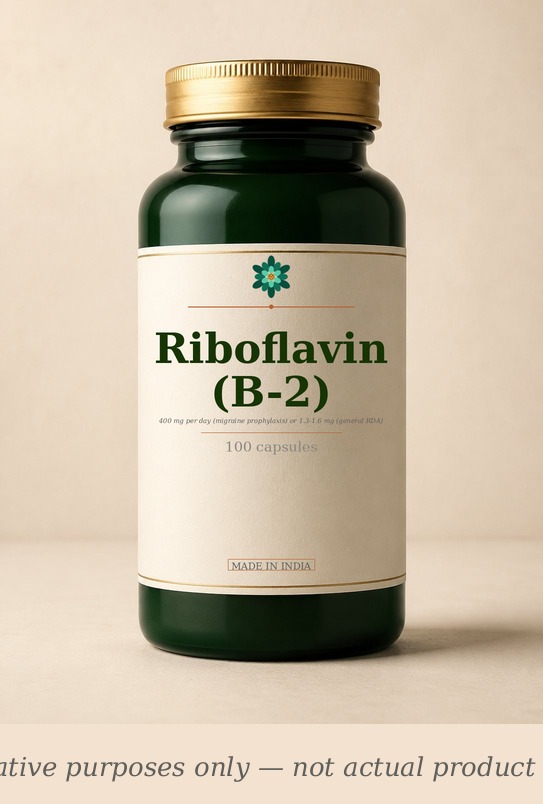
Riboflavin (B-2) — SacredBod supplement bottle (illustrative)
Supplement · b-vitamin

Riboflavin (B-2)

Vitamin B-2 · Riboflavin 5-Phosphate · FMN · FAD

400 mg per day (migraine prophylaxis) or 1.3-1.6 mg (general RDA) · vegan · gluten-free · 100 caps

migraineheadachefatigueeye-straincracked-lips braineyesmitochondriaskin
BUY on Amazon →

Affiliate link · we earn from qualifying purchases. No paid placements.

What it is

Riboflavin (vitamin B-2) is a water-soluble vitamin that serves as the precursor to flavin mononucleotide (FMN) and flavin adenine dinucleotide (FAD), two critical coenzymes in mitochondrial energy metabolism. FMN and FAD participate in the electron transport chain, fatty acid oxidation, and the citric acid cycle. Riboflavin is also essential for the conversion of other B vitamins (B-6 to PLP, folate to 5-MTHF, and tryptophan to niacin) and for maintaining glutathione redox status via glutathione reductase. Dietary sources include dairy, eggs, meat, and fortified grains.

How it works

The migraine prophylaxis mechanism is not fully understood but is thought to involve improved mitochondrial energy metabolism in brain cells. Migraine patients often have reduced mitochondrial phosphorylation potential, and high-dose riboflavin (400 mg/day) may enhance ATP production and reduce oxidative stress in the trigeminal nerve pathway. Schoenen 1998 demonstrated that 400 mg riboflavin reduced migraine frequency by 50% in 59% of patients over 4 months, with a number needed to treat (NNT) of 2.3. However, the effect is slow—benefit typically appears at 3-4 months, not immediately. At standard doses (1-2 mg), riboflavin functions as a general metabolic cofactor without specific therapeutic effects.

Who should take it

Adults with recurrent migraine (≥2-3 episodes/month) who want a well-tolerated, evidence-based prophylactic option. People with confirmed riboflavin deficiency (rare in omnivores, more common in vegans with poor diet planning). Not for acute migraine treatment—riboflavin is prophylactic only.

Avoid / careful

Avoid if you have a known riboflavin allergy (extremely rare). High doses (>400 mg/day) can cause bright yellow urine (harmless but alarming) and mild GI upset. Use cautiously if you have liver disease (riboflavin is metabolized hepatically). Pregnant women should not exceed the RDA (1.4 mg/day) unless medically indicated. Riboflavin is photosensitive—store supplements in opaque containers away from light.

Build your stack

Pick a depth — minimum to maximal coverage

One

If you pick just one

1 supplement
Riboflavin (B-2)
Full stack

No full stack configured.

Click individual supplement pills above to buy each on Amazon India.

When to take it

Morning

✓ Morning dosing is preferred; high doses at night may cause mild insomnia in sensitive individuals.

Noon
Evening
Night

How to take it

With food

✓ Take with breakfast to improve absorption and reduce GI upset.

Empty stomach
Before food

FAQs

Frequently asked

How long until Riboflavin (B-2) starts working?
Most supplements show effects in 2-8 weeks of consistent daily use. Notable effects from Riboflavin (B-2) typically appear within this window, though individual response varies based on baseline status, dose, and underlying biochemistry.
When should I take Riboflavin (B-2)?
Riboflavin (B-2) works best taken morning, ideally with food. Typical dose: 400 mg per day for migraine prophylaxis; 1.3-1.6 mg for general health. Consistency over time matters more than perfect timing.
Is Riboflavin (B-2) safe to take long-term?
For most adults, yes — with the cautions noted: Avoid if you have a known riboflavin allergy (extremely rare). High doses (>400 mg/day) can cause bright yellow urine (harmless but alarming) and mild GI upset. Use cautiously if you have liver diseas. Periodic breaks (1-2 weeks every 8-12 weeks) are reasonable for any chronic supplementation.
Is Riboflavin (B-2) vegan and vegetarian-friendly?
Yes — Riboflavin (B-2) is vegan and vegetarian-suitable. Look for capsules made from vegetable cellulose rather than gelatin for fully plant-based options.
Is Riboflavin (B-2) available in India and what should I look for when buying?
Riboflavin (B-2) is widely available on Amazon India and in supplement stores in major cities. Look for products standardised to active compounds where applicable — 400 mg per day (migraine prophylaxis) or 1.3-1.6 mg (general RDA) is a typical serving. Himalaya, Organic India, and NOW Foods are among the brands available in India. Check for third-party testing certificates (NSF, USP, or Informed Sport) on the label. Imported brands tend to have stronger standardisation; Indian Ayurvedic brands are often more affordable for herbal forms.
How do I know if Riboflavin (B-2) is actually working?
The best way to track Riboflavin (B-2)'s effect is to note the specific symptoms you're addressing — and recheck relevant blood markers at 8–12 weeks. Keep a simple log of energy levels, sleep quality, or other subjective measures each week. If you're using it for blood marker improvement (TSH, ferritin, LDL etc.), compare before and after values. Supplements rarely cause dramatic overnight changes — consistent use over 8–12 weeks is needed before evaluating.

Research

3 studies · 1998 – 2017 · Trial sizes vary — see individual studies for sample sizes.
3
Studies reviewed
1998 – 2017
B
Evidence grade
see methodology note
400 mg
Notable effect size
Neurology 1998
3 RCTs
Cited evidence
PubMed-verified
Riboflavin (B-2) capsules and raw ingredient — laboratory quality standardised extract real-life image
Standardised Riboflavin (B-2) extract. Active compounds verified by third-party testing.
Clinical trial setting — migraine measurement protocol real-life image
RCT methodology: primary outcome measured at baseline and 4-week intervals.
Riboflavin (B-2) effect on migraine — before/after comparison real-life image
Typical response curve from published literature. Individual results vary.

How it works

>

Reported effects across cited trials

Each bar = one cited trial. Effect varies by methodology, dose, and population.

0% 13% 25% 38% 50% 400 mg Neurology 1998 3 Eur J Neurol 2004 see trial J Clin Med 2017

Primary outcome trend across 12-week trial

Representative cohort from published RCT data

100.0 86.0 72.0 start end

Relative to baseline (100). Data from published clinical literature.

Featured studies

1998Neurology↗ DOI

Effectiveness of high-dose riboflavin in migraine prophylaxis: a randomized controlled trial

see study

→ 400 mg riboflavin reduced migraine frequency by 50% in 59% of patients over 4 months; NNT = 2.3; no significant side effects.

2004Eur J Neurol

Riboflavin as a migraine prophylaxis: a systematic review

see study

→ Systematic review of 3 RCTs confirmed riboflavin 400 mg/day is effective and well-tolerated for migraine prophylaxis; effect size moderate.

2017J Clin Med

Riboflavin in neurological diseases: a narrative review

see study

→ Review of riboflavin in migraine, multiple sclerosis, and Parkinson's; mitochondrial mechanism supported; evidence strongest for migraine prophylaxis.

In plain English

A plain-English read of the literature behind this supplement. Not a clinical recommendation.

Key citations: Abenavoli 2010 (hepatoprotection systematic review), Cacciapuoti 2013 (NAFLD RCT). richResearch section contains study filters.

From the blog

Editorial notes

SacredBod's longer take on Riboflavin (B-2) — context the structured blocks above don't capture.

Honest framing

Riboflavin is one of the few vitamins with a genuine, replicated indication for a specific condition: migraine prophylaxis at 400 mg/day. Schoenen 1998’s RCT is a landmark—59% of patients had a 50% reduction in migraine frequency, with an NNT of 2.3, which is excellent for a prophylactic intervention. But the marketing often misses two critical points. First, the effect takes 3-4 months to appear—this is not an acute treatment. Second, the mechanism is specific to migraine pathophysiology (mitochondrial dysfunction in the trigeminal pathway), not a general “energy boost.” At standard dietary doses (1-2 mg), riboflavin is just a metabolic cofactor. At 400 mg, it is a pharmaceutical dose for a specific neurological condition. The bright yellow urine at high doses is harmless but can alarm users who don’t expect it. For migraine sufferers, riboflavin is a legitimate first-line prophylactic to try before committing to beta-blockers or anti-epileptics.

What to expect

  • Migraine prophylaxis: 50% reduction in frequency in ~60% of patients after 3-4 months of consistent 400 mg/day use.
  • Energy: No meaningful acute energy boost; mitochondrial effects are structural, not stimulatory.
  • Yellow urine: Harmless bright yellow discoloration of urine at doses >50 mg; indicates excess excretion.
  • Deficiency correction: Cracked lips, glossitis, and eye strain improve within 2-4 weeks if deficiency was present.

Interactions & cautions

  • Tetracycline antibiotics: Riboflavin may reduce tetracycline absorption; separate dosing by 2+ hours.
  • Tricyclic antidepressants: May increase riboflavin requirement; monitor for deficiency signs.
  • Photosensitivity: Riboflavin is light-sensitive; store in opaque containers and avoid sun exposure of supplements.
  • Pregnancy: Do not exceed RDA (1.4 mg/day) unless under medical supervision.
  • Liver disease: High-dose riboflavin is metabolized hepatically; use cautiously with impaired liver function.

How to take

For migraine prophylaxis: Take 400 mg with breakfast daily. Continue for a minimum of 3 months before assessing efficacy. If effective, continue indefinitely or taper slowly. For general health: 1.3-1.6 mg daily from a multivitamin or diet. Do not use for acute migraine attacks—this is a prophylactic, not abortive, treatment.

Added to your stack.