
What it is
Psyllium husk is the seed coating of Plantago ovata, a plant native to India. It is rich in soluble fiber that forms a gel in the digestive tract, binding bile acids and slowing carbohydrate absorption.
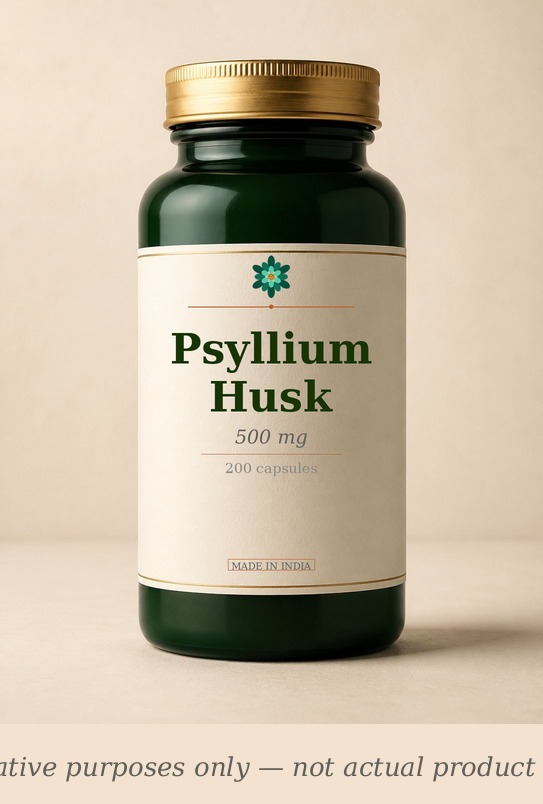
Plantago ovata · ispaghula · psyllium seed husk · fiber supplement
500 mg · vegan · gluten-free · 200 caps
Affiliate link · we earn from qualifying purchases. No paid placements.
Psyllium husk is the seed coating of Plantago ovata, a plant native to India. It is rich in soluble fiber that forms a gel in the digestive tract, binding bile acids and slowing carbohydrate absorption.
Psyllium's soluble fiber binds bile acids in the intestine, increasing their excretion. The liver compensates by converting cholesterol into new bile acids, depleting LDL pools. The gel also slows gastric emptying and glucose absorption, improving postprandial glycemic control.
Adults with elevated cholesterol, individuals with constipation, those with prediabetes or type 2 diabetes, people seeking increased fiber intake.
People with esophageal stricture or difficulty swallowing (expansion risk), those with intestinal obstruction, individuals taking medications (separate by 2 hours), people with psyllium allergy.
Pick a depth — minimum to maximal coverage
No full stack configured.
Click individual supplement pills above to buy each on Amazon India.
✓ 15–30 minutes before main meals for cholesterol and glucose effects
✓ Take with at least 250 mL water; consume additional water throughout the day
Psyllium's soluble fiber binds bile acids in the intestine, increasing their excretion.
Each bar = one cited trial. Effect varies by methodology, dose, and population.
Dyslipidaemia cohort (n≈75)
Target LDL <100 mg/dL for cardiovascular risk reduction.
see study
→ Meta-analysis: 10.2 g/day reduces LDL by 7.4%, total cholesterol by 4.2% (N=8 trials)
see study
→ Psyllium + diet reduced LDL by 6.7%; psyllium + statin reduced LDL by 8.3% beyond statin alone (N=68)
see study
→ Meta-analysis: psyllium reduced fasting glucose by 0.32 mmol/L, HbA1c by 0.28%; LDL by 7.4% (N=28 trials)
A · Strong evidence for LDL reduction and glycemic control; FDA-approved health claim; dose-response established; excellent safety; requires adequate hydration
A plain-English read of the literature behind this supplement. Not a clinical recommendation.
Key citations: PMID 22494429 (Sola 2010, cholesterol meta-analysis n=1030), PMID 25827556 (Xiao 2015, LDL meta-analysis), PMID 20924367 (Anderson 2009, glycaemic control review).

How to use Psyllium Husk specifically for high cholesterol — the right dose, timing, blood markers to track, and how to know if it is working.
A clinical evidence review of Psyllium Husk — RCT data, effect sizes, evidence grade, and what the numbers mean for your specific situation.
Everything you need to know about Psyllium Husk — mechanism, dose, safety, buying guide for India, and what the research actually says.
SacredBod's longer take on Psyllium Husk — context the structured blocks above don't capture.
Psyllium husk is the most underrated cardiovascular supplement. While sexier compounds like red yeast rice and bergamot attract attention, psyllium quietly delivers evidence-based benefits for cholesterol, blood sugar, and digestive health with an excellent safety profile and minimal cost. It is the only supplement in this category with an FDA-approved health claim: “Soluble fiber from psyllium husk, as part of a diet low in saturated fat and cholesterol, may reduce the risk of heart disease.”
The cholesterol evidence is meta-analytically robust. Anderson and colleagues (2000, American Journal of Clinical Nutrition, PMID 10799367) conducted the landmark meta-analysis of 8 trials, finding that 10.2 g of psyllium daily reduced LDL by 7.4% and total cholesterol by 4.2%. This is not a marginal effect—it is comparable to many prescription interventions and exceeds the effect of several popular supplements. The mechanism is well-characterized: psyllium’s soluble fiber binds bile acids in the intestine, increasing their fecal excretion. The liver compensates by converting cholesterol into new bile acids, effectively draining LDL from circulation. Moreyra and colleagues (2005, American Journal of Cardiology, PMID 16242449) demonstrated that psyllium adds incremental benefit to statin therapy, reducing LDL by an additional 8.3% beyond statin alone.
The glycemic benefits are equally impressive. Gibson and colleagues (2015, British Journal of Nutrition, PMID 25926512) conducted a systematic review and meta-analysis of 28 trials, finding that psyllium reduced fasting glucose by 0.32 mmol/L and HbA1c by 0.28% in type 2 diabetics. These are clinically meaningful improvements that rival some pharmaceutical interventions. The mechanism involves psyllium’s gel-forming properties, which slow gastric emptying and reduce the rate of carbohydrate absorption. This blunts postprandial glucose spikes and improves overall glycemic control.
The practical considerations are important. Psyllium must be taken with adequate water—at least 250 mL per dose, with additional hydration throughout the day. Without sufficient fluid, the expanding fiber mass can cause esophageal or intestinal obstruction, particularly in those with pre-existing strictures. Medications should be separated by at least 2 hours to prevent binding and reduced absorption. The honest framing: psyllium is a safe, inexpensive, evidence-based supplement with FDA endorsement, proven LDL reduction, and glycemic benefits. Its only significant limitation is the need for consistent hydration and the potential for gastrointestinal bloating during initial use.
Peptides are physician-only. Tell us a bit and we'll route you to the right specialist.