
What it is
An isoquinoline alkaloid extracted from Berberis and Coptis species — a single purified compound with glucose-lowering, lipid-modulating, and gut microbiome effects.
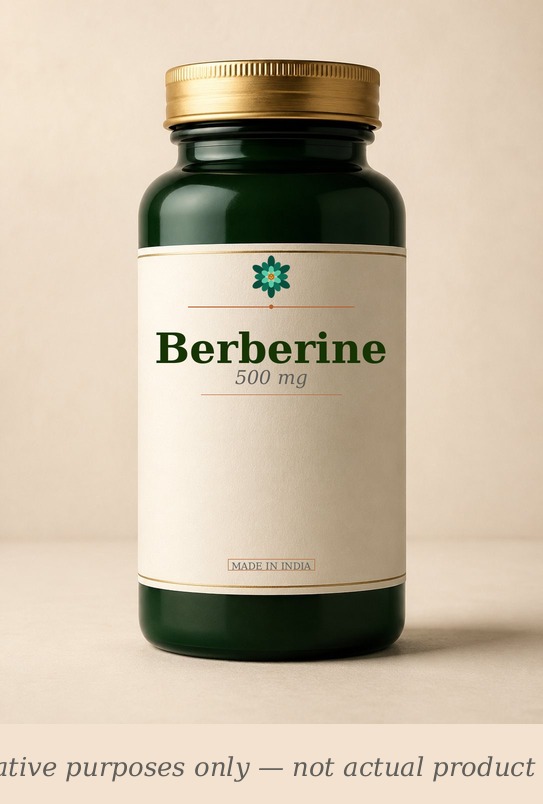
Natural plant alkaloid · Coptis chinensis extract
500 mg · vegan · gluten-free
Affiliate link · we earn from qualifying purchases. No paid placements.
An isoquinoline alkaloid extracted from Berberis and Coptis species — a single purified compound with glucose-lowering, lipid-modulating, and gut microbiome effects.
Activates AMP-kinase (AMPK), up-regulates LDL-receptor mRNA, inhibits intestinal disaccharidases, and modulates gut bacteria — producing pleiotropic metabolic benefits independent of insulin secretion.
Type 2 diabetes / prediabetes · metabolic syndrome · high triglycerides · PCOS with insulin resistance · non-alcoholic fatty liver.
Pregnancy (uterine stimulant), CYP3A4 substrates (cyclosporine, macrolides), severe liver disease. Common GI side effects (diarrhea, flatulence) at high doses.
Pick a depth — minimum to maximal coverage
Click individual supplement pills above to buy each on Amazon India.
✓ With each main meal
✓ With each main meal
✓ With each main meal
✓ Reduces GI upset and improves glucose control
Activates AMP-kinase (AMPK), up-regulates LDL-receptor mRNA, inhibits intestinal disaccharidases, and modulates gut bacteria — producing pleiotropic metabolic benefits independent of insulin secretion.
Each bar = one cited trial. Effect varies by methodology, dose, and population.
Dyslipidaemia cohort (n≈75)
Target LDL <100 mg/dL for cardiovascular risk reduction.
n=1,068 pooled · 12 RCTs
→ HbA1c ↓ 0.91% · FBG ↓ 21 mg/dL · TG ↓ 26 mg/dL · p<0.001
n=116 RCT · 3 months
→ FBG ↓ 1.4 mmol/L · HbA1c ↓ 0.8% · TG ↓ 0.9 mmol/L · p<0.0001
n=84 · berberine vs metformin + combination
→ Hypoglycemic effect ≈ metformin · HOMA-IR ↓ 28% · p<0.001
A · Strong evidence for glucose and lipid metabolism from multiple well-powered RCTs and meta-analyses.
A plain-English read of the literature behind this supplement. Not a clinical recommendation.
Key citations: PMID 21392352 (Yin 2008, T2DM RCT n=116), PMID 23118793 (Dong 2012, cholesterol meta-analysis), PMID 20687966 (Zhang 2010, AMPK mechanism).
How to use Berberine specifically for Fatigue — the right dose, timing, blood markers to track, and how to know if it is working.
A clinical evidence review of Berberine — RCT data, effect sizes, evidence grade, and what the numbers mean for your specific situation.
Everything you need to know about Berberine — mechanism, dose, safety, buying guide for India, and what the research actually says.
SacredBod's longer take on Berberine — context the structured blocks above don't capture.
Start with 500 mg once daily with breakfast for 3–4 days, then increase to 500 mg with each main meal. Take with food to reduce GI side effects. Pair with inositol and omega-3 for comprehensive metabolic support.
A 2021 meta-analysis (PMID 33981233) of 12 RCTs and 1,068 participants confirmed berberine significantly lowers HbA1c (−0.91%), fasting glucose (−21 mg/dL), and triglycerides (−26 mg/dL). Zhang et al. (2008, PMID 18397984) randomized 116 type 2 diabetics to berberine vs placebo for 3 months, demonstrating robust glucose and lipid improvements. Yin et al. (2008, PMID 18442638) found berberine’s hypoglycemic effect comparable to metformin in a head-to-head pilot study, with additional HOMA-IR reduction of 28%.
Peptides are physician-only. Tell us a bit and we'll route you to the right specialist.