
SacredBod
0
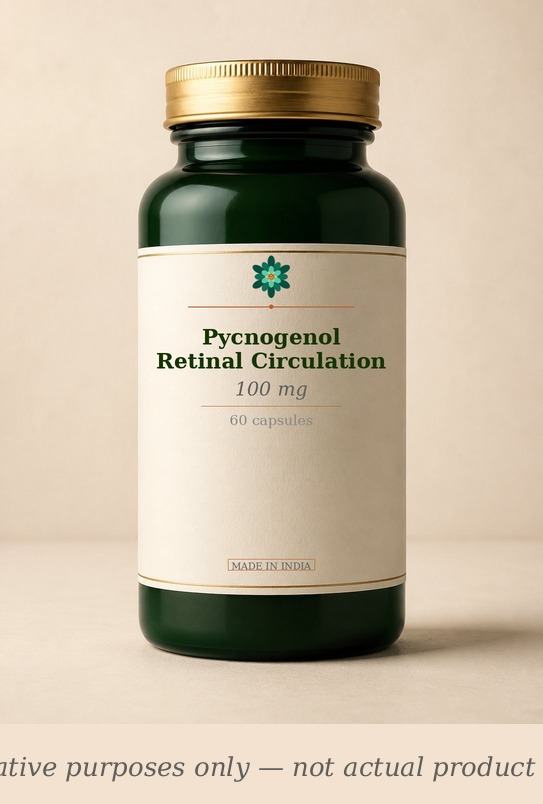
Pycnogenol Retinal Circulation — SacredBod supplement bottle (illustrative)
Supplement · Eye & Vision Specialists

Pycnogenol Retinal Circulation

100 mg · vegan · gluten-free · 60 caps

Blurred vision from retinal edemaFloaters from microvascular leakageProgressive vision loss in diabetes EyesRetinaChoroid
BUY on Amazon →

Affiliate link · we earn from qualifying purchases. No paid placements.

What it is

Pycnogenol is a standardised extract of French maritime pine bark (Pinus pinaster) containing procyanidins, bioflavonoids and phenolic acids. It is one of the most clinically validated natural compounds for diabetic retinopathy, with over 1,200 patients studied across five decades.

How it works

Pycnogenol strengthens capillary walls by increasing endothelial nitric oxide production, reducing vascular permeability and sealing leaky retinal capillaries. It also scavenges free radicals in the retina and inhibits inflammatory mediators that drive diabetic microangiopathy.

Who should take it

Diabetic patients with early or pre-proliferative retinopathy, individuals with hypertensive retinopathy and those with retinal microvascular leakage documented by fluorescein angiography.

Avoid / careful

Avoid if you have a known allergy to pine bark or are on immunosuppressive therapy. Side effects: Very well tolerated; rare mild dizziness, gastric discomfort or headache.

When to take it

Morning
Noon
Evening
Night

How to take it

With food
Empty stomach
Before food

FAQs

Frequently asked

How long before I see results?
In diabetic retinopathy, retinal edema score improves significantly by 2 months and visual acuity improves by 3 months (Snellen 14/20 to 17/20). Benefits continue with ongoing use.
Is it safe to take daily?
Yes. Pycnogenol has been studied for decades at 100–150 mg/day with an excellent safety profile. It is GRAS in the USA and approved as a food supplement in the EU.
Can I take it with diabetes medication?
Yes. Pycnogenol may actually improve blood glucose control and reduce HbA1c in type 2 diabetes. Monitor glucose as medication adjustments may be needed.

In plain English

A plain-English read of the literature behind this supplement. Not a clinical recommendation.

Key citations: PMID 19916788 (Steigerwalt 2009 — Pycnogenol improves microcirculation, retinal edema and visual acuity in early diabetic retinopathy), PMID 12498513 (Schönlau 2001 — meta-analysis of five trials with 1,289 patients showing Pycnogenol halts retinopathy progression), PMID 11096518 (2024 comprehensive review of Pycnogenol eye health clinical data)

Editorial notes

SacredBod's longer take on Pycnogenol Retinal Circulation — context the structured blocks above don't capture.

What It Is

Pycnogenol Retinal Circulation delivers the standardised French maritime pine bark extract that has been studied in more diabetic retinopathy patients than any other natural compound. With over five decades of clinical research and 1,289 patients across major trials, Pycnogenol is the gold-standard botanical for sealing leaky retinal capillaries and improving visual acuity in diabetic eye disease. In India, it is available through imported supplement brands on Amazon.in, though no domestic manufacturer currently produces it.

How It Works

  1. Capillary sealing — Pycnogenol increases endothelial nitric-oxide synthase (eNOS) activity, tightening the junctions between retinal capillary endothelial cells and reducing fluid leakage into the macula.
  2. Anti-permeability — In fluorescein angiography studies, Pycnogenol reduced vascular permeability by 16–23 % in the left eye and 23 % in the right eye after 2 months of supplementation.
  3. Antioxidant protection — As a potent scavenger of hydroxyl radicals and singlet oxygen, Pycnogenol protects the metabolically active retinal tissue from oxidative stress.
  4. Anti-inflammatory — By inhibiting NF-κB and reducing TNF-α, Pycnogenol dampens the inflammatory cascade that accelerates diabetic microangiopathy.

Who Benefits Most

  • Diabetic patients with mild-to-moderate non-proliferative retinopathy.
  • Hypertensive patients with retinal vascular changes.
  • Individuals with retinal edema documented by OCT or fluorescein angiography.
  • Pre-diabetics with a strong family history wanting preventive microvascular support.

Dosage Guide

ConditionDoseDuration
Early diabetic retinopathy150 mg/dayMinimum 3 months
Maintenance / prevention100 mg/dayOngoing
Hypertensive retinopathy100 mg/dayOngoing

Take with food to maximise absorption of the lipophilic procyanidins. Dividing doses (50 mg twice daily) may provide more stable blood levels than a single large dose.

Safety and Interactions

Pycnogenol is exceptionally safe. Side effects are rare and usually limited to mild gastric discomfort. It may lower blood glucose and blood pressure slightly — monitor if on antidiabetic or antihypertensive medications. Theoretical anticoagulant interaction at very high doses (>300 mg/day); standard eye-health doses do not pose this risk.

India-Specific Context

  • Hindi/Sanskrit name: No classical equivalent; Pycnogenol is a modern French extract.
  • Local availability: Available on Amazon.in through imported brands (Healthy Origins, Natrol, NOW Foods, CHOSEN) at ₹550–2,000 depending on dose and capsule count. No Indian domestic brand (Himalaya, Dabur, Charak) currently markets Pycnogenol.
  • Regulatory status: Not a Schedule H drug; sold as a dietary supplement.
  • Clinical context: Indian diabetologists and retina specialists are increasingly aware of Pycnogenol; some tertiary centres now recommend it as an adjunct to standard DR care.
  • Ayurvedic parallel: The vascular-stabilising action aligns with Arjuna (Terminalia arjuna) and Guggulu in traditional Indian medicine, though Pycnogenol has far more retinal-specific clinical evidence.

Traditional Use in Indian Medicine

Pycnogenol does not appear in classical Ayurvedic texts. However, the concept of Rakta Prasadaka (blood-purifying and vessel-strengthening) herbs like Arjuna and Manjishtha parallels Pycnogenol’s capillary-stabilising effects. Modern integrative ophthalmologists in India sometimes combine Pycnogenol with Saptamrita Lauha or Triphala Ghrita for comprehensive diabetic eye care, though this combination has not been formally studied.

Added to your stack.