
SacredBod
0
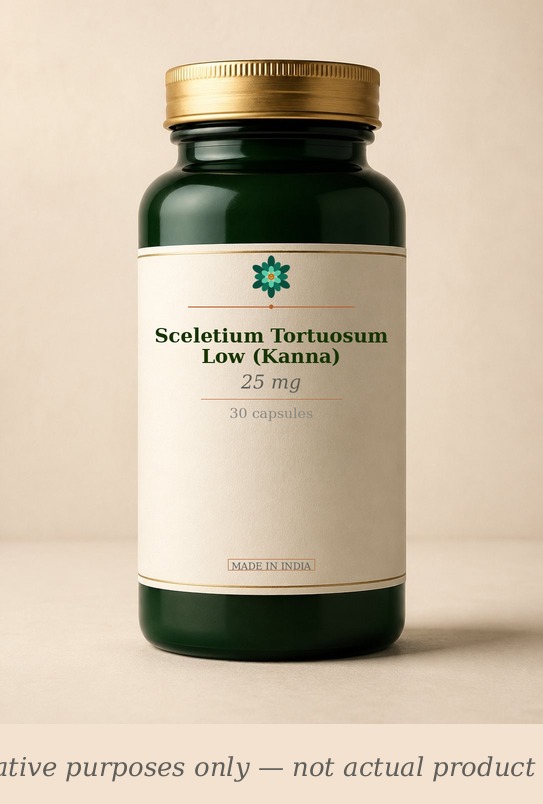
Sceletium Tortuosum Low (Kanna) — SacredBod supplement bottle (illustrative)
Supplement · Mood, Anxiety & Emotional Balance

Sceletium Tortuosum Low (Kanna)

25 mg · vegan · gluten-free · 30 caps

Low moodMild depressionStressAnxietySocial withdrawalAnhedonia BrainAmygdalaHippocampusPrefrontal cortex
BUY on Amazon →

Affiliate link · we earn from qualifying purchases. No paid placements.

What it is

Sceletium tortuosum, commonly known as kanna or channa, is a succulent plant native to South Africa. It has been used for millennia by San and Khoikhoi peoples as a masticatory and medicine for stress, hunger, and mood enhancement. The standardised extract Zembrin (25mg) contains mesembrine, mesembrenine, and mesembrenol — alkaloids that act as dual serotonin reuptake inhibitors (SRI) and phosphodiesterase-4 (PDE4) inhibitors. A pharmaco-fMRI study confirmed acute amygdala reactivity reduction after a single 25mg dose.

How it works

Mesembrine and related alkaloids inhibit the serotonin transporter (SERT), increasing synaptic serotonin levels — the same mechanism as SSRIs. Additionally, they inhibit phosphodiesterase-4 (PDE4), increasing cAMP and CREB-mediated gene expression for neuroplasticity. The 2013 fMRI study showed that a single 25mg dose of Zembrin attenuated amygdala reactivity to fearful faces and reduced amygdala-hypothalamus coupling — demonstrating direct modulation of the brain's threat circuitry.

Who should take it

Adults with mild depression, anxiety, or stress-related low mood; individuals seeking a rapid-acting mood enhancer; those interested in ethnobotanical medicines with modern neuroimaging validation; and biohackers targeting the serotonin-PDE4 dual pathway.

Avoid / careful

Pregnant or breastfeeding women; individuals with bipolar disorder (may trigger mania); those on SSRIs or MAOIs (additive serotonergic effect — risk of serotonin syndrome); people with severe anxiety disorders (may paradoxically increase anxiety in some individuals). Side effects: Generally well tolerated. Mild headache, nausea, or dizziness in some users. Rare insomnia if taken late in the day. The 2025 animal study noted that higher doses (25mg/kg) paradoxically decreased cortical glutathione, suggesting a narrow therapeutic window.

When to take it

Morning
Noon
Evening
Night

How to take it

With food
Empty stomach
Before food

FAQs

Frequently asked

How quickly does it work?
The 2013 fMRI study showed that a single 25mg dose reduced amygdala reactivity to fearful faces within hours. For sustained mood improvement, 2–4 weeks of daily use is needed. The animal study (Gericke 2025) showed that 12.5mg/kg was more effective than 25mg/kg for anhedonia and anxiety, suggesting a narrow therapeutic window where lower doses may be optimal.
Is it an SSRI?
Functionally yes — mesembrine inhibits the serotonin transporter (SERT), increasing synaptic serotonin. However, kanna also inhibits PDE4, which SSRIs do not. This dual mechanism may provide faster onset and additional neuroplasticity benefits. Despite the serotonergic mechanism, clinical trials have not reported sexual dysfunction or emotional blunting — the most common SSRI side effects.
Can I take it with my antidepressant?
No. Combining kanna with SSRIs, SNRIs, or MAOIs carries a real risk of serotonin syndrome — a potentially life-threatening condition characterised by agitation, confusion, rapid heartbeat, and hyperthermia. If you are on any serotonergic medication, do not use kanna without explicit psychiatric supervision.

In plain English

A plain-English read of the literature behind this supplement. Not a clinical recommendation.

Key citations: PMID 23903032 (Acute fMRI effects of Zembrin on amygdala — Terburg et al. 2013), PMID 40643548 (Neuro-inflammatory and behavioral effects of Sceletium — Gericke et al. 2025), PMID 24456909 (complementary Silexan evidence)

Editorial notes

SacredBod's longer take on Sceletium Tortuosum Low (Kanna) — context the structured blocks above don't capture.

What Sceletium Tortuosum Low Is

Sceletium tortuosum, commonly known as kanna or channa, is a succulent ground-cover plant native to the semi-arid regions of South Africa. For over 3,000 years, the San and Khoikhoi peoples have chewed, smoked, or snuffed kanna for its mood-elevating, stress-relieving, and hunger-suppressing effects. European colonial farmers later adopted it as a psychotropic tincture.

Zembrin is a patented, standardised extract of Sceletium tortuosum manufactured by HG&H Pharmaceuticals in South Africa. It is standardised for mesembrine, mesembrenine, and mesembrenol content — the primary psychoactive alkaloids. The extract is produced from sustainably cultivated plants and has been evaluated in both human neuroimaging studies and animal models of depression.

How It Works

  1. Serotonin reuptake inhibition (SRI) — Mesembrine binds to the serotonin transporter (SERT), blocking serotonin reuptake and increasing synaptic concentrations. This is the same mechanism as escitalopram, sertraline, and fluoxetine.
  2. PDE4 inhibition — Mesembrenine inhibits phosphodiesterase-4, increasing cAMP levels and activating CREB — the transcription factor that upregulates BDNF and other neuroplasticity genes. This is the mechanism of prescription PDE4 inhibitors like roflumilast.
  3. Amygdala modulation — The 2013 fMRI study demonstrated that Zembrin attenuates amygdala reactivity to threat stimuli and reduces amygdala-hypothalamus functional connectivity.
  4. Anti-inflammatory — The 2025 animal study showed that Zembrin increased plasma IL-10 (anti-inflammatory) and reduced hippocampal PDE4B expression.
  5. Monoaminergic enhancement — Increases cortical dopamine and hippocampal serotonin in animal models.

Who Benefits Most

  • Mild depression sufferers — The dual SRI + PDE4 mechanism offers a multimodal approach.
  • Social anxiety patients — Amygdala reactivity reduction may specifically help social threat processing.
  • SSRI non-responders — The PDE4 component addresses a pathway that SSRIs do not target.
  • Ethnobotanical enthusiasts — One of the few African traditional medicines with modern neuroimaging validation.
  • Biohackers — The serotonin-PDE4 combination is unique among natural supplements.

Dosage Guide

GoalDoseDuration
Mood elevation25 mg/day4–6 weeks
Acute anxiety25 mg single doseAs needed
Stress resilience25 mg/day4–8 weeks
Cognitive support12.5–25 mg/dayOngoing

Take with breakfast. The animal study suggests lower doses (12.5mg equivalent) may be more effective than higher doses for mood.

Safety & Interactions

  • Serotonin syndrome: Absolute contraindication with SSRIs, SNRIs, MAOIs, tramadol, or St. John’s Wort.
  • Bipolar: May trigger mania; avoid.
  • Stimulants: Additive CNS activation.
  • Pregnancy: Not recommended.
  • Glutathione: High doses may reduce cortical glutathione; use antioxidant support if concerned.

India-Specific Context

  • Availability: Kanna/Zembrin is not available on Amazon.in as of May 2026. It is sold in the USA (e.g., Nootropics Depot, LiftMode) and South Africa. Indian users may need to import from international vendors.
  • Regulatory status: Sceletium tortuosum is not scheduled under India’s Narcotic Drugs and Psychotropic Substances Act, nor is it approved by CDSCO. It exists in a grey area — sold as a “research compound” or dietary supplement by some vendors.
  • Ayurvedic parallel: Kanna has no direct Ayurvedic equivalent. The closest conceptual parallels are Brahmi (Bacopa monnieri) for mood and Jatamansi (Nardostachys jatamansi) for anxiety. However, kanna’s SRI + PDE4 mechanism is entirely distinct from classical Indian nervines.
  • Import cost: Zembrin capsules cost approximately $25–40 for 30 capsules plus shipping (roughly ₹2,500–4,500 total).
  • Cultural note: Kanna is sometimes confused with cannabis (also called “kanna” in some Indian contexts). They are completely different plants with different mechanisms.
  • Quality warning: Only purchase from vendors who provide third-party alkaloid testing. Raw kanna powder varies wildly in mesembrine content.
Added to your stack.