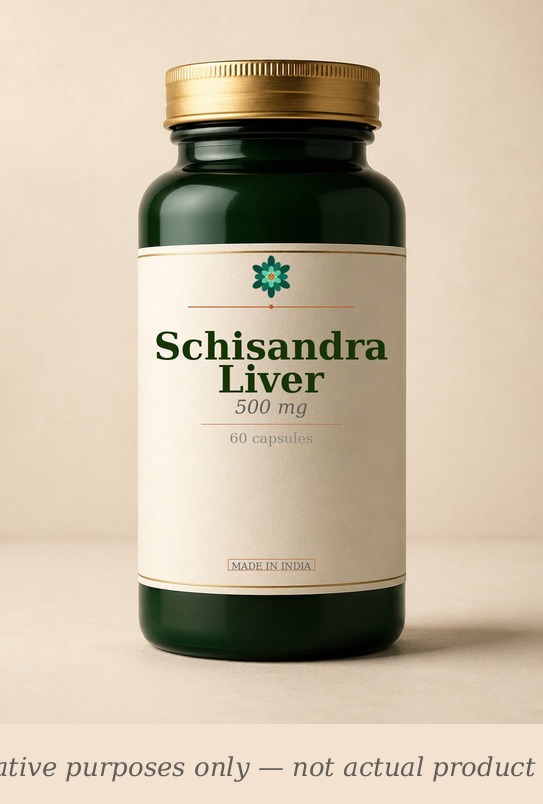
SacredBod's longer take on Schisandra Liver — context the structured blocks above don't capture.
What It Is
Schisandra chinensis (Turcz.) Baill. — known as Wu Wei Zi (Five-Flavour Berry) in Chinese — is a deciduous woody vine native to northern China and Russia whose berries uniquely contain all five tastes: sweet, sour, salty, bitter and pungent. It has been a premier liver tonic, adaptogen and astringent in traditional Chinese medicine (TCM) for over 2,000 years, first documented in the Shen Nong Ben Cao Jing. In Russia, it was adopted into official medicine as an adaptogen for physical and mental performance. In India, Schisandra is not an Ayurvedic herb and has no Charaka Samhita entry; it is sold as an imported TCM adaptogen by Shree Herbal, Nature’s Way and Health Roots.
How It Works
Schisandra berries contain over 30 lignans, primarily schisandrin, schisandrin B and gomisins. These compounds exert hepatoprotection through: (1) antioxidant enhancement — increasing SOD, GSH-Px and GSH while reducing MDA, (2) anti-inflammatory action — reducing TNF-α, IL-6 and IL-1β, (3) anti-apoptotic protection — modulating Bax/Bcl-2 to prevent hepatocyte death, and (4) phase-I metabolism protection — a 1999 study showed that schisandra lignan fraction (160 mg/kg) normalised antipyrine clearance, SGPT, SGOT and cytochrome P450 levels in CCl4-damaged rat livers. A 2025 systematic review and preclinical meta-analysis of 54 animal studies found that Schisandra chinensis significantly reduced ALT (SMD = −4.74, p < 0.001) and AST (SMD = −5.10, p < 0.001) across diverse liver injury models.
Who Benefits Most
Adults with elevated liver enzymes, NAFLD, or those on hepatotoxic medications needing phase-I metabolism support. It is valued in TCM for “astringing essence” and protecting the liver from chemical damage. Not for acute hepatitis or severe cirrhosis.
Dosage Guide
- Berry extract capsules/tablets: 500 mg once or twice daily with food (standardised to 2–9% schisandrins)
- Traditional TCM dose: 1.5–6 g dried berry daily
- Cycle: Continuous daily use is safe at standard doses
Safety and Interactions
Well tolerated at moderate doses. Mild GI upset or heartburn may occur. Because schisandra modulates cytochrome P450 enzymes (both inhibiting and inducing depending on context), use cautiously with warfarin, phenytoin, and other CYP3A4/CYP2C9 substrates. Contraindicated in epilepsy and pregnancy.
India-Specific Context
Schisandra is a new import category on Amazon.in, available primarily from Shree Herbal (extract tablets, ₹400–₹600), Nature’s Way (₹2,500–₹3,500) and in adaptogenic blends from Health Roots (₹700). Standalone standardised capsules are scarce. It is not a scheduled drug. Because it is foreign to Ayurveda, there is no dosha classification, though its five tastes suggest a broad balancing action. Indian consumers seeking domestic alternatives for liver enzyme reduction may find Kutki (Picrorhiza) or Bhumyamalaki more accessible and equally well-validated.