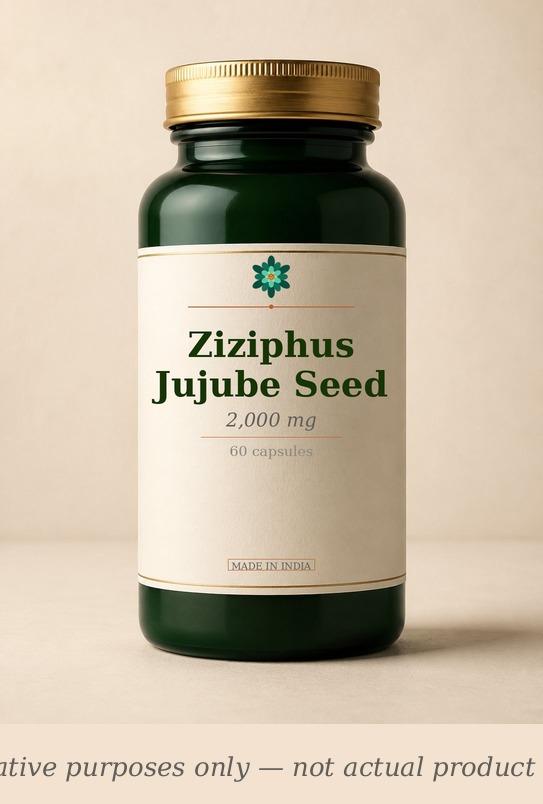
SacredBod's longer take on Ziziphus Jujube Seed — context the structured blocks above don't capture.
What It Is
Ziziphus Jujube Seed provides the seed of Ziziphus jujuba var. spinosa — known in Traditional Chinese Medicine as Suan Zao Ren (酸枣仁). This is distinct from the sweet jujube fruit (Ziziphus jujuba) commonly eaten as a snack. The seed has been the premier TCM remedy for insomnia and anxiety for over 2,000 years, documented in the classical text Shen Nong Ben Cao Jing. Modern pharmacology has identified spinosin, jujubosides and flavonoids as the active compounds responsible for GABA-A receptor modulation and serotonin pathway enhancement. In India, the related species Ziziphus mauritiana (Ber) has traditional sedative uses, but true Z. spinosa seed supplements are not commercially available.
How It Works
- GABA-A receptor upregulation — Spinosin and jujubosides increase the expression of GABA-A receptor subunits α1 and γ2 in the hypothalamus and hippocampus. This enhances the brain’s sensitivity to its own GABA, promoting inhibition without exogenous sedatives.
- Serotonin enhancement — Ziziphus spinosa increases 5-HT (serotonin) levels in the hypothalamus, supporting the serotonin→melatonin conversion pathway and promoting the calm mood state that precedes sleep.
- Glutamate and dopamine reduction — The extract decreases excitatory glutamate and arousal-promoting dopamine, shifting the neurochemical balance toward the inhibitory side.
- Neuroprotection — In the PCPA-induced insomnia rat model, Ziziphus spinosa extract protected hypothalamic and hippocampal neurons from degeneration — a unique benefit among sleep botanicals.
Who Benefits Most
- Insomnia sufferers seeking a non-habit-forming, non-sedating botanical alternative.
- Individuals who have not responded to valerian or melatonin — Ziziphus works through different receptor mechanisms.
- Those interested in TCM-inspired sleep support with modern pharmacological validation.
- Individuals with neuroinflammation-related sleep disruption — the neuroprotective effects are relevant.
Dosage Guide
| Goal | Dose | Timing |
|---|
| Insomnia | 2,000 mg seed granules or 500 mg extract | 1 hour before bed with warm water |
| Maintenance | 1,000 mg seed or 250 mg extract | As above |
| Anxiety + sleep | 2,000 mg twice daily | Morning and evening |
Traditional TCM decoctions use 9–15 g of crushed seeds boiled in water. Modern capsule extracts are concentrated equivalents. Take with warm water rather than cold — TCM principles suggest warm fluids enhance the calming effect.
Safety and Interactions
Ziziphus spinosa has an exceptional safety profile with millennia of traditional use. The Shergis 2021 RCT reported only minor adverse events with no serious effects. No dependence, tolerance or withdrawal has been documented. Mild additive sedation with CNS depressants is theoretically possible. Avoid in pregnancy due to insufficient data.
India-Specific Context
- Hindi/Sanskrit name: Ber (बेर) for the related Ziziphus mauritiana; no classical equivalent for Z. spinosa specifically.
- Local availability: Not available on Amazon.in as of 2026-05-16. True Ziziphus spinosa seed supplements must be imported via iHerb, TCM practitioners or specialty Ayurvedic clinics that stock imported TCM herbs. The related Ber (Z. mauritiana) is widely available as a fruit and folk remedy but not as a standardised sleep supplement.
- Regulatory status: Not a Schedule H drug; sold as a dietary supplement. Import duty and GST apply.
- Ayurvedic parallel: The related Indian jujube (Ber, Z. mauritiana) is used in folk medicine for sedation, anxiety and nervous disorders. The bark and leaves are used in diabetes and fever. Modern Indian integrative practitioners may recommend Z. spinosa seed (imported) alongside classical Ayurvedic sleep herbs for a cross-traditional approach.
- TCM context: In TCM, Suan Zao Ren is classified as sweet and sour, entering the Heart and Liver meridians. It “nourishes Heart Yin and Liver blood, calms the Shen (spirit), and anchors the ethereal soul” — the classical TCM explanation for its sleep-promoting effects.
Traditional Use in Indian Medicine
While Ziziphus spinosa itself does not appear in classical Ayurvedic texts, the related Ziziphus mauritiana (Ber, Badari) is mentioned in Charaka Samhita and Sushruta Samhita as a Balya (strength-promoting) and Vrushya (aphrodisiac) fruit. The bark and root are used for dyspepsia, fever and diabetes in folk medicine. The sedative properties of Ber are recognised in rural Indian traditional medicine — decoctions of the leaves or bark are used for insomnia and nervous disorders. Modern Indian integrative sleep clinics sometimes import Z. spinosa seed extract and combine it with classical Ayurvedic preparations like Saraswatarishta or Brahmi Ghrita for comprehensive sleep support, though this combination has not been formally studied.