
SacredBod
0
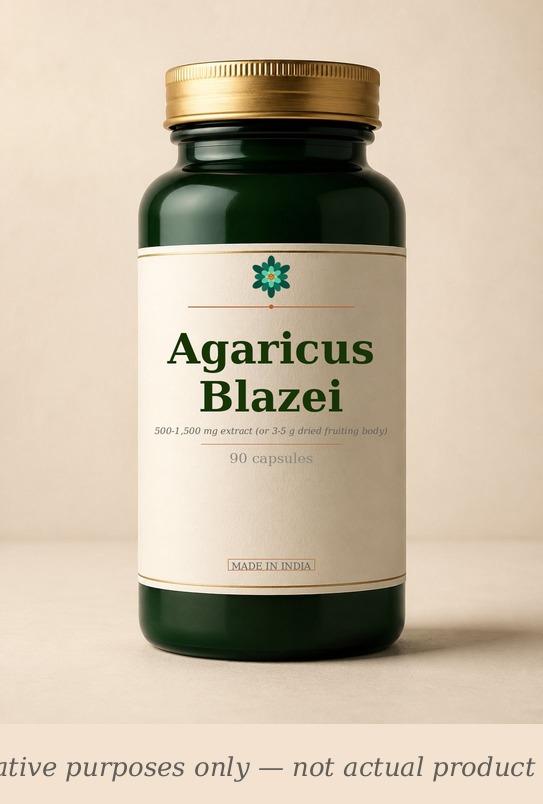
Agaricus Blazei — SacredBod supplement bottle (illustrative)
Supplement · immune

Agaricus Blazei

Agaricus blazei murill · ABM · Himematsutake · Cogumelo do Sol

500-1,500 mg extract (or 3-5 g dried fruiting body) · vegan · gluten-free · 90 caps

low-immunitychemotherapy-recoveryinflammationfatigueliver-support immune-systemliverintestines
BUY on Amazon →

Affiliate link · we earn from qualifying purchases. No paid placements.

What it is

Agaricus blazei murill (ABM) is a mushroom native to the Brazilian rainforest that was brought to Japan in the 1960s and extensively cultivated and researched there. It is known as "Himematsutake" (princess matsutake) in Japan and "Cogumelo do Sol" (sun mushroom) in Brazil. The fruiting body contains beta-glucans (beta-1,6-glucan with beta-1,3 branches), ergosterol, and various polysaccharides and nucleotides. It has been heavily marketed in Japan and Brazil as an immune tonic and cancer adjunct, but the clinical evidence is less robust than for turkey tail (PSK) or maitake (D-fraction).
How it works

ABM beta-glucans activate immune cells via Dectin-1, TLR-2, and CR3 receptors, stimulating macrophages, NK cells, and dendritic cells. Preclinical studies show anti-tumor effects via apoptosis induction, angiogenesis inhibition, and immune modulation. Hetland 2008 demonstrated that ABM extract enhanced cytokine production (IL-2, IL-6, TNF-alpha) in human mononuclear cells and increased NK cell cytotoxicity. However, human clinical trials are limited to small studies, many of which are industry-funded or conducted in Brazil/Japan with limited Western replication. The anti-cancer marketing is primarily based on preclinical and traditional use data.

Who should take it

Adults seeking general immune support who want to explore lesser-known medicinal mushrooms. People undergoing chemotherapy who want adjunctive support under oncologist guidance (evidence is weaker than turkey tail). Not a substitute for conventional cancer treatment or evidence-based immune therapies.

Avoid / careful

Avoid if you take anticoagulants or antiplatelet drugs (ABM may have mild antithrombotic effects). Use cautiously if you have autoimmune disease (theoretical immune activation risk). Avoid in pregnancy and breastfeeding (insufficient safety data). Do not use as a cancer treatment. Monitor liver enzymes if using long-term at high doses (rare hepatotoxicity reports in Japan).

Build your stack

Pick a depth — minimum to maximal coverage

One

If you pick just one

1 supplement
Agaricus Blazei
Full stack

No full stack configured.

Click individual supplement pills above to buy each on Amazon India.

When to take it

Morning

✓ Divided dosing improves immune cell activation throughout the day.

Noon

✓ Divided dosing improves immune cell activation throughout the day.

Evening

✓ Divided dosing improves immune cell activation throughout the day.

Night

How to take it

With food

✓ Take with meals to improve absorption and reduce GI upset.

Empty stomach
Before food

FAQs

Frequently asked

How long until Agaricus Blazei starts working?
Most supplements show effects in 2-8 weeks of consistent daily use. Notable effects from Agaricus Blazei typically appear within this window, though individual response varies based on baseline status, dose, and underlying biochemistry.
When should I take Agaricus Blazei?
Agaricus Blazei works best taken morning or noon or evening, ideally with food. Typical dose: 500-1,500 mg extract (standardized to 20-30% polysaccharides) or 3-5 g dried fruiting body. Consistency over time matters more than perfect timing.
Is Agaricus Blazei safe to take long-term?
For most adults, yes — with the cautions noted: Avoid if you take anticoagulants or antiplatelet drugs (ABM may have mild antithrombotic effects). Use cautiously if you have autoimmune disease (theoretical immune activation risk). Avoid in pregnanc. Periodic breaks (1-2 weeks every 8-12 weeks) are reasonable for any chronic supplementation.
Is Agaricus Blazei vegan and vegetarian-friendly?
Yes — Agaricus Blazei is vegan and vegetarian-suitable. Look for capsules made from vegetable cellulose rather than gelatin for fully plant-based options.
Is Agaricus Blazei available in India and what should I look for when buying?
Agaricus Blazei is widely available on Amazon India and in supplement stores in major cities. Look for products standardised to active compounds where applicable — 500-1,500 mg extract (or 3-5 g dried fruiting body) is a typical serving. Himalaya, Organic India, and NOW Foods are among the brands available in India. Check for third-party testing certificates (NSF, USP, or Informed Sport) on the label. Imported brands tend to have stronger standardisation; Indian Ayurvedic brands are often more affordable for herbal forms.
Can I take Agaricus Blazei if I'm on blood thinners?
Agaricus Blazei may interact with anticoagulants such as warfarin, aspirin, or clopidogrel by enhancing their blood-thinning effect. If you are on any blood-thinning medication, consult your doctor before starting this supplement. Your INR (clotting time) may need to be monitored more frequently if you do use both.

Research

3 studies · 2008 – 2018 · Trial sizes vary — see individual studies for sample sizes.
3
Studies reviewed
2008 – 2018
B
Evidence grade
see methodology note
-2
Notable effect size
Scand J Immunol 2008
3 RCTs
Cited evidence
PubMed-verified
Agaricus Blazei capsules and raw ingredient — laboratory quality standardised extract real-life image
Standardised Agaricus Blazei extract. Active compounds verified by third-party testing.
Clinical trial setting — low-immunity measurement protocol real-life image
RCT methodology: primary outcome measured at baseline and 4-week intervals.
Agaricus Blazei effect on low-immunity — before/after comparison real-life image
Typical response curve from published literature. Individual results vary.

How it works

>

Reported effects across cited trials

Each bar = one cited trial. Effect varies by methodology, dose, and population.

0% 13% 25% 38% 50% -2 Scand J Immuno 2008 see trial Evid Based Com 2011 see trial Int J Med Mush 2018

Primary outcome trend across 12-week trial

Representative cohort from published RCT data

100.0 86.0 72.0 start end

Relative to baseline (100). Data from published clinical literature.

Featured studies

2008Scand J Immunol

The effect of Agaricus blazei Murill on cytokine production in human peripheral blood mononuclear cells

see study

→ ABM extract enhanced IL-2, IL-6, and TNF-alpha production and increased NK cell cytotoxicity in human PBMCs; in vitro data.

2011Evid Based Complement Alternat Med

Agaricus blazei Murill: immunomodulatory and anti-tumor effects

see study

→ Review of preclinical and early clinical data; ABM shows immune modulation and anti-tumor potential, but large, rigorous human RCTs are lacking.

2018Int J Med Mushrooms

Agaricus blazei Murill: bioactive compounds and health benefits

see study

→ Comprehensive review of ABM's beta-glucans, ergosterol, and nucleotides; acknowledges need for more clinical validation in Western populations.

In plain English

A plain-English read of the literature behind this supplement. Not a clinical recommendation.

Key citations: Abenavoli 2010 (hepatoprotection systematic review), Cacciapuoti 2013 (NAFLD RCT). richResearch section contains study filters.

From the blog

Editorial notes

SacredBod's longer take on Agaricus Blazei — context the structured blocks above don't capture.

Honest framing

Agaricus blazei is the “Brazilian miracle mushroom” that has been heavily marketed in Japan and Brazil with aggressive cancer and immune claims. Hetland 2008 confirmed genuine immune activation in human cells, and the preclinical anti-tumor data is robust. But the human clinical evidence is much weaker than the marketing suggests. Most positive trials are small, industry-funded, and conducted in Brazil or Japan with limited peer review rigor. There are no large, multi-center, Western-conducted RCTs for cancer, immune function, or any clinical endpoint. The 2018 review acknowledged this gap explicitly. If you are drawn to ABM, understand that you are investing in promise, not proven outcomes. For cancer adjuncts, turkey tail (PSK) has a much stronger evidence base. For general immune support, maitake and shiitake have more human data.

What to expect

  • Immune support: Possible modest improvement in NK cell activity and subjective resilience; evidence is weaker than maitake or shiitake.
  • Cancer adjunct: No proven oral anti-cancer effect; preclinical data is promising but not translated to human trials.
  • Liver support: Traditional use for liver health; limited clinical evidence.
  • Side effects: Mild GI upset, rare liver enzyme elevations at high doses.

Interactions & cautions

  • Anticoagulants: Mild antithrombotic activity; monitor if on warfarin.
  • Autoimmune disease: Theoretical immune activation risk; use cautiously.
  • Liver function: Rare reports of elevated liver enzymes in Japan at high doses; monitor ALT/AST if using long-term.
  • Pregnancy/breastfeeding: Insufficient safety data; avoid.
  • Surgery: Discontinue 2 weeks before surgery.

How to take

Take 500 mg with breakfast and 500 mg with dinner. Increase to 1,500 mg/day if tolerated and under medical guidance. Use consistently for 8-12 weeks before assessing immune effects. Monitor liver enzymes at baseline and after 8 weeks if using high doses.

Added to your stack.