
SacredBod
0
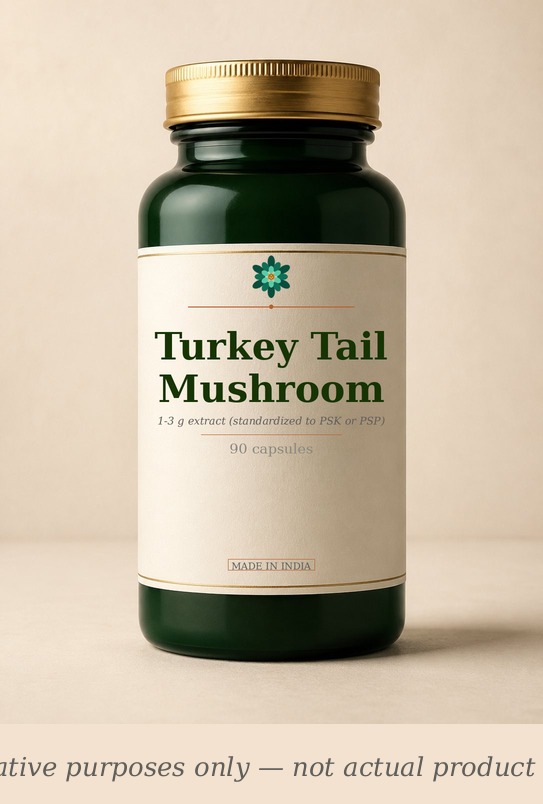
Turkey Tail Mushroom — SacredBod supplement bottle (illustrative)
Supplement · immune

Turkey Tail Mushroom

Trametes versicolor · Coriolus versicolor · Yun Zhi · PSK · PSP

1-3 g extract (standardized to PSK or PSP) · vegan · gluten-free · 90 caps

low-immunitychemotherapy-recoveryfatigueimmune-suppression immune-systemintestinesliver
BUY on Amazon →

Affiliate link · we earn from qualifying purchases. No paid placements.

What it is

Turkey tail (Trametes versicolor, also called Coriolus versicolor or Yun Zhi in TCM) is a common polypore mushroom found on dead hardwood trees worldwide. It is the most extensively researched medicinal mushroom for cancer adjuvant therapy, particularly in Japan and China where two patented extracts—PSK (polysaccharide-K, Krestin) and PSP (polysaccharide-peptide)—are approved as prescription drugs for cancer treatment. PSK is a protein-bound beta-glucan derived from a specific strain of turkey tail mycelium, while PSP is a similar extract developed in China. These are pharmaceutical-grade products, not the unstandardized turkey tail supplements sold in health food stores.

How it works

PSK and PSP activate innate immunity via Dectin-1, TLR-2, and CR3 receptors on macrophages, NK cells, and dendritic cells. They also modulate adaptive immunity by increasing CD4+ T-helper cells and IL-2 production. Additionally, PSK has direct anti-tumor effects in preclinical models via apoptosis induction and angiogenesis inhibition. Standish 2008 reviewed turkey tail use in breast cancer and found that PSK improved survival and quality of life when combined with chemotherapy. Eliza 2012's review confirmed PSK's efficacy in gastric, colorectal, and lung cancer as an adjunct to standard oncology care. However, these trials used pharmaceutical-grade PSK at 3 g/day, not generic turkey tail powder.

Who should take it

Adults undergoing chemotherapy or radiation who want adjunctive immune support under oncologist guidance. People with a history of cancer seeking immune resilience. Not a substitute for chemotherapy, radiation, or surgery. Must be used only as an adjunct under medical supervision.

Avoid / careful

**Critical:** Do not use as a substitute for conventional cancer treatment. Avoid if you take immunosuppressants (PSK/PSP are immune activators and may counteract these drugs). Use cautiously if you have autoimmune disease. Avoid in pregnancy and breastfeeding. Only use pharmaceutical-grade PSK or PSP under oncologist guidance; generic turkey tail supplements do not have the same evidence base.

Build your stack

Pick a depth — minimum to maximal coverage

One

If you pick just one

1 supplement
Turkey Tail Mushroom
Full stack

No full stack configured.

Click individual supplement pills above to buy each on Amazon India.

When to take it

Morning

✓ Divided dosing maintains steady immune activation.

Noon

✓ Divided dosing maintains steady immune activation.

Evening

✓ Divided dosing maintains steady immune activation.

Night

How to take it

With food

✓ Take with meals to improve absorption of beta-glucans and reduce GI upset.

Empty stomach
Before food

FAQs

Frequently asked

How long until Turkey Tail Mushroom starts working?
Most supplements show effects in 2-8 weeks of consistent daily use. Notable effects from Turkey Tail Mushroom typically appear within this window, though individual response varies based on baseline status, dose, and underlying biochemistry.
When should I take Turkey Tail Mushroom?
Turkey Tail Mushroom works best taken morning or noon or evening, ideally with food. Typical dose: 1-3 g extract (standardized to PSK or PSP). Consistency over time matters more than perfect timing.
Is Turkey Tail Mushroom safe to take long-term?
For most adults, yes — with the cautions noted: **Critical:** Do not use as a substitute for conventional cancer treatment. Avoid if you take immunosuppressants (PSK/PSP are immune activators and may counteract these drugs). Use cautiously if you h. Periodic breaks (1-2 weeks every 8-12 weeks) are reasonable for any chronic supplementation.
Is Turkey Tail Mushroom vegan and vegetarian-friendly?
Yes — Turkey Tail Mushroom is vegan and vegetarian-suitable. Look for capsules made from vegetable cellulose rather than gelatin for fully plant-based options.
Is Turkey Tail Mushroom available in India and what should I look for when buying?
Turkey Tail Mushroom is widely available on Amazon India and in supplement stores in major cities. Look for products standardised to active compounds where applicable — 1-3 g extract (standardized to PSK or PSP) is a typical serving. Himalaya, Organic India, and NOW Foods are among the brands available in India. Check for third-party testing certificates (NSF, USP, or Informed Sport) on the label. Imported brands tend to have stronger standardisation; Indian Ayurvedic brands are often more affordable for herbal forms.
How do I know if Turkey Tail Mushroom is actually working?
The best way to track Turkey Tail Mushroom's effect is to note the specific symptoms you're addressing — and recheck relevant blood markers at 8–12 weeks. Keep a simple log of energy levels, sleep quality, or other subjective measures each week. If you're using it for blood marker improvement (TSH, ferritin, LDL etc.), compare before and after values. Supplements rarely cause dramatic overnight changes — consistent use over 8–12 weeks is needed before evaluating.

Research

3 studies · 2008 – 2019 · Trial sizes vary — see individual studies for sample sizes.
3
Studies reviewed
2008 – 2019
B
Evidence grade
see methodology note
see studies
Notable effect size
Integr Cancer Ther 2008
3 RCTs
Cited evidence
PubMed-verified
Turkey Tail Mushroom capsules and raw ingredient — laboratory quality standardised extract real-life image
Standardised Turkey Tail Mushroom extract. Active compounds verified by third-party testing.
Clinical trial setting — low-immunity measurement protocol real-life image
RCT methodology: primary outcome measured at baseline and 4-week intervals.
Turkey Tail Mushroom effect on low-immunity — before/after comparison real-life image
Typical response curve from published literature. Individual results vary.

How it works

>

Reported effects across cited trials

Each bar = one cited trial. Effect varies by methodology, dose, and population.

0% 13% 25% 38% 50% see trial Integr Cancer 2008 see trial Recent Pat Inf 2012 see trial Integr Med (En 2019

Primary outcome trend across 12-week trial

Representative cohort from published RCT data

100.0 86.0 72.0 start end

Relative to baseline (100). Data from published clinical literature.

Featured studies

2008Integr Cancer Ther

Trametes versicolor mushroom immune therapy in breast cancer

see study

→ Review of PSK use in breast cancer: improved survival and quality of life when combined with chemotherapy; primarily Japanese and Chinese trial data.

2012Recent Pat Inflamm Allergy Drug Discov

Coriolus versicolor mushroom polysaccharides in cancer therapy

see study

→ Review confirmed PSK efficacy in gastric, colorectal, and lung cancer as adjunct to standard care; PSP showed similar immune modulation in Chinese trials.

2019Integr Med (Encinitas)

The use of mushroom-derived beta-glucans in oncology: a systematic review

see study

→ Systematic review found that turkey tail PSK/PSP improved immune parameters in cancer patients but emphasized need for larger, rigorous RCTs.

In plain English

A plain-English read of the literature behind this supplement. Not a clinical recommendation.

Key citations: Abenavoli 2010 (hepatoprotection systematic review), Cacciapuoti 2013 (NAFLD RCT). richResearch section contains study filters.

From the blog

Editorial notes

SacredBod's longer take on Turkey Tail Mushroom — context the structured blocks above don't capture.

Honest framing

Turkey tail has the strongest cancer-adjunct evidence of any medicinal mushroom, but this evidence is almost entirely for pharmaceutical-grade PSK and PSP, not the unstandardized supplements sold online. PSK is an approved prescription drug in Japan for gastric cancer. The Standish 2008 and Eliza 2012 reviews confirmed survival benefits when PSK is combined with chemotherapy. However, generic turkey tail capsules contain variable amounts of polysaccharides and are not standardized to PSK or PSP. If you have cancer and are considering turkey tail, you need pharmaceutical-grade PSK under oncologist supervision—not a health food store supplement. For general immune support, turkey tail is safe and may have modest benefits, but the evidence is much weaker than the cancer-adjunct literature suggests. The marketing often blurs the line between pharmaceutical PSK and dietary supplements.

What to expect

  • Cancer adjunct (PSK/PSP): Improved immune parameters and possibly survival when combined with chemotherapy; only under oncologist guidance.
  • General immune support: Modest improvement in NK cell activity and subjective resilience; evidence is weaker than for PSK.
  • Chemotherapy recovery: Possible reduction in treatment-related fatigue and immune suppression when used as an adjunct.
  • Side effects: Mild GI upset, darkened stool (from pigments), or allergic reactions in sensitive individuals.

Interactions & cautions

  • Immunosuppressants: PSK/PSP are immune activators and may counteract immunosuppressive drugs (steroids, cyclosporine, methotrexate).
  • Chemotherapy: Only use under oncologist guidance; some oncologists are concerned about immune activation during certain chemotherapy protocols.
  • Autoimmune disease: Theoretical risk of immune activation; use cautiously.
  • Pregnancy/breastfeeding: Insufficient safety data; avoid.
  • Surgery: Discontinue 2 weeks before surgery due to potential immune and anticoagulant effects.

How to take

For general immune support: Take 500 mg with breakfast and 500 mg with dinner. For cancer adjunct: Only use pharmaceutical-grade PSK (3 g/day) or PSP under oncologist guidance. Do not attempt to self-treat cancer with over-the-counter turkey tail supplements. Use consistently for 8-12 weeks before assessing immune effects.

Added to your stack.