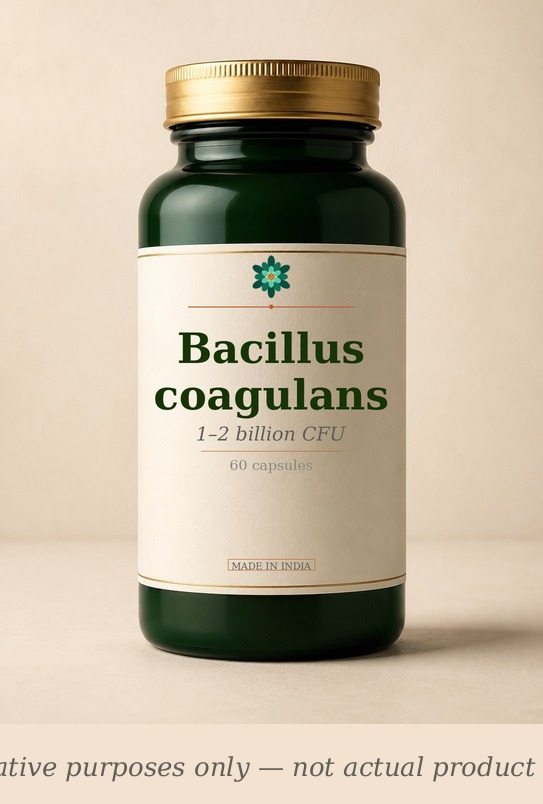
SacredBod's longer take on Bacillus coagulans — context the structured blocks above don't capture.
Bacillus coagulans occupies a unique position in the probiotic landscape because it is not like the others. While Lactobacillus and Bifidobacterium are delicate, requiring refrigeration and often dying in large numbers before reaching the intestine, B. coagulans forms protective endospores — essentially armor that shields it from heat, moisture, stomach acid, and manufacturing stress. This means it can sit on a shelf at room temperature for months and still arrive in the small intestine viable and ready to germinate. For travelers, for people in hot climates, and for anyone frustrated by probiotics that seem to do nothing, this is a meaningful practical advantage.
The mechanism begins with survival. The spore coat protects the bacterium through the acidic environment of the stomach (pH 1.5–3.5), where most non-spore probiotics perish. Once in the small intestine, where pH rises and nutrients are abundant, the spore germinates into a vegetative cell that produces lactic acid and bacteriocins — antimicrobial compounds that inhibit pathogenic bacteria. Some strains, particularly GBI-30, also produce enzymes that may aid in the digestion of proteins and carbohydrates, which is why B. coagulans is sometimes marketed as a “digestive enzyme plus probiotic” combination.
The clinical evidence is moderate and strain-specific. Hun’s 2009 trial in BMC Gastroenterology tested B. coagulans GBI-30 in IBS patients and found significant reductions in daily abdominal pain scores and bloating over 8 weeks versus placebo. Majeed’s 2016 study with MTCC 5856 showed improved IBS quality-of-life scores over 90 days. These are not blockbuster effects — IBS symptom scores improve modestly — but they are consistent and reproducible with specific strains. The critical caveat is that not all B. coagulans products contain verified strains. Some contain generic, undocumented strains that may not germinate efficiently or produce the same metabolites.
The arthritis evidence is more preliminary and should be framed honestly. Mandel’s 2010 study in BMC Complementary Medicine found that B. coagulans reduced pain and improved functional ability in rheumatoid arthritis patients who were already on standard therapy. However, this was a small trial (45 participants), and the effect size was modest. No large, long-term RCTs have replicated this finding, and the mechanism — hypothesized to involve reduction of systemic inflammation via gut-derived mediators — remains speculative. Claims that B. coagulans is an “anti-inflammatory powerhouse” exceed the current evidence.
Safety is generally good, but the spore-forming nature raises theoretical concerns. Bacillus species can cause infection in immunocompromised hosts, and there are rare case reports of B. coagulans bacteremia in patients with prosthetic joints or severe immunosuppression. These are extremely uncommon, but they mean immunocompromised individuals and those with prosthetic hardware should consult a physician before use. For healthy adults, side effects are typically limited to mild bloating or gas during the first week.
Practical guidance: Look for products that specify the strain — GBI-30, MTCC 5856, or LactoSpore are the most evidence-backed. The typical dose is 1–2 billion CFU daily for general use, or up to 10 billion CFU for IBS symptoms. Take with food to stimulate germination in the small intestine. No refrigeration is needed, making this ideal for travel. Give it 4–8 weeks before judging effectiveness. If the label does not specify a strain, the product quality is uncertain.