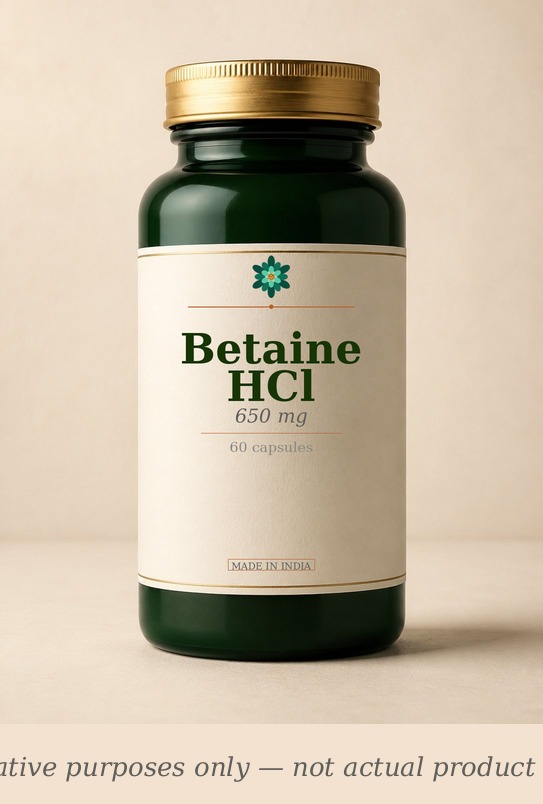
SacredBod's longer take on Betaine HCl — context the structured blocks above don't capture.
Betaine hydrochloride is one of the most misused supplements in the digestive health category. Marketed aggressively for “low stomach acid” — a condition that sounds plausible and is diagnosed by exactly zero validated at-home tests — it is taken by thousands of people who actually have the opposite problem: too much acid reaching the esophagus, not too little in the stomach. Understanding when betaine HCl is appropriate, when it is dangerous, and what the actual evidence says is essential for safe use.
The mechanism is straightforward: betaine HCl is a salt that dissociates in the stomach to release hydrochloric acid, lowering gastric pH. In theory, this improves protein digestion by activating pepsin (which requires pH below 2 for optimal activity) and enhances absorption of minerals and vitamin B12 that require acidic conditions. Yago’s 2013 study in Molecular Pharmaceutics proved the concept: healthy volunteers given proton pump inhibitors to induce hypochlorhydria were able to restore gastric acidity with betaine HCl. But this is a pharmacokinetic proof-of-concept, not a clinical outcome trial. It shows that betaine HCl releases acid; it does not show that taking it improves digestion, nutrient status, or symptoms in people with actual hypochlorhydria.
The honest framing is that hypochlorhydria is genuinely rare in the general population. It occurs in pernicious anemia, after gastric surgery (gastrectomy, bariatric procedures), in advanced autoimmune gastritis, and as a side effect of long-term proton pump inhibitor use. In these specific, medically diagnosed conditions, betaine HCl may have a role as an adjunct to standard care. But the vast majority of people experiencing bloating, indigestion, or “food sitting in my stomach” do not have hypochlorhydria. They have functional dyspepsia, GERD, gastroparesis, or simply eat too quickly. Taking acid supplements in these conditions is not neutral — it is actively harmful.
The safety concern is real and underappreciated. Betaine HCl will worsen GERD, esophagitis, gastritis, and peptic ulcer disease. The “acid challenge” test promoted by some practitioners — increasing the dose until a warm or burning sensation is felt — is not medically validated and carries genuine risk of gastric mucosal injury, esophageal damage, and aspiration. There are case reports of esophageal ulceration from betaine HCl capsules that lodged in the esophagus before dissolving. The supplement should never be taken on an empty stomach, never by people with any history of acid reflux or ulcer disease, and never without medical confirmation of low acid production.
For those with confirmed hypochlorhydria, the typical dose is 650 mg with protein-containing meals. Some products combine betaine HCl with pepsin, which is logical since pepsin requires acidic pH for activation, though the clinical benefit of this combination has not been tested in RCTs. The effect is transient — gastric pH returns to baseline within 1–2 hours — so betaine HCl must be taken with each meal.
Practical guidance: Do not self-diagnose hypochlorhydria. If you suspect low stomach acid, consult a gastroenterologist for validated testing (gastric pH monitoring, Heidelberg capsule test). If you have any history of GERD, acid reflux, gastritis, or peptic ulcer disease, do not take betaine HCl. If medically confirmed hypochlorhydria is present, start with 650 mg with protein-containing meals only, never on an empty stomach. Stop immediately if you experience burning, chest pain, or worsening reflux. In India, betaine HCl with pepsin is available from brands like Nutrapark and Pure Nutrition.