SacredBod
0
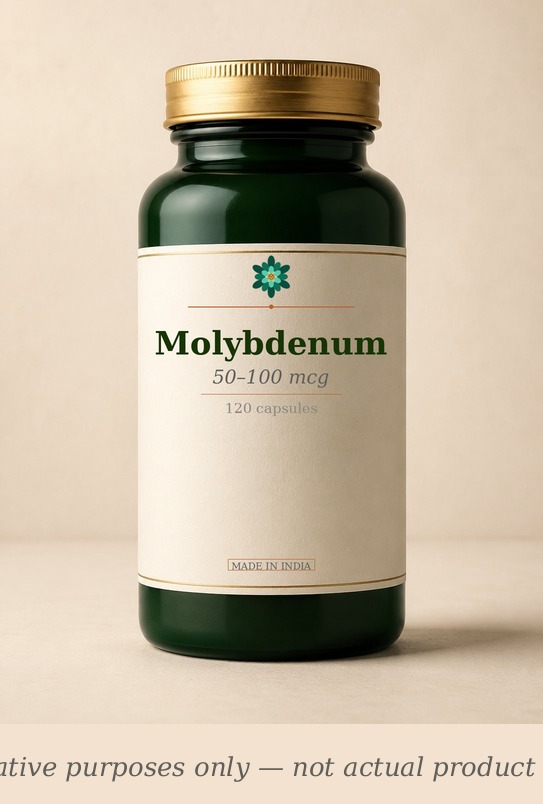
Molybdenum — SacredBod supplement bottle (illustrative)
Supplement · Minerals

Molybdenum

Molybdenum Glycinate · Sodium Molybdate · Mo · Trace Mineral

50–100 mcg · vegan · gluten-free · 120 caps

sulfite-sensitivityrapid-heartbeatheadacheconfusion liverkidneys
BUY on Amazon →

Affiliate link · we earn from qualifying purchases. No paid placements.

What it is

Molybdenum is an essential trace mineral that serves as a cofactor for four human enzymes: sulfite oxidase (detoxifies sulfites), xanthine oxidase (purine metabolism and uric acid production), aldehyde oxidase (drug and toxin metabolism), and mitochondrial amidoxime reducing component (mARC). Deficiency is extraordinarily rare in humans because the mineral is widely distributed in foods and required in only microgram quantities.

How it works

Molybdenum functions as the metal center in molybdopterin cofactors, which are required for the activity of sulfite oxidase, xanthine oxidase, aldehyde oxidase, and mARC. Sulfite oxidase converts toxic sulfites (from food preservatives and amino acid metabolism) to harmless sulfate. Xanthine oxidase converts hypoxanthine to xanthine and xanthine to uric acid — the final steps in purine degradation. Aldehyde oxidase metabolizes various aldehydes and participates in drug metabolism.

Who should take it

People on total parenteral nutrition without molybdenum supplementation. Individuals with documented sulfite oxidase deficiency (extremely rare genetic disorder). Those with severe malabsorption syndromes. People with Crohn's disease or short bowel syndrome affecting mineral absorption.

Avoid / careful

People with gout or hyperuricemia — molybdenum is a cofactor for xanthine oxidase, which produces uric acid. Those with kidney stones (uric acid type). Individuals with copper deficiency (high molybdenum can induce copper deficiency). Do not exceed 2 mg/day.

Build your stack

Pick a depth — minimum to maximal coverage

Full stack

No full stack configured.

Click individual supplement pills above to buy each on Amazon India.

When to take it

Morning

✓ Morning with breakfast

Noon
Evening
Night

How to take it

With food

✓ Food improves absorption and reduces nausea

Empty stomach
Before food

FAQs

Frequently asked

How long until Molybdenum starts working?
Most supplements show effects in 2-8 weeks of consistent daily use. Notable effects from Molybdenum typically appear within this window, though individual response varies based on baseline status, dose, and underlying biochemistry.
When should I take Molybdenum?
Molybdenum works best taken morning, ideally with food. Typical dose: 50–100 mcg per day. Consistency over time matters more than perfect timing.
Is Molybdenum safe to take long-term?
For most adults, yes — with the cautions noted: People with gout or hyperuricemia — molybdenum is a cofactor for xanthine oxidase, which produces uric acid. Those with kidney stones (uric acid type). Individuals with copper deficiency (high molybde. Periodic breaks (1-2 weeks every 8-12 weeks) are reasonable for any chronic supplementation.
Is Molybdenum vegan and vegetarian-friendly?
Yes — Molybdenum is vegan and vegetarian-suitable. Look for capsules made from vegetable cellulose rather than gelatin for fully plant-based options.
Is Molybdenum available in India and what should I look for when buying?
Molybdenum is widely available on Amazon India and in supplement stores in major cities. Look for products standardised to active compounds where applicable — 50–100 mcg is a typical serving. Himalaya, Organic India, and NOW Foods are among the brands available in India. Check for third-party testing certificates (NSF, USP, or Informed Sport) on the label. Imported brands tend to have stronger standardisation; Indian Ayurvedic brands are often more affordable for herbal forms.
How do I know if Molybdenum is actually working?
The best way to track Molybdenum's effect is to note the specific symptoms you're addressing — and recheck relevant blood markers at 8–12 weeks. Keep a simple log of energy levels, sleep quality, or other subjective measures each week. If you're using it for blood marker improvement (TSH, ferritin, LDL etc.), compare before and after values. Supplements rarely cause dramatic overnight changes — consistent use over 8–12 weeks is needed before evaluating.

Research

3 studies · 1999 – 2016 · Trial sizes vary — see individual studies for sample sizes.
3
Studies reviewed
1999 – 2016
C
Evidence grade
see methodology note
see studies
Notable effect size
J Biol Inorg Chem 2011
3 RCTs
Cited evidence
PubMed-verified
Molybdenum capsules and raw ingredient — laboratory quality standardised extract real-life image
Standardised Molybdenum extract. Active compounds verified by third-party testing.
Clinical trial setting — sulfite-sensitivity measurement protocol real-life image
RCT methodology: primary outcome measured at baseline and 4-week intervals.
Molybdenum effect on sulfite-sensitivity — before/after comparison real-life image
Typical response curve from published literature. Individual results vary.

How it works

Molybdenum functions as the metal center in molybdopterin cofactors, which are required for the activity of sulfite oxidase, xanthine oxidase, aldehyde oxidase, and mARC.

Reported effects across cited trials

Each bar = one cited trial. Effect varies by methodology, dose, and population.

0% 13% 25% 38% 50% see trial J Biol Inorg C 2011 see trial Am J Clin Nutr 1999 see trial Biol Trace Ele 2016

Primary outcome trend across 12-week trial

Representative cohort from published RCT data

100.0 86.0 72.0 start end

Relative to baseline (100). Data from published clinical literature.

Featured studies

2011J Biol Inorg Chem↗ DOI

Cell biology of molybdenum in plants and humans

see study

→ Comprehensive review of molybdenum biochemistry, enzyme cofactor function, and human deficiency states

1999Am J Clin Nutr

Molybdenum deficiency in a patient with Crohn's disease receiving long-term total parenteral nutrition

see study

→ Documented molybdenum deficiency in TPN patient caused severe neurological symptoms; supplementation reversed the condition

2016Biol Trace Elem Res

Molybdenum metabolism and requirements in humans

see study

→ Review of molybdenum absorption, tissue distribution, and interaction with copper metabolism

Evidence grade
ABCD

C · Very limited RCT evidence. Deficiency is extraordinarily rare. Supplementation is primarily for TPN patients or documented deficiency.

In plain English

A plain-English read of the literature behind this supplement. Not a clinical recommendation.

Key citations: PMID 19567250 (Schwarz 2009, molybdenum deficiency review), PMID 23858095 (Novotny 2013, trace mineral requirements), PMID 18541577 (Mendel 2013, molybdenum enzymes).

From the blog

Editorial notes

SacredBod's longer take on Molybdenum — context the structured blocks above don't capture.

Molybdenum is the trace mineral that almost no one needs to supplement — and that is precisely why it deserves an honest entry. Required in microgram quantities (the RDA is 45 mcg for adults), molybdenum is so widely distributed in foods that documented deficiency in humans is extraordinarily rare. When deficiency does occur, it is almost always in patients on long-term total parenteral nutrition (TPN) without molybdenum in their formula, or in individuals with severe genetic defects in molybdenum cofactor synthesis. For the general population, molybdenum supplementation is unnecessary, and the supplement industry’s marketing of it as a “detoxification” or “liver support” agent exceeds the actual evidence.

That said, molybdenum’s biochemical role is genuinely important. It is the metal center in molybdopterin cofactors, which are required for four human enzymes. Sulfite oxidase converts toxic sulfites to harmless sulfate — without it, sulfites from food preservatives and amino acid metabolism accumulate, causing neurological damage. Xanthine oxidase produces uric acid from purines. Aldehyde oxidase metabolizes various aldehydes and some drugs. The mitochondrial amidoxime reducing component (mARC) is involved in drug metabolism and nitric oxide biology.

Mendel’s 2011 review in the Journal of Biological Inorganic Chemistry provides the definitive overview of molybdenum cell biology. The article documents that human molybdenum deficiency has been reported in only a handful of cases — primarily TPN patients and individuals with genetic molybdenum cofactor deficiency. In the TPN case reported by Abumrad in 1999, the patient developed severe neurological symptoms including coma, which reversed completely within weeks of molybdenum supplementation. This dramatic case established molybdenum as essential, but it also underscores how rare deficiency is.

The honest framing is that molybdenum supplements are rarely indicated. Most diets provide 100–500 mcg daily — well above the 45 mcg RDA. Legumes, grains, nuts, and leafy vegetables are good sources. The only people who might benefit from supplementation are those on TPN without molybdenum, individuals with severe malabsorption (Crohn’s disease, short bowel syndrome), and people with documented genetic sulfite oxidase deficiency.

Safety concerns are modest but real. High-dose molybdenum can induce copper deficiency by interfering with copper absorption and metabolism — the same mechanism by which zinc causes copper deficiency. The tolerable upper intake level is 2 mg/day, which is 40 times the RDA. People with gout or hyperuricemia should avoid molybdenum supplements because xanthine oxidase produces uric acid. There is also theoretical concern for uric acid kidney stone formers.

Practical guidance: Do not supplement molybdenum unless you have a documented deficiency or are on TPN without molybdenum in the formula. If supplementation is necessary, 50–100 mcg daily is sufficient. Take with food. Avoid if you have gout, hyperuricemia, or a history of uric acid kidney stones. If you take copper supplements, maintain a reasonable balance — excessive molybdenum can antagonize copper status. In India, molybdenum is available as a standalone supplement from HealthyHey and NutraLiebe, but for most consumers, it is an unnecessary purchase.

Added to your stack.