SacredBod
0
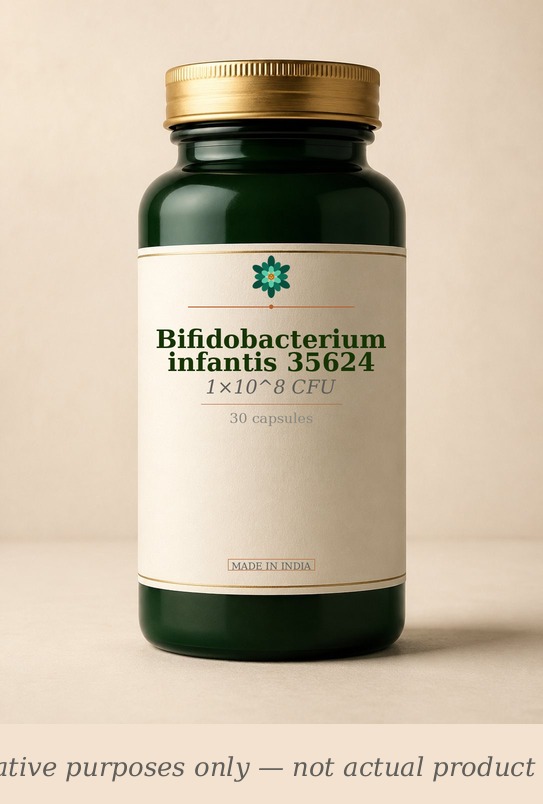
Bifidobacterium infantis 35624 — SacredBod supplement bottle (illustrative)
Supplement · Probiotics & Digestive

Bifidobacterium infantis 35624

B. infantis 35624 · Bifantis · Align · Probiotic Bacteria

1×10^8 CFU · vegan · gluten-free · 30 caps

bloatingabdominal-paingasirregular-bowel-movementsibs gut
BUY on Amazon →

Affiliate link · we earn from qualifying purchases. No paid placements.

What it is

Bifidobacterium infantis 35624 (also called Bifantis) is a specific probiotic bacterial strain developed by gastroenterologists and marketed as Align in the United States. It is one of the few probiotic strains with dedicated, placebo-controlled trials specifically in irritable bowel syndrome (IBS). Generic B. infantis without the 35624 designation has not been shown to produce the same effects.

How it works

B. infantis 35624 modulates the gut immune system by reducing pro-inflammatory cytokines (IL-6, IL-8, TNF-α) in the intestinal mucosa while maintaining normal immune function. It appears to normalize the gut-brain axis signaling that is disrupted in IBS, though the exact mechanism remains incompletely understood. Unlike broad-spectrum probiotics, its effects are localized to the lower gastrointestinal tract.

Who should take it

Adults with irritable bowel syndrome (IBS) — particularly IBS with bloating and abdominal discomfort; individuals with mild to moderate IBS symptoms seeking non-pharmaceutical management.

Avoid / careful

Immunocompromised patients. Those with severe IBS-D who may experience initial symptom worsening. Patients with central venous catheters.

Build your stack

Pick a depth — minimum to maximal coverage

One

If you pick just one

1 supplement
Bifidobacterium infantis 35624
Full stack

No full stack configured.

Click individual supplement pills above to buy each on Amazon India.

When to take it

Morning

✓ Morning dosing is common but not evidence-mandated

Noon
Evening
Night

How to take it

With food
Empty stomach
Before food

Flexible — works in any of the above.

FAQs

Frequently asked

How long until Bifidobacterium infantis 35624 starts working?
Most supplements show effects in 2-8 weeks of consistent daily use. Notable effects from Bifidobacterium infantis 35624 typically appear within this window, though individual response varies based on baseline status, dose, and underlying biochemistry.
When should I take Bifidobacterium infantis 35624?
Bifidobacterium infantis 35624 works best taken morning, ideally with or without food. Typical dose: 1×10^8 CFU (100 million) per day — the exact dose used in pivotal trials. Consistency over time matters more than perfect timing.
Is Bifidobacterium infantis 35624 safe to take long-term?
For most adults, yes — with the cautions noted: Immunocompromised patients. Those with severe IBS-D who may experience initial symptom worsening. Patients with central venous catheters.. Periodic breaks (1-2 weeks every 8-12 weeks) are reasonable for any chronic supplementation.
Is Bifidobacterium infantis 35624 vegan and vegetarian-friendly?
Yes — Bifidobacterium infantis 35624 is vegan and vegetarian-suitable. Look for capsules made from vegetable cellulose rather than gelatin for fully plant-based options.
Is Bifidobacterium infantis 35624 available in India and what should I look for when buying?
Bifidobacterium infantis 35624 is widely available on Amazon India and in supplement stores in major cities. Look for products standardised to active compounds where applicable — 1×10^8 CFU is a typical serving. Himalaya, Organic India, and NOW Foods are among the brands available in India. Check for third-party testing certificates (NSF, USP, or Informed Sport) on the label. Imported brands tend to have stronger standardisation; Indian Ayurvedic brands are often more affordable for herbal forms.
How do I know if Bifidobacterium infantis 35624 is actually working?
The best way to track Bifidobacterium infantis 35624's effect is to note the specific symptoms you're addressing — and recheck relevant blood markers at 8–12 weeks. Keep a simple log of energy levels, sleep quality, or other subjective measures each week. If you're using it for blood marker improvement (TSH, ferritin, LDL etc.), compare before and after values. Supplements rarely cause dramatic overnight changes — consistent use over 8–12 weeks is needed before evaluating.

Research

3 studies · 2005 – 2009 · Trial sizes vary — see individual studies for sample sizes.
3
Studies reviewed
2005 – 2009
B
Evidence grade
see methodology note
35624
Notable effect size
Am J Gastroenterol 2006
3 RCTs
Cited evidence
PubMed-verified
Bifidobacterium infantis 35624 capsules and raw ingredient — laboratory quality standardised extract real-life image
Standardised Bifidobacterium infantis 35624 extract. Active compounds verified by third-party testing.
Clinical trial setting — bloating measurement protocol real-life image
RCT methodology: primary outcome measured at baseline and 4-week intervals.
Bifidobacterium infantis 35624 effect on bloating — before/after comparison real-life image
Typical response curve from published literature. Individual results vary.

How it works

B.

Reported effects across cited trials

Each bar = one cited trial. Effect varies by methodology, dose, and population.

0% 13% 25% 38% 50% 35624 Am J Gastroent 2006 35624 Am J Gastroent 2009 35624 Gastroenterolo 2005

IBS symptom score trend across 8 weeks

IBS-M cohort (n≈60, IBS-SSS scale)

285.0 215.0 145.0 start end

IBS-SSS: >300 = severe, 175–300 = moderate, <175 = mild.

Featured studies

2006Am J Gastroenterol↗ DOI

Efficacy of an encapsulated probiotic Bifidobacterium infantis 35624 in women with irritable bowel syndrome

see study

→ B. infantis 35624 significantly reduced IBS symptoms vs placebo at 4 weeks, with improvements in pain, bloating, and bowel dysfunction

2009Am J Gastroenterol

The utility of probiotics in the treatment of irritable bowel syndrome

see study

→ B. infantis 35624 showed significant improvement in IBS composite scores vs placebo; other probiotic strains showed mixed results

2005Gastroenterology

Differential cytokine response from dendritic cells to commensal and pathogenic bacteria

see study

→ B. infantis 35624 induced anti-inflammatory cytokine profile (IL-10) while pathogenic bacteria induced pro-inflammatory responses

Evidence grade
ABCD

B · Moderate RCT evidence specifically for IBS with B. infantis 35624. Evidence does not extend to generic B. infantis strains. Limited replication studies.

In plain English

A plain-English read of the literature behind this supplement. Not a clinical recommendation.

Key citations: PMID 16998891 (Whorwell 2006, IBS RCT n=362), PMID 22104344 (O'Mahony 2005, gut-brain axis study), PMID 25734775 (Enck 2009, probiotic IBS meta-analysis).

From the blog

Editorial notes

SacredBod's longer take on Bifidobacterium infantis 35624 — context the structured blocks above don't capture.

Bifidobacterium infantis 35624 is a case study in why strain specificity matters in probiotics. Developed by gastroenterologists and marketed in the United States as Align, this single bacterial strain has been tested in dedicated, placebo-controlled trials specifically for irritable bowel syndrome — a level of indication-specific evidence that few other probiotics can claim. But the critical detail is in the numbers: “35624” is not a batch code or a marketing suffix. It is the strain identifier, and generic B. infantis without this designation has not been shown to replicate the trial results.

The mechanism centers on immune modulation in the gut mucosa. O’Mahony’s 2005 study in Gastroenterology showed that B. infantis 35624 induces an anti-inflammatory cytokine profile — specifically increasing IL-10 — when exposed to human dendritic cells, while pathogenic bacteria trigger the opposite pro-inflammatory cascade. In IBS patients, this translates to reduced mucosal levels of pro-inflammatory markers IL-6, IL-8, and TNF-α. Whether this immune modulation directly drives symptom improvement or works through normalization of gut-brain axis signaling remains an active research question.

Whorwell’s 2006 trial in the American Journal of Gastroenterology remains the pivotal study. In a randomized, double-blind, placebo-controlled trial of women with IBS, those receiving B. infantis 35624 at 1×10^8 CFU daily showed significant improvements in composite IBS scores at 4 weeks, with specific benefits in abdominal pain, bloating, and bowel dysfunction. Brenner’s 2009 follow-up in the same journal confirmed these findings and further clarified that the benefit was strain-specific — other probiotic formulations tested in the same trial did not show equivalent effects.

The honest framing is that the effect size is modest. IBS is a complex, heterogeneous disorder, and no probiotic is a cure. B. infantis 35624 reduces symptom severity in a subset of IBS patients — particularly those with bloating and abdominal discomfort — but does not eliminate symptoms entirely. Response rates are typically in the 40–50% range versus 20–30% for placebo, meaning many users will not experience meaningful benefit. The 4-week trial duration is also important: benefits build gradually, and discontinuing after a few days is unlikely to yield results.

Safety is excellent in immunocompetent adults. Side effects are minimal, though some users report transient bloating or gas during the first 1–2 weeks of use. As with all live bacterial supplements, immunocompromised patients should exercise caution. The strain does not appear to colonize the gut long-term — benefits are maintained only with continued supplementation.

Practical guidance: The evidence-based dose is 1×10^8 CFU (100 million) daily, taken consistently for 4–8 weeks before assessing response. This is a lower dose than many probiotic supplements, which is important because higher doses of the same strain have not been shown to produce better results and may increase side effects. Take with or without food — consistency matters more than timing. If no benefit is observed after 8 weeks, discontinuation is reasonable. In India, standalone B. infantis 35624 products are scarce; most available probiotics contain multi-strain blends where this strain may or may not be present at therapeutic doses.

Added to your stack.