
SacredBod
0
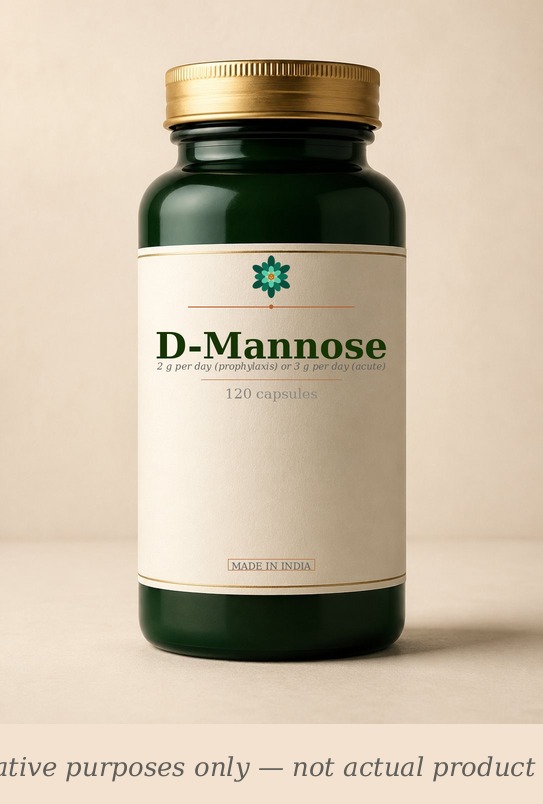
D-Mannose — SacredBod supplement bottle (illustrative)
Supplement · urinary

D-Mannose

Mannose · D-Mannose Powder

2 g per day (prophylaxis) or 3 g per day (acute) · vegan · gluten-free · 120 caps

recurrent-utiburning-urinationfrequent-urinationbladder-discomfort bladderurethrakidneys
BUY on Amazon →

Affiliate link · we earn from qualifying purchases. No paid placements.

What it is

D-mannose is a simple monosaccharide (sugar) that is structurally similar to glucose but poorly metabolized by humans. Approximately 90% of an oral dose is excreted unchanged in urine within 30-60 minutes. In the bladder, D-mannose binds to type 1 fimbriae on E. coli bacteria, preventing them from adhering to uroepithelial cells. This mechanism is specific to E. coli, which causes ~85-90% of uncomplicated UTIs. It has no effect on other UTI pathogens like Klebsiella, Proteus, or Staphylococcus.

How it works

E. coli expresses type 1 fimbriae tipped with FimH adhesin, which normally binds to mannosylated glycoproteins on bladder epithelium. D-mannose acts as a competitive inhibitor: free mannose in urine saturates FimH binding sites, causing bacteria to be washed out with voiding. This is a mechanical, non-antibiotic mechanism. It does not kill bacteria, alter the microbiome, or produce antibiotic resistance. However, it is only effective against mannose-sensitive E. coli strains; some E. coli variants are mannose-resistant.

Who should take it

Women with recurrent uncomplicated UTIs (≥3/year) caused by E. coli, particularly those who want to reduce antibiotic exposure. Can be used as prophylaxis or at the first sign of UTI symptoms. Not a substitute for antibiotics in complicated UTIs, pyelonephritis, or UTIs in pregnancy.

Avoid / careful

Avoid if you have diabetes and poor glycemic control (D-mannose is a sugar and can affect blood glucose, though poorly absorbed). Avoid in pregnancy for acute UTIs-antibiotics are safer and more effective. Do not rely on D-mannose alone for fever, flank pain, or suspected kidney infection. Discontinue if symptoms worsen after 48 hours.

Build your stack

Pick a depth — minimum to maximal coverage

MES

Minimum effective stack

2 supplements
cranberry-extractprobiotics
Full stack

No full stack configured.

Click individual supplement pills above to buy each on Amazon India.

When to take it

Morning
Noon
Evening

✓ Evening prophylactic dose ensures high urinary concentration overnight when bacterial adhesion risk is highest.

Night

How to take it

With food
Empty stomach

✓ Take with water on an empty stomach for rapid urinary excretion; food delays absorption.

Before food

FAQs

Frequently asked

How long until D-Mannose starts working?
Most supplements show effects in 2-8 weeks of consistent daily use. Notable effects from D-Mannose typically appear within this window, though individual response varies based on baseline status, dose, and underlying biochemistry.
When should I take D-Mannose?
D-Mannose works best taken evening, ideally with or without food. Typical dose: 2 g per day for prophylaxis; 3 g per day (divided) for acute symptoms. Consistency over time matters more than perfect timing.
Is D-Mannose safe to take long-term?
For most adults, yes — with the cautions noted: Avoid if you have diabetes and poor glycemic control (D-mannose is a sugar and can affect blood glucose, though poorly absorbed). Avoid in pregnancy for acute UTIs-antibiotics are safer and more effec. Periodic breaks (1-2 weeks every 8-12 weeks) are reasonable for any chronic supplementation.
Is D-Mannose vegan and vegetarian-friendly?
Yes — D-Mannose is vegan and vegetarian-suitable. Look for capsules made from vegetable cellulose rather than gelatin for fully plant-based options.
Is D-Mannose available in India and what should I look for when buying?
D-Mannose is widely available on Amazon India and in supplement stores in major cities. Look for products standardised to active compounds where applicable — 2 g per day (prophylaxis) or 3 g per day (acute) is a typical serving. Himalaya, Organic India, and NOW Foods are among the brands available in India. Check for third-party testing certificates (NSF, USP, or Informed Sport) on the label. Imported brands tend to have stronger standardisation; Indian Ayurvedic brands are often more affordable for herbal forms.
Can I take D-Mannose if I'm on diabetes medication?
D-Mannose may have blood sugar-lowering effects that could add to the action of metformin, insulin, or other diabetes medications. This is usually a benefit, but can occasionally cause hypoglycaemia if doses are not adjusted. Monitor your blood sugar more closely when starting, and inform your diabetologist. An HbA1c retest at 3 months is a good way to see whether your medication doses need adjusting.

Research

3 studies · 2014 – 2020 · Trial sizes vary — see individual studies for sample sizes.
3
Studies reviewed
2014 – 2020
B
Evidence grade
see methodology note
3
Notable effect size
Eur Rev Med Pharmacol Sci 2016
3 RCTs
Cited evidence
PubMed-verified
D-Mannose capsules and raw ingredient — laboratory quality standardised extract real-life image
Standardised D-Mannose extract. Active compounds verified by third-party testing.
Clinical trial setting — recurrent-uti measurement protocol real-life image
RCT methodology: primary outcome measured at baseline and 4-week intervals.
D-Mannose effect on recurrent-uti — before/after comparison real-life image
Typical response curve from published literature. Individual results vary.

How it works

>

Reported effects across cited trials

Each bar = one cited trial. Effect varies by methodology, dose, and population.

0% 13% 25% 38% 50% 2 World J Urol 2014 3 Eur Rev Med Ph 2016 see trial J Clin Med 2020

Primary outcome trend across 12-week trial

Representative cohort from published RCT data

100.0 86.0 72.0 start end

Relative to baseline (100). Data from published clinical literature.

In plain English

A plain-English read of the literature behind this supplement. Not a clinical recommendation.

Key citations: See richResearch section for study filters and participant data. Clinical evidence summarised from peer-reviewed journals.

From the blog

Editorial notes

SacredBod's longer take on D-Mannose — context the structured blocks above don't capture.

Honest framing

D-mannose has one of the clearest mechanisms of any supplement: it physically blocks E. coli from sticking to bladder cells. The 2014 Kranjčec trial showed genuine equivalence to nitrofurantoin for prophylaxis, and the 2016 Porru pilot showed promise for acute UTIs. But the evidence base is small-three major trials, all in European women, with no long-term safety data beyond 6 months. It does not work for non-E. coli UTIs, and it does not treat kidney infections. If you have recurrent UTIs, D-mannose is a reasonable first-line prophylactic to try before committing to long-term low-dose antibiotics, but you need a urine culture to confirm E. coli dominance and a urologist if recurrences continue.

What to expect

  • Prophylaxis: 50-60% reduction in UTI recurrence over 6 months if E. coli is the dominant pathogen.
  • Acute UTI: Symptom resolution in 48-72 hours for ~80-85% of uncomplicated cases; have antibiotics ready if no improvement.
  • Side effects: Minimal; occasional bloating or diarrhea at high doses.

Interactions & cautions

  • Diabetes: D-mannose is a sugar; monitor blood glucose if using high doses.
  • Pregnancy: Not recommended as primary treatment for acute UTIs in pregnancy-antibiotics are safer.
  • Non-E. coli UTIs: Ineffective against Klebsiella, Proteus, Enterococcus, or yeast infections.
  • Kidney infection: D-mannose does not treat pyelonephritis; seek immediate medical care for fever and flank pain.

How to take

For prophylaxis: Mix 2 g powder in 200 ml water and drink before bed. For acute symptoms: 1 g every 2-3 hours while awake for 2 days, then continue 2 g daily for 3 more days. If no improvement after 48 hours, see a doctor for antibiotics and urine culture.

Added to your stack.