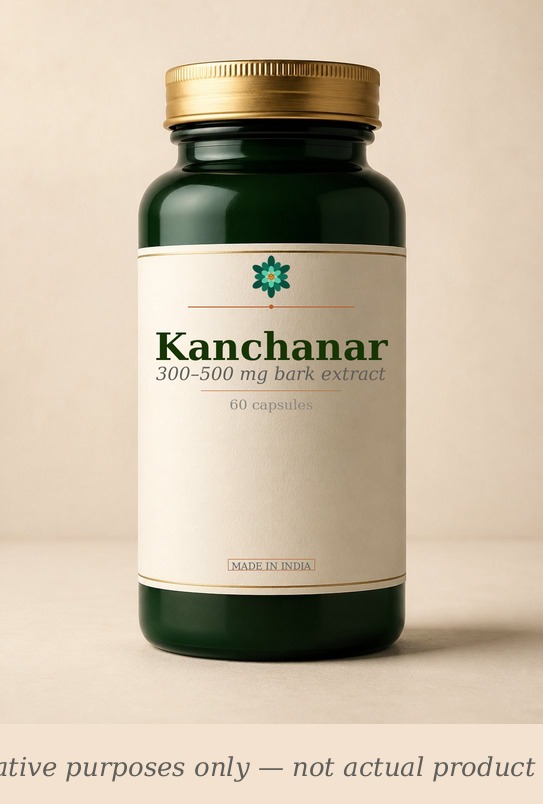
SacredBod's longer take on Kanchanar — context the structured blocks above don't capture.
Kanchanar — Bauhinia variegata — is one of the most visually striking trees in the Indian landscape, with orchid-like flowers and characteristic twin-lobed leaves. In Ayurveda, its bark has been used for centuries to address glandular swellings, goiter, and lymphatic congestion, conditions classified under the broad term Galganda. It is almost never used alone in classical practice; instead, it is the lead ingredient in Kanchanar Guggulu, a complex formulation combining the bark with guggul resin, triphala, ginger, and other botanicals.
The modern pharmacological literature on kanchanar is limited and does not support the traditional thyroid and lymphatic claims. A 2016 study found that aqueous leaf extract had antihyperglycemic effects in diabetic rats, reducing plasma glucose, cholesterol, and triglycerides. A 2013 study reported antibacterial, antioxidant, and cytotoxic activity against several human cancer cell lines. A 2023 study demonstrated neuroprotective effects in diabetic neuropathy models, reducing thermal hyperalgesia and oxidative stress markers. These are biologically interesting findings, but they relate to diabetes, infection, and pain — not thyroid function, goiter shrinkage, or lymphatic drainage.
There are no published randomized controlled trials evaluating Bauhinia variegata bark or Kanchanar Guggulu for hypothyroidism, thyroid nodules, goiter, or lymphatic disorders in humans. The traditional evidence is extensive but anecdotal; the modern evidence required to make specific therapeutic claims does not exist. This is not a criticism of Ayurvedic tradition — it is a factual statement about the current state of clinical literature. Consumers should be wary of any product claiming clinical proof for kanchanar’s thyroid effects.
Safety at traditional doses appears reasonable, though the same caveats apply as for all Ayurvedic supplements: heavy metal testing, authentication, and quality control are essential. The tree is not endangered, but adulteration with other Bauhinia species is possible. Pregnancy and breastfeeding are contraindicated due to lack of safety data. Most importantly, kanchanar should never replace standard thyroid medication or delay evaluation of suspicious thyroid nodules by an endocrinologist.
For those interested in traditional Ayurvedic glandular support, kanchanar is a culturally significant herb with a long history of use in classical formulations. It should be approached as a traditional adjunct, not a clinically proven thyroid treatment, with careful attention to sourcing and realistic expectations.