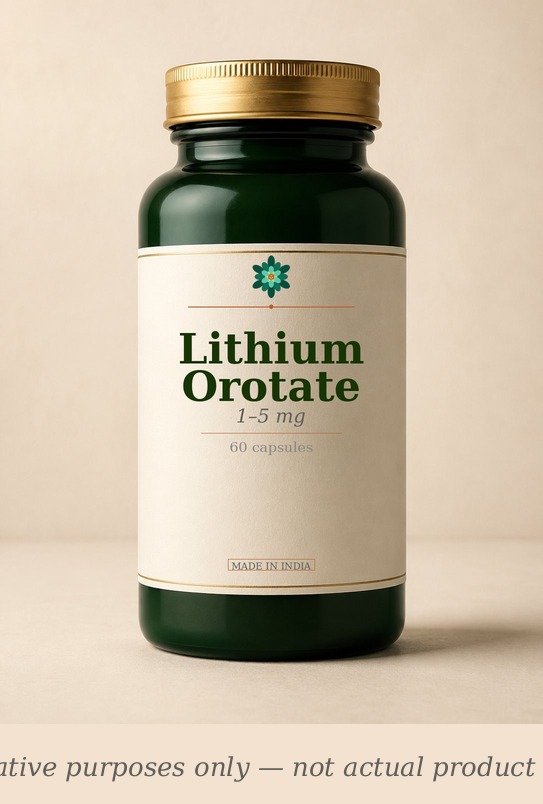
SacredBod's longer take on Lithium Orotate — context the structured blocks above don't capture.
Lithium orotate is one of the most fascinating and controversial supplements in the trace mineral category. The fascination comes from robust epidemiological data: populations with higher trace lithium in drinking water have lower rates of suicide, homicide, and dementia admissions. The controversy comes from the gap between this population-level data and individual supplement use — microdose lithium has never been tested in large RCTs for dementia prevention, and the safety margin between “microdose” and “toxic dose” is narrower than most supplement users realize.
The epidemiological evidence is genuinely compelling. Schrauzer’s 2002 study in Biological Trace Element Research analyzed 27 Texas counties and found that those with higher lithium levels in drinking water (70–170 micrograms per liter) had significantly lower rates of suicide, homicide, and drug-related arrests. This was not an isolated finding. A 2017 meta-analysis in JAMA Psychiatry pooling data from multiple countries confirmed the association between trace lithium in drinking water and reduced suicide rates. A 2019 systematic review in the European Journal of Nutrition found that microdose lithium (150–400 micrograms daily, far below psychiatric doses) showed preliminary evidence of slowing cognitive decline in Alzheimer’s patients across small trials.
The mechanism is multifaceted. Lithium inhibits glycogen synthase kinase-3β (GSK-3β), an enzyme involved in tau phosphorylation and amyloid plaque formation — pathways central to Alzheimer’s disease. It increases brain-derived neurotrophic factor (BDNF), which supports neuronal survival and plasticity. It modulates glutamate and GABA neurotransmission, stabilizing neuronal excitability. At pharmacological doses (300–1,800 mg/day for bipolar disorder), these effects are well established. At microdoses (1–5 mg/day), the mechanisms are the same but the magnitude is unknown.
The honest framing must address the safety problem. Lithium has a narrow therapeutic index — the gap between effective and toxic doses is small. Even at microdoses, lithium accumulates in the body over time because it is cleared renally, and kidney function declines with age. Side effects include thyroid suppression (lithium inhibits thyroid hormone release), kidney damage (nephrogenic diabetes insipidus), tremor, and cognitive dulling. These risks are well characterized at psychiatric doses but poorly characterized at microdoses. The assumption that “microdose equals micro-risk” is not evidence-based.
The orotate salt form is marketed as superior to carbonate or citrate because orotic acid is claimed to facilitate transport across cell membranes and the blood-brain barrier. This claim originated from animal studies in the 1970s but has not been convincingly replicated in humans. Comparative pharmacokinetic studies show that lithium orotate and lithium carbonate produce similar serum and brain lithium levels at equivalent doses. The orotate form may have better tolerability for some individuals, but it is not pharmacologically superior.
Practical guidance: Microdose lithium should not be used without medical supervision. If you and your physician decide to try it, start at 1 mg elemental lithium daily, taken in the morning with food. Monitor serum lithium, thyroid function (TSH), and kidney function (creatinine, eGFR) every 3–6 months. Do not exceed 5 mg/day without medical monitoring. Avoid if you have kidney disease, thyroid disorders, heart disease, or take ACE inhibitors, ARBs, or diuretics. Do not combine with prescription lithium or other mood stabilizers. In India, lithium orotate is available from HealthyHey and NutraLiebe at microdose levels.